Department of Health Policy and Management, Johns Hopkins Bloomberg School of Public Health, Baltimore, Maryland 21205, USA.
Annu Rev Public Health. 2012 Apr;33:7-40. doi: 10.1146/annurev-publhealth-031811-124658. Epub 2012 Jan 6.
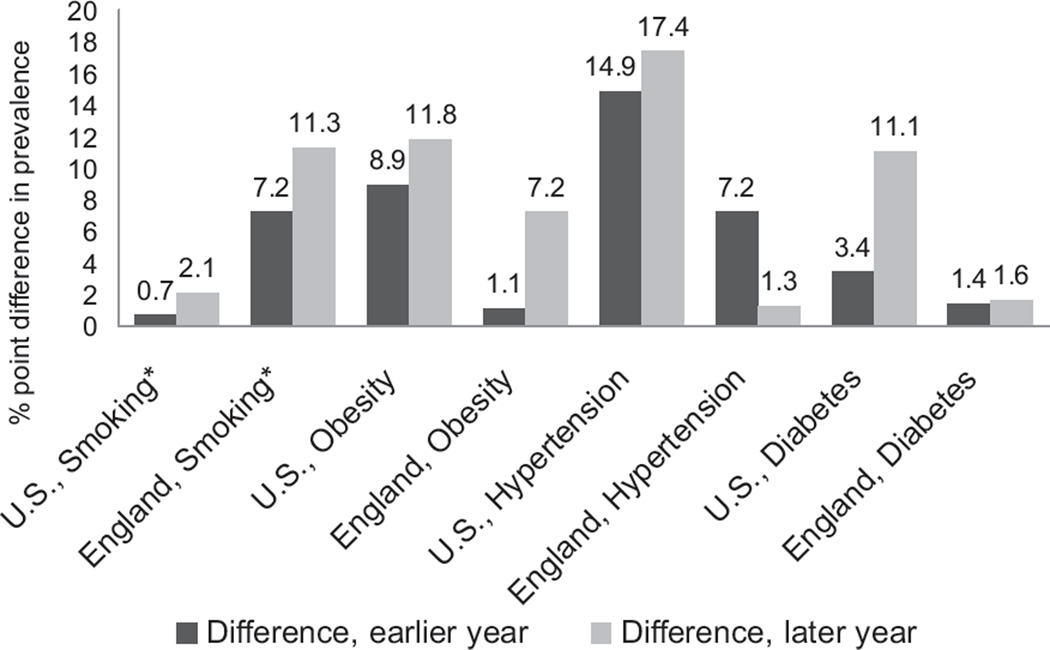
Health inequalities, which have been well documented for decades, have more recently become policy targets in developed countries. This review describes time trends in health inequalities (by sex, race/ethnicity, and socioeconomic status), commitments to reduce health inequalities, and progress made to eliminate health inequalities in the United States, United Kingdom, and other OECD countries. Time-trend data in the United States indicate a narrowing of the gap between the best- and worst-off groups in some health indicators, such as life expectancy, but a widening of the gap in others, such as diabetes prevalence. Similarly, time-trend data in the United Kingdom indicate a narrowing of the gap between the best- and worst-off groups in some indicators, such as hypertension prevalence, whereas the gap between social classes has increased for life expectancy. More research and better methods are needed to measure precisely the relationships between stated policy goals and observed trends in health inequalities.
健康不平等现象已经被记录了几十年,最近已成为发达国家的政策目标。本综述描述了健康不平等现象(按性别、种族/族裔和社会经济地位划分)的时间趋势、减少健康不平等现象的承诺以及在美国、英国和其他经合组织国家消除健康不平等现象方面取得的进展。美国的时间趋势数据表明,在一些健康指标(如预期寿命)方面,贫富差距有所缩小,但在其他指标(如糖尿病患病率)方面,贫富差距有所扩大。同样,英国的时间趋势数据表明,在一些指标(如高血压患病率)方面,贫富差距有所缩小,但预期寿命方面社会阶层之间的差距却有所扩大。需要更多的研究和更好的方法来准确衡量既定政策目标与健康不平等现象观察到的趋势之间的关系。