MRC Centre of Epidemiology for Child Health, UCL Institute of Child Health, London, UK.
J Acquir Immune Defic Syndr. 2012 Mar 1;59(3):287-93. doi: 10.1097/QAI.0b013e31823dbeac.
To explore the pattern of repeat pregnancies among diagnosed HIV-infected women in the United Kingdom and Ireland, estimate the rate of these sequential pregnancies, and investigate the demographic and clinical characteristics of women experiencing them.
Diagnosed HIV-infected pregnant women are reported through an active confidential reporting scheme to the National Study of HIV in Pregnancy and Childhood.
Pregnancies occurring during 1990-2009 were included. Multivariable analyses were conducted fitting Cox proportional hazards models.
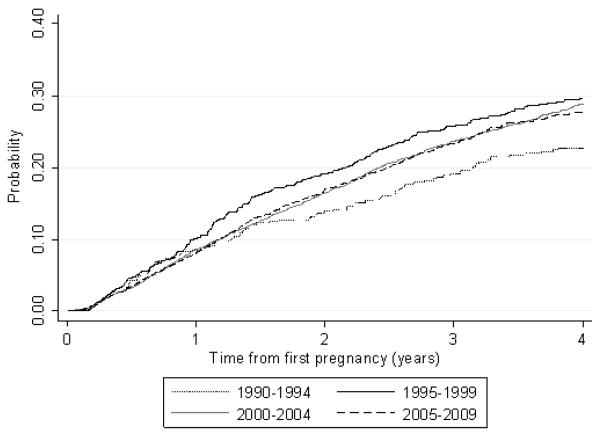
There were 14,096 pregnancies in 10,568 women; 2737 (25.9%) had 2 or more pregnancies reported. The rate of repeat pregnancies was 6.7 (95% confidence interval: 6.5 to 7.0) per 100 woman-years. The proportion of pregnancies in women who already had at least 1 pregnancy reported increased from 20.3% (32 of 158) in 1997 to 38.6% (565 of 1465) in 2009 (P < 0.001). In multivariable analysis, the probability of repeat pregnancy significantly declined with increasing age at first pregnancy. Parity was also inversely associated with repeat pregnancy. Compared with women born in the United Kingdom or Ireland, those from Europe, Eastern Africa, and Southern Africa were less likely to have a repeat pregnancy, whereas women from Middle Africa and Western Africa were more likely to. Maternal health at first pregnancy was not associated with repeat pregnancy.
The number of diagnosed HIV-infected women in the United Kingdom and Ireland experiencing repeat pregnancies is increasing. Variations in the probability of repeat pregnancies, according to demographic and clinical characteristics, are an important consideration when planning reproductive health services and HIV care for people living with HIV.
探讨英国和爱尔兰已确诊 HIV 感染妇女重复妊娠的模式,估计这些连续妊娠的发生率,并调查经历这些妊娠的妇女的人口统计学和临床特征。
通过向国家妊娠和儿童期 HIV 研究报告主动保密报告方案报告已确诊 HIV 感染的孕妇妊娠情况。
纳入 1990 年至 2009 年期间发生的妊娠。采用 Cox 比例风险模型进行多变量分析。
共有 10568 名妇女的 14096 次妊娠;2737 名(25.9%)报告了 2 次或以上妊娠。重复妊娠率为每 100 名妇女-年 6.7(95%置信区间:6.5 至 7.0)。已有至少 1 次妊娠报告的妇女中,妊娠比例从 1997 年的 20.3%(32/158)增加到 2009 年的 38.6%(565/1465)(P<0.001)。多变量分析显示,首次妊娠年龄越大,重复妊娠的可能性越低。产次与重复妊娠呈负相关。与出生在英国或爱尔兰的妇女相比,来自欧洲、东非和南非的妇女重复妊娠的可能性较低,而来自中非和西非的妇女重复妊娠的可能性较高。首次妊娠时的产妇健康状况与重复妊娠无关。
英国和爱尔兰重复妊娠的已确诊 HIV 感染妇女人数正在增加。根据人口统计学和临床特征,重复妊娠的可能性存在差异,这在规划生殖健康服务和艾滋病毒感染者的艾滋病毒护理时需要考虑。