Geriatrics Unit, Azienda ULSS 16 Padova, S. Antonio Hospital, Padova, Italy.
PLoS One. 2012;7(1):e29090. doi: 10.1371/journal.pone.0029090. Epub 2012 Jan 11.
Frailty is a dynamic age-related condition of increased vulnerability characterized by declines across multiple physiologic systems and associated with an increased risk of death. We compared the predictive accuracy for one-month and one-year all-cause mortality of four frailty instruments in a large population of hospitalized older patients in a prospective multicentre cohort study.
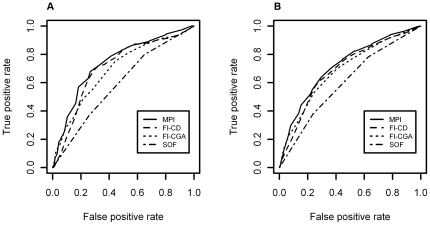
On 2033 hospitalized patients aged ≥ 65 years from twenty Italian geriatric units, we calculated the frailty indexes derived from the Study of Osteoporotic Fractures (FI-SOF), based on the cumulative deficits model (FI-CD), based on a comprehensive geriatric assessment (FI-CGA), and the Multidimensional Prognostic Index (MPI). The overall mortality rates were 8.6% after one-month and 24.9% after one-year follow-up. All frailty instruments were significantly associated with one-month and one-year all-cause mortality. The areas under the receiver operating characteristic (ROC) curves estimated from age- and sex-adjusted logistic regression models, accounting for clustering due to centre effect, showed that the MPI had a significant higher discriminatory accuracy than FI-SOF, FI-CD, and FI-CGA after one month (areas under the ROC curves: FI-SOF = 0.685 vs. FI-CD = 0.738 vs. FI-CGA = 0.724 vs. MPI = 0.765, p<0.0001) and one year of follow-up (areas under the ROC curves: FI-SOF = 0.694 vs. FI-CD = 0.729 vs. FI-CGA = 0.727 vs. MPI = 0.750, p<0.0001). The MPI showed a significant higher discriminatory power for predicting one-year mortality also in hospitalized older patients without functional limitations, without cognitive impairment, malnourished, with increased comorbidity, and with a high number of drugs.
All frailty instruments were significantly associated with short- and long-term all-cause mortality, but MPI demonstrated a significant higher predictive power than other frailty instruments in hospitalized older patients.
衰弱是一种与年龄相关的动态脆弱状态,其特征是多个生理系统的衰退,并与死亡风险增加有关。我们在一项前瞻性多中心队列研究中,比较了四个衰弱工具对住院老年患者一个月和一年全因死亡率的预测准确性。
在来自 20 个意大利老年医学单位的 2033 名年龄≥65 岁的住院患者中,我们根据累积缺陷模型(FI-CD)、基于综合老年评估(FI-CGA)和多维预后指数(MPI)计算了源自骨质疏松性骨折研究(FI-SOF)的衰弱指数。一个月和一年的总死亡率分别为 8.6%和 24.9%。所有衰弱工具均与一个月和一年的全因死亡率显著相关。年龄和性别调整后的逻辑回归模型估计的接受者操作特征(ROC)曲线下面积,考虑到中心效应的聚类,表明 MPI 在一个月后(ROC 曲线下面积:FI-SOF=0.685 vs. FI-CD=0.738 vs. FI-CGA=0.724 vs. MPI=0.765,p<0.0001)和一年随访时(ROC 曲线下面积:FI-SOF=0.694 vs. FI-CD=0.729 vs. FI-CGA=0.727 vs. MPI=0.750,p<0.0001)的区分准确性显著高于 FI-SOF、FI-CD 和 FI-CGA。MPI 在没有功能限制、认知障碍、营养不良、合并症增加和服用大量药物的住院老年患者中预测一年死亡率的区分能力也更高。
所有衰弱工具均与短期和长期全因死亡率显著相关,但 MPI 在住院老年患者中预测能力显著高于其他衰弱工具。