Institute of Health & Wellbeing, Public Health, University of Glasgow, 1 Lilybank Gardens, Glasgow G12 8RZ, UK.
BMC Cancer. 2012 Jan 19;12:25. doi: 10.1186/1471-2407-12-25.
High cholesterol may be a modifiable risk factor for prostate cancer but results have been inconsistent and subject to potential "reverse causality" where undetected disease modifies cholesterol prior to diagnosis.
We conducted a prospective cohort study of 12,926 men who were enrolled in the Midspan studies between 1970 and 1976 and followed up to 31st December 2007. We used Cox-Proportional Hazards Models to evaluate the association between baseline plasma cholesterol and Gleason grade-specific prostate cancer incidence. We excluded cancers detected within at least 5 years of cholesterol assay.
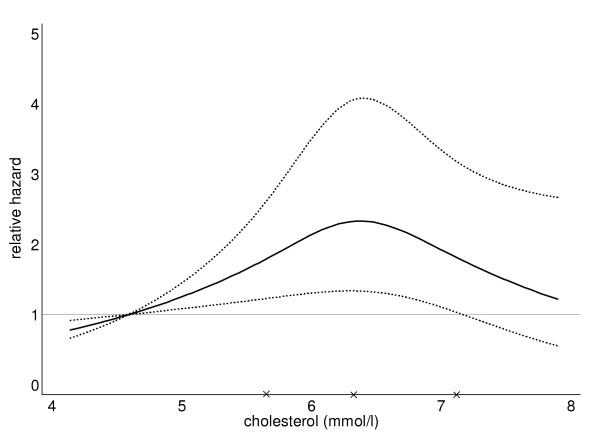
650 men developed prostate cancer in up to 37 years' follow-up. Baseline plasma cholesterol was positively associated with hazard of high grade (Gleason score≥8) prostate cancer incidence (n = 119). The association was greatest among men in the 2nd highest quintile for cholesterol, 6.1 to < 6.69 mmol/l, Hazard Ratio 2.28, 95% CI 1.27 to 4.10, compared with the baseline of < 5.05 mmol/l. This association remained significant after adjustment for body mass index, smoking and socioeconomic status.
Men with higher cholesterol are at greater risk of developing high-grade prostate cancer but not overall risk of prostate cancer. Interventions to minimise metabolic risk factors may have a role in reducing incidence of aggressive prostate cancer.
高胆固醇可能是前列腺癌的一个可改变的风险因素,但结果一直不一致,并且存在潜在的“反向因果关系”,即未被发现的疾病可能在诊断前改变胆固醇。
我们进行了一项前瞻性队列研究,纳入了 1970 年至 1976 年间参加 Midspan 研究的 12926 名男性,并随访至 2007 年 12 月 31 日。我们使用 Cox 比例风险模型评估基线血浆胆固醇与 Gleason 分级特异性前列腺癌发病率之间的关系。我们排除了在胆固醇检测后至少 5 年内发现的癌症。
在长达 37 年的随访中,有 650 名男性患上了前列腺癌。基线血浆胆固醇与高级别(Gleason 评分≥8)前列腺癌发病率呈正相关(n=119)。胆固醇水平处于第二高五分位数(6.1-<6.69mmol/L)的男性相关性最大,风险比为 2.28,95%可信区间为 1.27-4.10,与基线<5.05mmol/L 相比。在调整了体重指数、吸烟和社会经济状况后,这种相关性仍然显著。
胆固醇水平较高的男性患高级别前列腺癌的风险更高,但并非总体前列腺癌风险更高。减少代谢危险因素的干预措施可能在降低侵袭性前列腺癌的发病率方面发挥作用。