Shoklo Malaria Research Unit, Mae Sot, Tak, Thailand.
Ultrasound Obstet Gynecol. 2012 Aug;40(2):151-7. doi: 10.1002/uog.11091.
In a refugee camp on the Thai-Burmese border, accurate dating of pregnancy relies on ultrasound measurements obtained by locally trained health workers. The aim of this study was to substantiate the accuracy of fetal biometry measurements performed by locally trained health workers by comparing derived reference equations with those published for Asian and European hospitals.
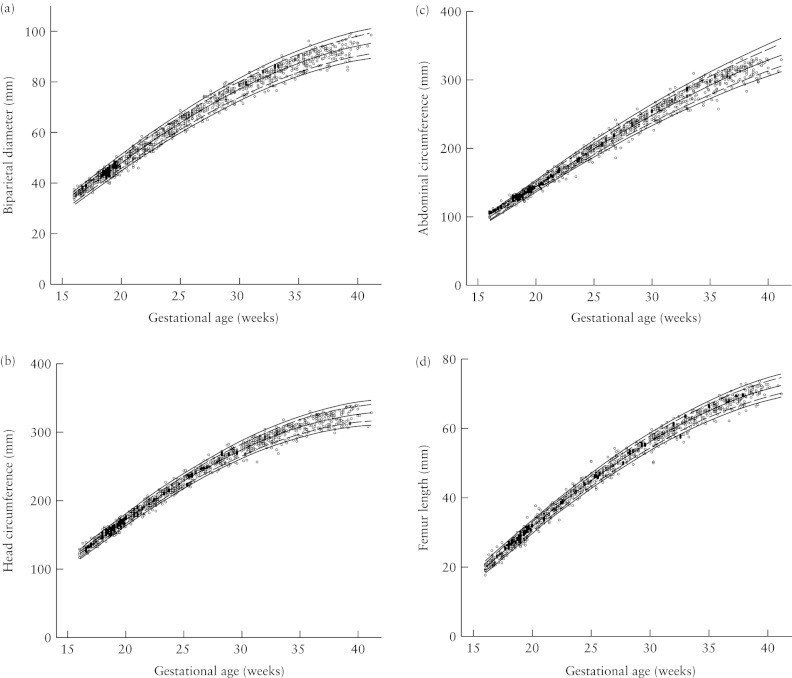
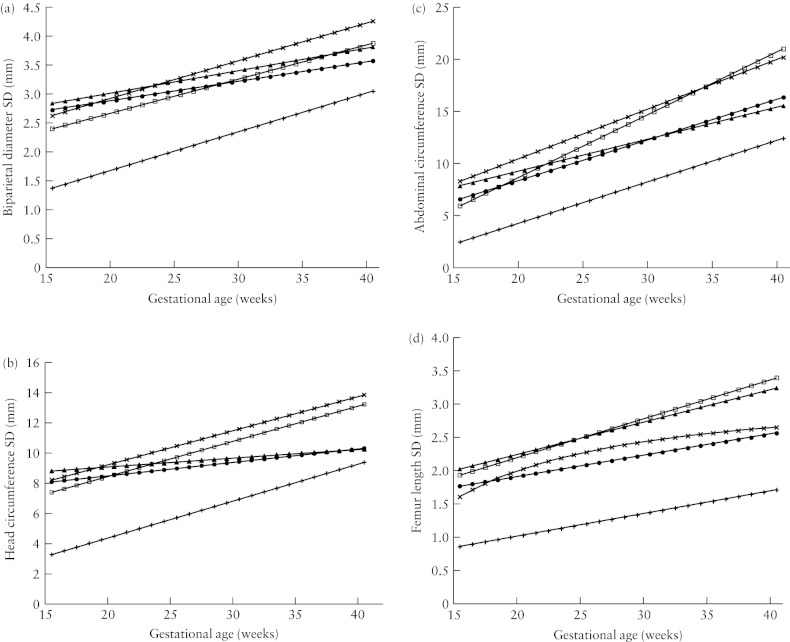
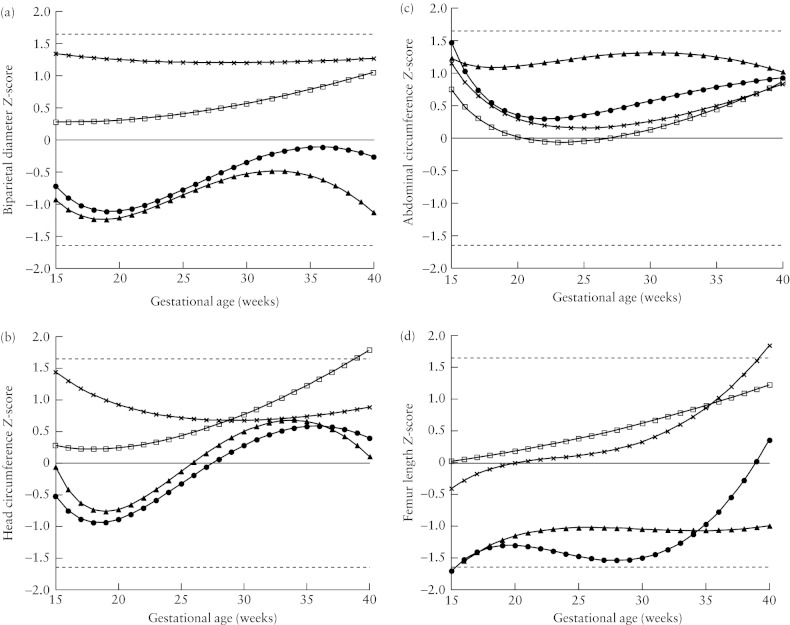
This prospective observational study included 1090 women who had a dating crown-rump length (CRL) scan and one study-appointed ultrasound biometry scan between 16 and 40 weeks of gestation. The average of two measurements of each of biparietal diameter, head circumference, abdominal circumference and femur length was used in a polynomial regression model for the mean and SD against gestational age (GA). The biometry equations obtained were compared with published equations of professional sonographers from Asian and European hospitals by evaluation of the SD and Z-scores of differences between models.
Reference equations of biometric parameters were found to fit cubic polynomial models. The observed SD values, for any given GA, of fetal biometric measurements obtained by locally trained health workers were lower than those previously reported by centers with professional sonographers. For nearly the entire GA range considered, the mean values of the Asian and European equations for all four biometric measurements were within the 90% expected range (mean ± 1.645 SD) of our equations.
Locally trained health workers in a refugee camp on the Thai-Burmese border can obtain measurements that are associated with low SD values and within the normal limits of published Asian and European equations. The fact that the SD values were lower than in other studies may be explained by the use of the average of two measurements, CRL dating or motivation of the locally trained sonographers.
在泰国-缅甸边境的难民营中,准确的妊娠日期依赖于经当地培训的卫生工作者进行的超声测量。本研究的目的是通过将本地训练的卫生工作者进行的胎儿生物测量测量值与亚洲和欧洲医院发布的参考方程进行比较,来证实其准确性。
这项前瞻性观察研究包括 1090 名在妊娠 16 至 40 周之间进行过胎儿头臀长(CRL)扫描和一次指定超声生物测量扫描的妇女。使用二元回归模型,将双顶径、头围、腹围和股骨长度的每两个测量值的平均值和标准差与胎龄(GA)进行回归。获得的生物测量方程与亚洲和欧洲医院专业超声医师发表的方程进行比较,通过评估模型之间的差异的标准差和 Z 分数进行比较。
发现生物测量参数的参考方程适合三次多项式模型。与具有专业超声医师的中心以前报道的结果相比,由当地培训的卫生工作者获得的胎儿生物测量值的任何给定 GA 的观察到的标准差(SD)值较低。对于考虑的几乎整个 GA 范围,亚洲和欧洲方程的所有四个生物测量值的平均值均在我们方程的 90%预期范围内(平均值±1.645SD)。
在泰国-缅甸边境的难民营中,经过当地培训的卫生工作者可以获得具有低 SD 值且在已发表的亚洲和欧洲方程的正常范围内的测量值。其他研究中 SD 值较低的事实可能是由于使用了两次测量的平均值、CRL 日期或当地培训的超声医师的积极性。