Department of Materials Science and Engineering, McMaster University, Hamilton, Ontario, Canada.
PLoS One. 2012;7(1):e29258. doi: 10.1371/journal.pone.0029258. Epub 2012 Jan 17.
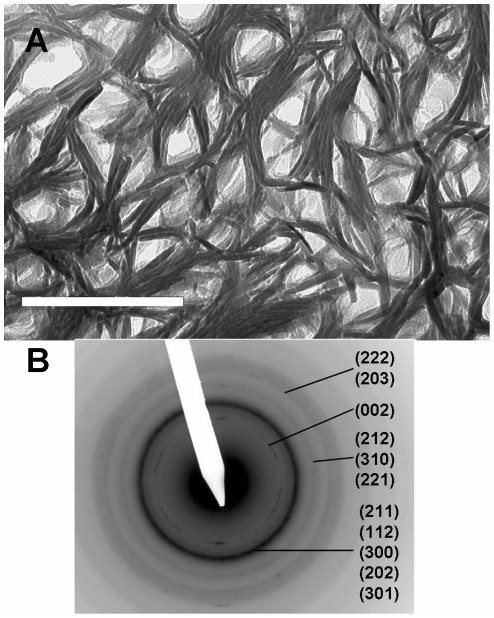
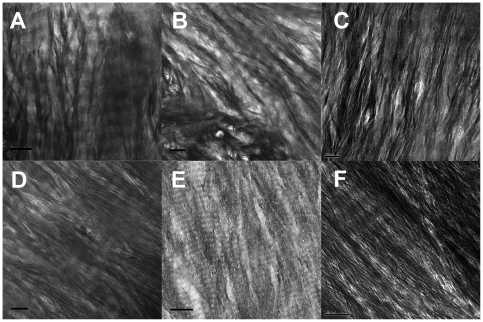
The relationship between the mineral component of bone and associated collagen has been a matter of continued dispute. We use transmission electron microscopy (TEM) of cryogenically ion milled sections of fully-mineralized cortical bone to study the spatial and topological relationship between mineral and collagen. We observe that hydroxyapatite (HA) occurs largely as elongated plate-like structures which are external to and oriented parallel to the collagen fibrils. Dark field images suggest that the structures ("mineral structures") are polycrystalline. They are approximately 5 nm thick, 70 nm wide and several hundred nm long. Using energy-dispersive X-ray analysis we show that approximately 70% of the HA occurs as mineral structures external to the fibrils. The remainder is found constrained to the gap zones. Comparative studies of other species suggest that this structural motif is ubiquitous in all vertebrates.
骨的矿物质成分与相关胶原之间的关系一直存在争议。我们使用低温离子铣切的完全矿化皮质骨切片的透射电子显微镜(TEM)来研究矿物质和胶原之间的空间和拓扑关系。我们观察到羟基磷灰石(HA)主要以长而薄的板状结构存在,这些结构位于胶原纤维之外,并与胶原纤维平行排列。暗场图像表明这些结构(“矿物质结构”)是多晶的。它们的厚度约为 5nm,宽度为 70nm,长度为数百纳米。通过能谱分析,我们发现大约 70%的 HA 以纤维外的矿物质结构存在。其余的则存在于纤维间隙中。对其他物种的比较研究表明,这种结构模式在所有脊椎动物中普遍存在。