Department of Pediatrics and Tropical Medicine, John A. Burns School of Medicine, University of Hawaii at Manoa, Honolulu, HI 96813, USA.
Virol J. 2012 Jan 26;9:34. doi: 10.1186/1743-422X-9-34.
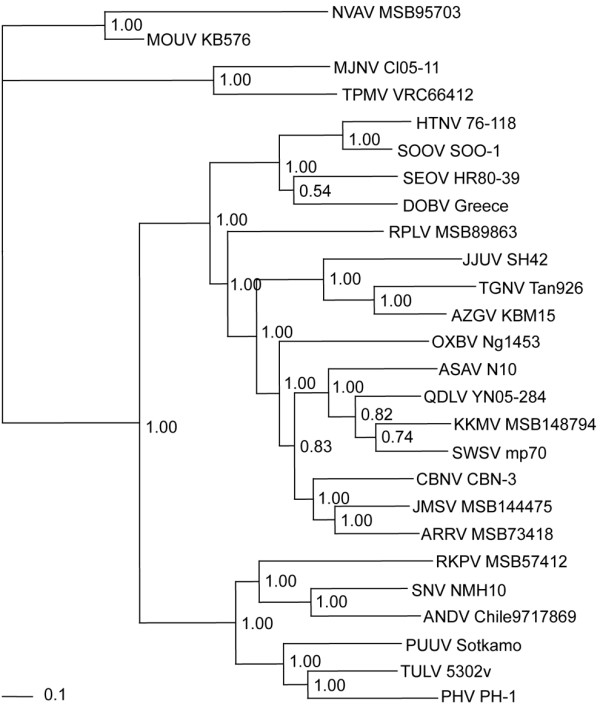
Recently identified hantaviruses harbored by shrews and moles (order Soricomorpha) suggest that other mammals having shared ancestry may serve as reservoirs. To investigate this possibility, archival tissues from 213 insectivorous bats (order Chiroptera) were analyzed for hantavirus RNA by RT-PCR. Following numerous failed attempts, hantavirus RNA was detected in ethanol-fixed liver tissue from two banana pipistrelles (Neoromicia nanus), captured near Mouyassué village in Côte d'Ivoire, West Africa, in June 2011. Phylogenetic analysis of partial L-segment sequences using maximum-likelihood and Bayesian methods revealed that the newfound hantavirus, designated Mouyassué virus (MOUV), was highly divergent and basal to all other rodent- and soricomorph-borne hantaviruses, except for Nova virus in the European common mole (Talpa europaea). Full genome sequencing of MOUV and further surveys of other bat species for hantaviruses, now underway, will provide critical insights into the evolution and diversification of hantaviruses.
最近在鼩鼱和鼹鼠(食虫目)中发现的汉坦病毒表明,其他具有共同祖先的哺乳动物可能是病毒的宿主。为了研究这种可能性,研究人员通过 RT-PCR 对 213 只食虫蝙蝠(翼手目)的存档组织进行了汉坦病毒 RNA 分析。在多次失败的尝试后,于 2011 年 6 月在西非科特迪瓦穆亚苏埃村附近捕获的两只香蕉蛞蝓(Neoromicia nanus)的乙醇固定肝组织中检测到汉坦病毒 RNA。使用最大似然法和贝叶斯法对部分 L 片段序列进行的系统发育分析表明,新发现的汉坦病毒命名为穆亚苏埃病毒(MOUV),与除欧洲普通鼹鼠(Talpa europaea)中的 Nova 病毒以外的所有啮齿动物和食虫目动物携带的汉坦病毒高度分化且处于基础地位。目前正在对 MOUV 进行全基因组测序,并对其他蝙蝠物种进行汉坦病毒进一步调查,这将为汉坦病毒的进化和多样化提供重要的见解。