Biomedical Sciences Research Complex and EaStCHEM School of Chemistry, Purdie Building, University of St Andrews, North Haugh, St Andrews, Scotland KY16 9ST, UK.
J Cheminform. 2012 Jan 26;4:2. doi: 10.1186/1758-2946-4-2.
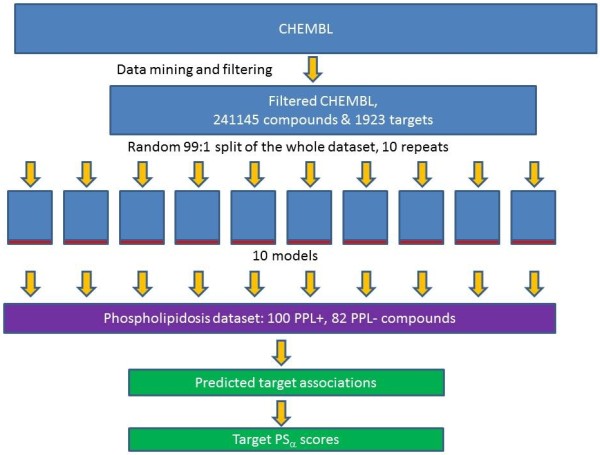
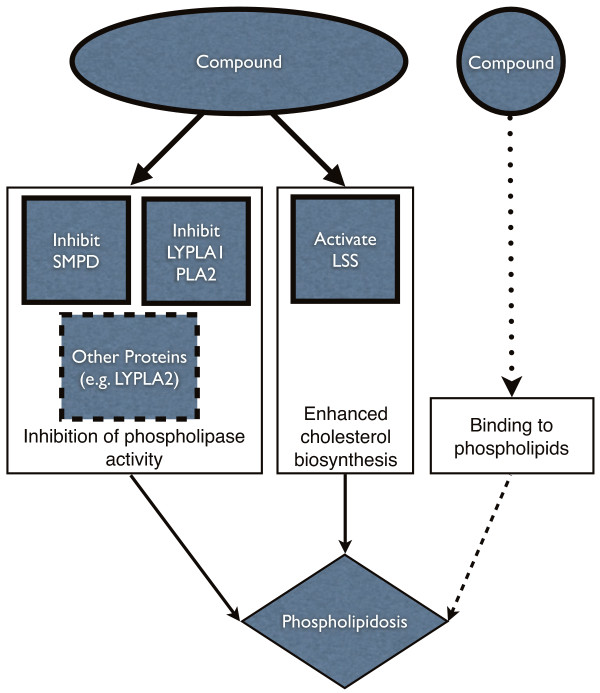
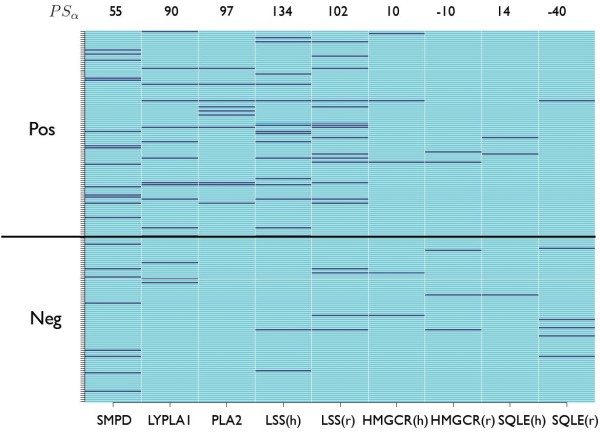
The mechanism of phospholipidosis is still not well understood. Numerous different mechanisms have been proposed, varying from direct inhibition of the breakdown of phospholipids to the binding of a drug compound to the phospholipid, preventing breakdown. We have used a probabilistic method, the Parzen-Rosenblatt Window approach, to build a model from the ChEMBL dataset which can predict from a compound's structure both its primary pharmaceutical target and other targets with which it forms off-target, usually weaker, interactions. Using a small dataset of 182 phospholipidosis-inducing and non-inducing compounds, we predict their off-target activity against targets which could relate to phospholipidosis as a side-effect of a drug. We link these targets to specific mechanisms of inducing this lysosomal build-up of phospholipids in cells. Thus, we show that the induction of phospholipidosis is likely to occur by separate mechanisms when triggered by different cationic amphiphilic drugs. We find that both inhibition of phospholipase activity and enhanced cholesterol biosynthesis are likely to be important mechanisms. Furthermore, we provide evidence suggesting four specific protein targets. Sphingomyelin phosphodiesterase, phospholipase A2 and lysosomal phospholipase A1 are shown to be likely targets for the induction of phospholipidosis by inhibition of phospholipase activity, while lanosterol synthase is predicted to be associated with phospholipidosis being induced by enhanced cholesterol biosynthesis. This analysis provides the impetus for further experimental tests of these hypotheses.
磷脂病的发病机制仍不清楚。已经提出了许多不同的机制,从直接抑制磷脂的分解到药物化合物与磷脂结合,阻止其分解不等。我们使用了一种概率方法,即 Parzen-Rosenblatt 窗口方法,从 ChEMBL 数据集构建了一个模型,该模型可以根据化合物的结构预测其主要药物靶标和其他与其形成非靶标(通常较弱)相互作用的靶标。我们使用了一个包含 182 种诱导和不诱导磷脂病的化合物的小数据集,预测了它们针对可能与药物副作用磷脂病相关的靶标的非靶标活性。我们将这些靶标与诱导细胞中这种溶酶体中磷脂积累的特定机制联系起来。因此,我们表明,当不同的阳离子两亲性药物触发时,磷脂病的诱导可能通过不同的机制发生。我们发现抑制磷脂酶活性和增强胆固醇生物合成都可能是重要的机制。此外,我们提供的证据表明有四个特定的蛋白质靶标。鞘磷脂磷酸二酯酶、磷脂酶 A2 和溶酶体磷脂酶 A1 被证明是通过抑制磷脂酶活性诱导磷脂病的可能靶标,而羊毛甾醇合酶则被预测与胆固醇生物合成增强诱导的磷脂病有关。这种分析为进一步实验测试这些假设提供了动力。