Division of Occupational and Environmental medicine, Department of Preventive medicine, Keimyung University School of Medicine, 216 Dalseong-ro, Jung-gu, Daegu, South Korea, 700-712.
BMC Public Health. 2012 Jan 27;12:87. doi: 10.1186/1471-2458-12-87.
South Korea and surrounding countries in East Asia are believed to have the highest proportion in the world of high frequency hearing loss due to occupational noise exposure, yet there has been limited information published in international journals, and limited information for control of noise in local workplaces beyond strategies from western countries. We exploit medical surveillance information from two worker groups to enhance local knowledge about noise-induced hearing loss and explore the possible importance of shift work to risk.
Four-years of hearing data were evaluated for 81 male farm machine factory workers and 371 male firefighters who had successfully completed a health examination and questionnaires for the duration of the study period. The averages of hearing thresholds at 2, 3, and 4 kHz were used as the primary end-point for comparison. Repeat measure analysis adjusted for age, exposure duration and smoking status was used to measure the difference in hearing threshold between the two groups.
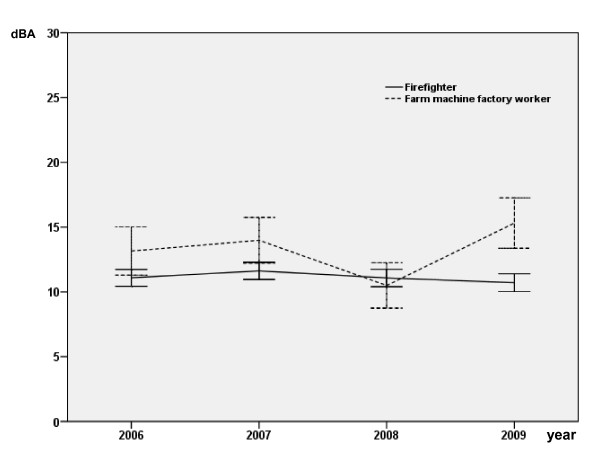
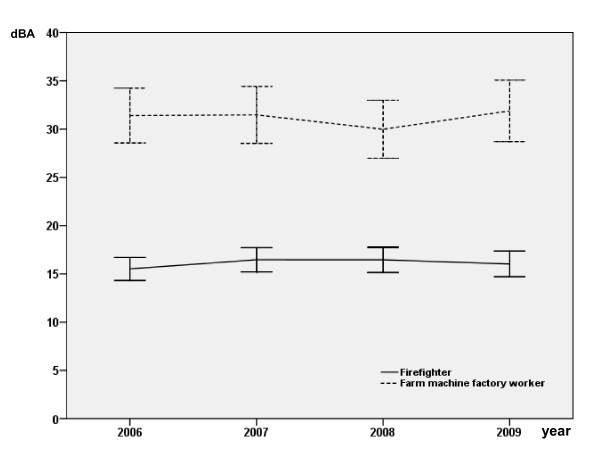
Noise levels were measured in the factory at a mean of 82 dBA, with a range of 66-97. No concurrent measurements were taken for the firefighters, but historic comparison values showed a wider range but a similar mean of 76-79 dBA. Although losses during follow-up were negligible, the factory workers had significantly (P < 0.0001) more hearing loss at the baseline of the study than the firefighters in both ears at 2, 3, and 4 kHz, adjusted for age, duration of employment and smoking status. Among those with 10 years of employment, mean losses at these frequencies among the factory workers fell into the impairment range (> 25 dB loss). Firefighters also showed increased losses associated with longer exposure duration, but these were significantly less marked. Losses at lower frequencies (< or = 1 kHz) were negligible in both groups.
Korean work environments with continuous noise exposure in the measured range should consider implementation of a hearing conservation program. Further evaluation of hearing loss in workers exposed to irregular or intermittent high noise levels, such as firefighters, is also warranted.
东亚的韩国和周边国家据信是全世界因职业性噪声暴露而导致高频听力损失比例最高的地区,但国际期刊上发表的相关信息有限,而且除了西方国家的策略之外,针对当地工作场所噪声控制的信息也很有限。我们利用两组工人的医学监测信息,来增进对噪声性听力损失的本地知识,并探讨轮班工作对风险的可能重要性。
对 81 名男性农机厂工人和 371 名男性消防员的四年听力数据进行了评估,他们在研究期间成功完成了健康检查和问卷调查。将 2、3 和 4 kHz 的听力阈值平均值作为比较的主要终点。使用重复测量分析,根据年龄、暴露时间和吸烟状况进行调整,以测量两组之间听力阈值的差异。
工厂噪声水平的平均测量值为 82 dBA,范围为 66-97 dBA。消防员未进行同时测量,但历史比较值显示范围更宽,但均值相似,为 76-79 dBA。尽管随访期间的损失可以忽略不计,但工厂工人在研究开始时的双耳在 2、3 和 4 kHz 的听力损失明显(P < 0.0001)大于消防员,调整年龄、就业时间和吸烟状况后。在有 10 年就业时间的人群中,工厂工人在这些频率上的平均损失进入了损伤范围(> 25 dB 损失)。消防员的暴露时间较长也会导致听力损失增加,但这些损失明显较轻。两组低频(<或= 1 kHz)的听力损失可以忽略不计。
对于有连续噪声暴露的韩国工作环境,应考虑实施听力保护计划。对于暴露于不规则或间歇性高强度噪声的工人(如消防员)的听力损失也需要进一步评估。