Department of Medicine, Johns Hopkins University School of Medicine, 10755 Falls Road, Suite 200, Lutherville, MD 21093, USA.
Qual Life Res. 2013 Feb;22(1):75-84. doi: 10.1007/s11136-012-0126-6.
A subset of patients treated for Lyme disease report persistent or recurrent symptoms of unknown etiology named post-treatment Lyme disease syndrome (PTLDS). This study aims to describe a cohort of participants with early, untreated Lyme disease, and characterize post-treatment symptomatology and functional impact of PTLDS over time.
Sixty-three participants with erythema migrans and systemic symptoms were enrolled in a prospective cohort study. Participants underwent physical exams and clinical assessments, and completed the SF-36 (daily life functioning) and the Beck Depression Inventory, Second Edition (BDI-II) (depression), at each of five visits over a period of 6 months.
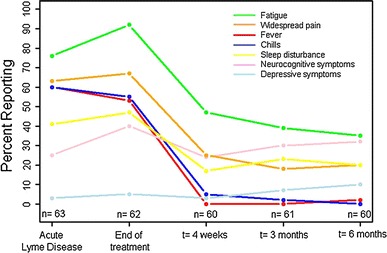
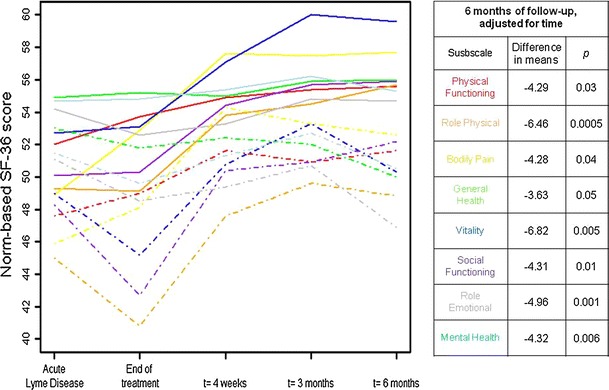
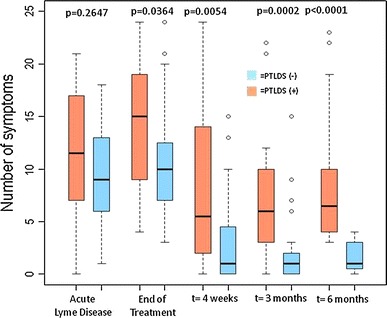
Signs of Lyme disease disappeared post-treatment; however, new-onset patient-reported symptoms increased or plateaued over time. At 6 months, 36% of patients reported new-onset fatigue, 20% widespread pain, and 45% neurocognitive difficulties. However, less than 10% reported greater than “minimal” depression across the entire period. Those with PTLDS (36%) did not differ significantly from those without with respect to demographics, pre-treatment SF-36, and BDI-II scores. Statistically significant differences were found over time on the Role Physical, Vitality, Social Functioning, Role Emotional, and Mental Health subscales (with a trend toward significance for the remaining three subscales of Physical Functioning, Bodily Pain, and General Health) of the SF-36 between those with an eventual PTLDS diagnosis and those without when measured at 6 months.
Unlike clinical signs of Lyme disease, new-onset symptoms are reported by a subset of participants without evidence of depressive symptomatology. Patients who developed PTLDS had significantly lower life functioning compared to those without PTLDS. We propose future avenues for researching infection-triggered symptoms resulting from multiple mechanisms.
接受莱姆病治疗的患者中有一部分报告存在持续性或复发性、病因不明的症状,被称为治疗后莱姆病综合征(PTLDS)。本研究旨在描述一组未经治疗的早期莱姆病患者,并描述随着时间的推移 PTLDS 的治疗后症状和功能影响。
63 名患有游走性红斑和全身症状的参与者被纳入前瞻性队列研究。参与者接受了体格检查和临床评估,并在 6 个月的 5 次就诊中,分别完成了 SF-36(日常生活功能)和贝克抑郁量表第二版(BDI-II)(抑郁)。
治疗后莱姆病的体征消失;然而,新出现的患者报告症状随着时间的推移而增加或趋于稳定。在 6 个月时,36%的患者报告出现新的疲劳,20%的患者出现广泛疼痛,45%的患者出现神经认知困难。然而,整个期间只有不到 10%的患者报告有“轻微”以上的抑郁。PTLDS 患者(36%)在人口统计学特征、治疗前 SF-36 和 BDI-II 评分方面与无 PTLDS 患者无显著差异。在 6 个月时,SF-36 的生理职能、活力、社会功能、情感职能和心理健康等子量表的评分随时间发生了显著差异(对于生理功能、躯体疼痛和总体健康的其余三个子量表也存在显著差异的趋势),而在有或无 PTLDS 诊断的参与者之间。
与莱姆病的临床体征不同,新出现的症状是一部分参与者报告的,他们没有明显的抑郁症状。患有 PTLDS 的患者的生活功能明显低于没有 PTLDS 的患者。我们提出了未来研究感染触发的多种机制引起的症状的途径。