National Institute of Public Health-INSP, 5-7 Rue El-Khartoum, Tunis, Tunisie.
BMC Public Health. 2012 Feb 3;12:98. doi: 10.1186/1471-2458-12-98.
In southern and eastern Mediterranean countries, changes in lifestyle and the increasing prevalence of excess weight in childhood are risk factors for high blood pressure (BP) during adolescence and adulthood. The aim of this study was to evaluate the BP status of Tunisian adolescents and to identify associated factors.
A cross-sectional study in 2005, based on a national, stratified, random cluster sample of 1294 boys and 1576 girls aged 15-19 surveyed in home visits. The socio-economic and behavioral characteristics of the adolescents were recorded. Overweight/obesity were assessed by Body Mass Index (BMI) from measured height and weight (WHO, 2007), abdominal obesity by waist circumference (WC). BP was measured twice during the same visit. Elevated BP was systolic (SBP) or diastolic blood pressure (DBP) ≥ 90th of the international reference or ≥ 120/80 mm Hg for 15-17 y., and SBP/DBP ≥ 120/80 mm Hg for 18-19 y.; hypertension was SBP/DBP ≥ 95th for 15-17 y. and ≥ 140/90 mm Hg for 18-19 y. Adjusted associations were assessed by logistic regression.
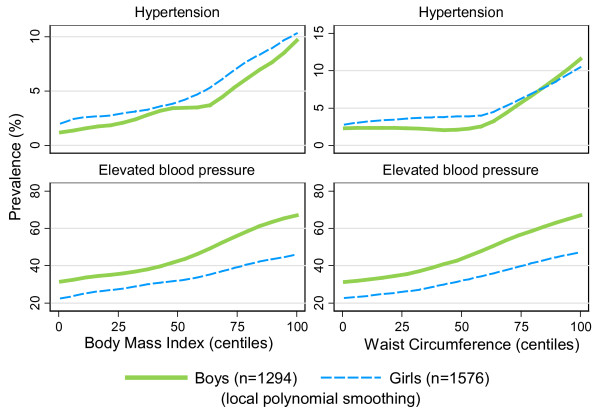
The prevalence of elevated BP was 35.1%[32.9-37.4]: higher among boys (46.1% vs. 33.3%; P < 0.0001); 4.7%[3.8-5.9] of adolescents had hypertension. Associations adjusted for all covariates showed independent relationships with BMI and WC: - obesity vs. no excess weight increased elevated BP (boys OR = 2.1[1.0-4.2], girls OR = 2.3[1.3-3.9]) and hypertension (boys OR = 3.5[1.4-8.9], girls OR = 5.4[2.2-13.4]), - abdominal obesity (WC) was also associated with elevated BP in both genders (for boys: 2nd vs. 1st tertile OR = 1.7[1.3-2.3], 3rd vs.1st tertile OR = 2.8[1.9-4.2]; for girls: 2nd vs. 1st tertile OR = 1.6[1.2-2.1], 3rd vs.1st tertile OR = 2.1[1.5-3.0]) but only among boys for hypertension. Associations with other covariates were weaker: for boys, hypertension increased somewhat with sedentary lifestyle, while elevated BP was slightly more prevalent among urban girls and those not attending school.
Within the limits of BP measurement on one visit only, these results suggest that Tunisian adolescents of both genders are likely not spared from early elevated BP. Though further assessment is likely needed, the strong association with overweight/obesity observed suggests that interventions aimed at changing lifestyles to reduce this main risk factor may also be appropriate for the prevention of elevated BP.
在南欧和地中海东部国家,生活方式的改变和儿童超重的普遍流行是青少年和成年期高血压(BP)的危险因素。本研究的目的是评估突尼斯青少年的 BP 状况,并确定相关因素。
2005 年进行了一项横断面研究,对 1294 名男孩和 1576 名年龄在 15-19 岁的女孩进行了全国性、分层、随机聚类抽样调查。记录了青少年的社会经济和行为特征。超重/肥胖用身高和体重(WHO,2007 年)测量的体重指数(BMI)评估,腰围(WC)评估腹部肥胖。在同一次就诊中测量两次 BP。BP 升高定义为收缩压(SBP)或舒张压(DBP)≥国际参考值的第 90 百分位或 15-17 岁时≥120/80mmHg,18-19 岁时 SBP/DBP≥120/80mmHg;15-17 岁时 SBP/DBP≥第 95 百分位或 18-19 岁时≥140/90mmHg为高血压。使用逻辑回归评估调整后的关联。
BP 升高的患病率为 35.1%[32.9-37.4]:男孩(46.1%比 33.3%;P<0.0001)更高;4.7%[3.8-5.9]的青少年患有高血压。调整所有协变量后的关联显示与 BMI 和 WC 有独立关系:肥胖与超重相比,BP 升高(男孩 OR=2.1[1.0-4.2],女孩 OR=2.3[1.3-3.9])和高血压(男孩 OR=3.5[1.4-8.9],女孩 OR=5.4[2.2-13.4]);腹部肥胖(WC)在两性中也与 BP 升高相关(男孩:第 2 位与第 1 位 tertile OR=1.7[1.3-2.3],第 3 位与第 1 位 tertile OR=2.8[1.9-4.2];女孩:第 2 位与第 1 位 tertile OR=1.6[1.2-2.1],第 3 位与第 1 位 tertile OR=2.1[1.5-3.0]),但仅在男孩中与高血压相关。与其他协变量的关联较弱:对于男孩,久坐的生活方式会导致高血压略有增加,而城市女孩和未上学的女孩中 BP 升高的比例略高。
在仅一次就诊时进行 BP 测量的限制内,这些结果表明,突尼斯青少年男女都可能无法免受早期升高的 BP 的影响。尽管可能需要进一步评估,但观察到的超重/肥胖与 BP 升高的强烈关联表明,旨在改变生活方式以降低这一主要危险因素的干预措施也可能适用于预防升高的 BP。