Department of Psychology, Centre for Cognitive Neuroimaging, University of Glasgow, Glasgow G12 8QB, United Kingdom.
Hum Brain Mapp. 2013 Apr;34(4):890-913. doi: 10.1002/hbm.21482. Epub 2012 Feb 13.
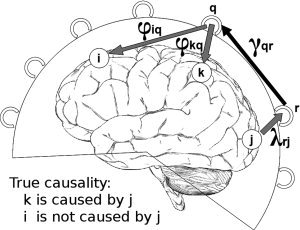
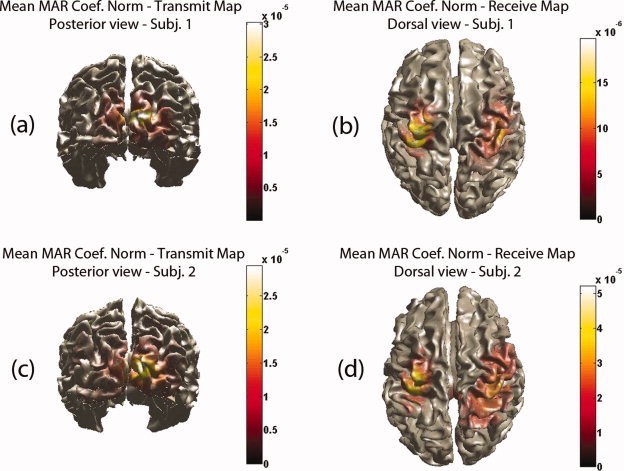
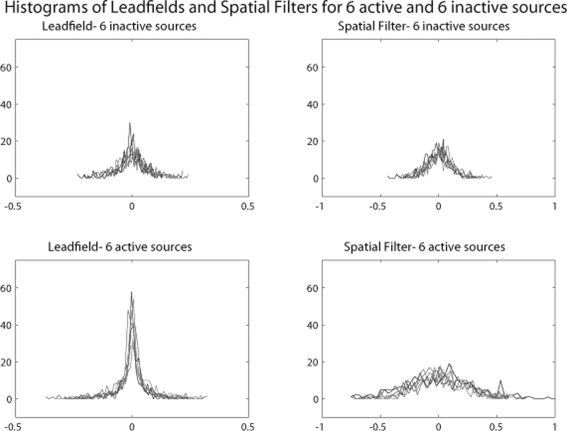
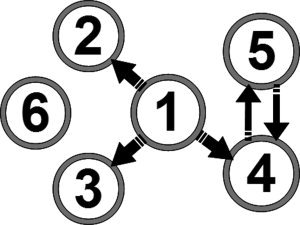
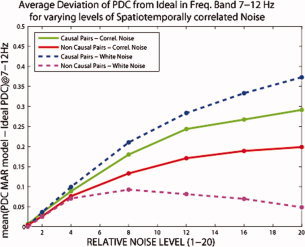
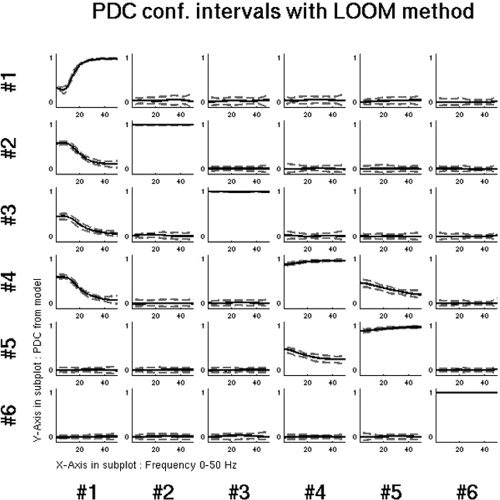
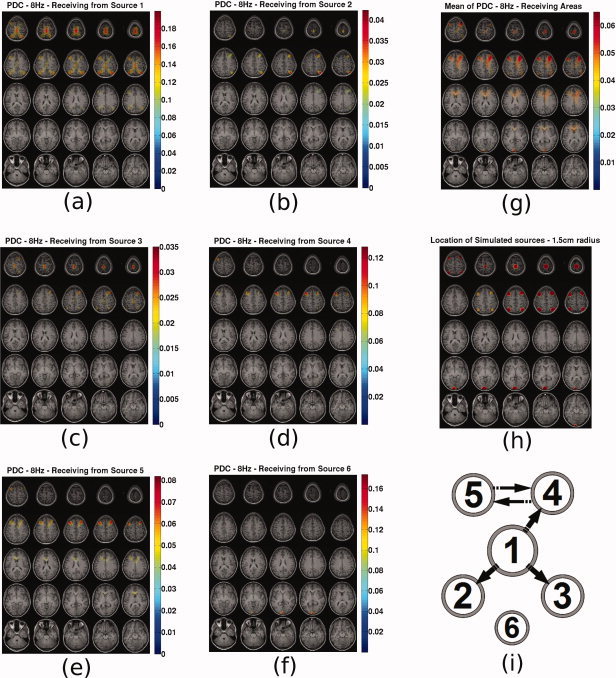
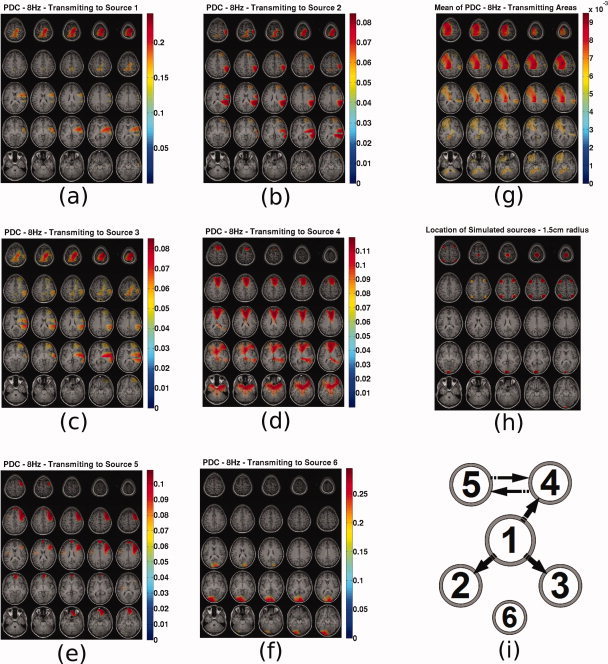
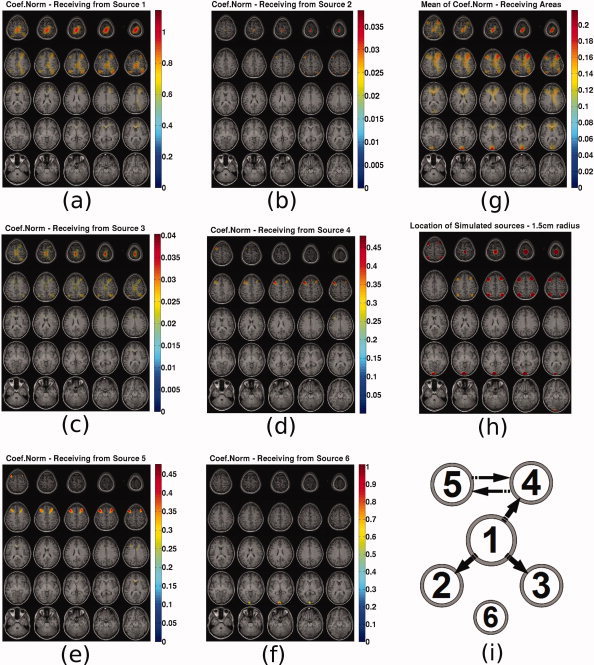
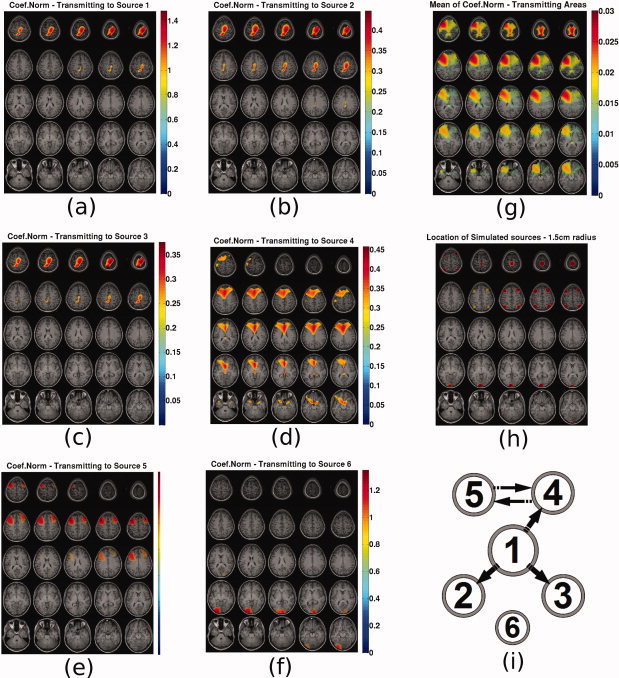
In this work, we investigate the feasibility to estimating causal interactions between brain regions based on multivariate autoregressive models (MAR models) fitted to magnetoencephalographic (MEG) sensor measurements. We first demonstrate the theoretical feasibility of estimating source level causal interactions after projection of the sensor-level model coefficients onto the locations of the neural sources. Next, we show with simulated MEG data that causality, as measured by partial directed coherence (PDC), can be correctly reconstructed if the locations of the interacting brain areas are known. We further demonstrate, if a very large number of brain voxels is considered as potential activation sources, that PDC as a measure to reconstruct causal interactions is less accurate. In such case the MAR model coefficients alone contain meaningful causality information. The proposed method overcomes the problems of model nonrobustness and large computation times encountered during causality analysis by existing methods. These methods first project MEG sensor time-series onto a large number of brain locations after which the MAR model is built on this large number of source-level time-series. Instead, through this work, we demonstrate that by building the MAR model on the sensor-level and then projecting only the MAR coefficients in source space, the true casual pathways are recovered even when a very large number of locations are considered as sources. The main contribution of this work is that by this methodology entire brain causality maps can be efficiently derived without any a priori selection of regions of interest.
在这项工作中,我们研究了基于多变量自回归模型 (MAR 模型) 拟合脑磁图 (MEG) 传感器测量值来估计脑区之间因果相互作用的可行性。我们首先证明了在将传感器水平模型系数投影到神经源位置后,在源水平估计因果相互作用的理论可行性。接下来,我们用模拟 MEG 数据表明,如果已知相互作用的脑区位置,通过部分定向相干度 (PDC) 测量的因果关系可以正确重建。我们进一步证明,如果考虑大量的脑体素作为潜在的激活源,那么作为重建因果相互作用的度量的 PDC 就不太准确。在这种情况下,MAR 模型系数本身包含有意义的因果信息。与现有的方法相比,该方法克服了因果分析中模型不稳健和计算时间长的问题。这些方法首先将 MEG 传感器时间序列投影到大量脑区上,然后在这个大量的源级时间序列上构建 MAR 模型。相反,通过这项工作,我们证明了通过在传感器水平上构建 MAR 模型,然后仅在源空间中投影 MAR 系数,可以在考虑大量位置作为源的情况下恢复真实的因果途径。这项工作的主要贡献在于,通过这种方法,可以在没有任何先验选择感兴趣区域的情况下,有效地推导出整个大脑的因果关系图。