Department of Pharmaceutics, Brain Barriers Research Center, University of Minnesota, Minneapolis, Minnesota 55455, United States.
Mol Pharm. 2012 Mar 5;9(3):678-84. doi: 10.1021/mp200465c. Epub 2012 Feb 22.
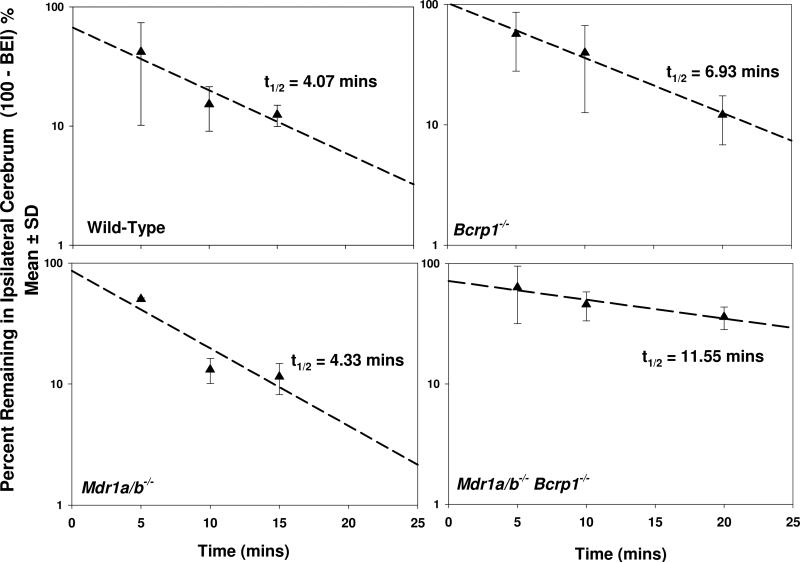
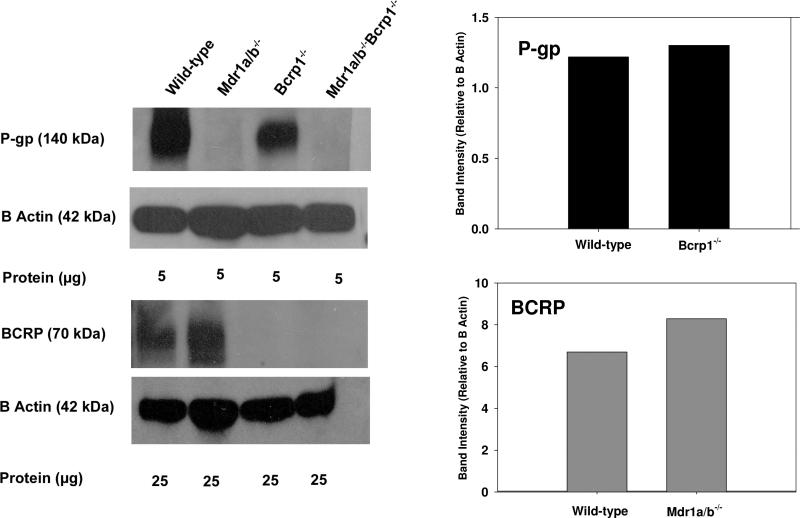
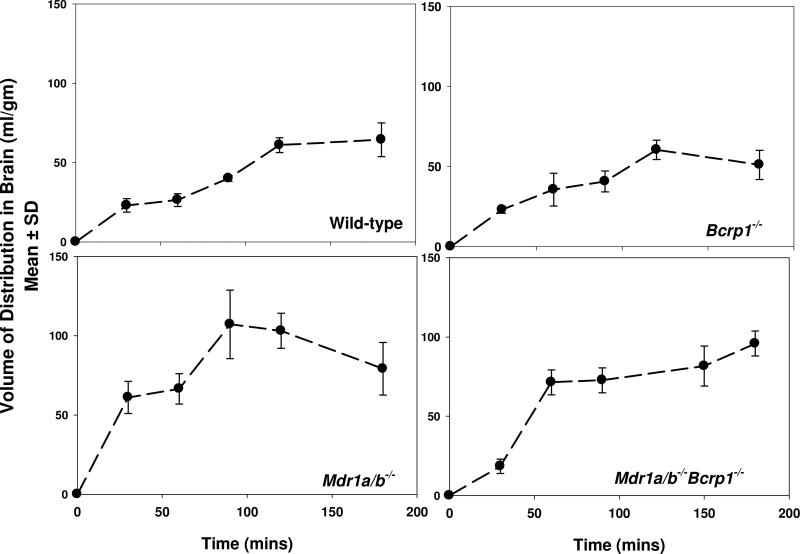
The ATP-binding cassette transporters P-glycoprotein and breast cancer resistance protein have been shown to be critical determinants limiting drug transport across the BBB into the brain. Several therapeutic agents have been shown to be substrates for these two transporters, and as a result they have limited distribution to the brain. Recently, it has been shown that these two drug transporters cooperate at the BBB and brain penetration of dual substrates increases significantly only when both are absent, e.g., in the Mdr1a/1b(-/-)Bcrp1(-/-) mice. The present study uses the brain penetration of sorafenib to investigate these findings and attempts to explain the mechanistic basis of this cooperation with a simple theory based on affinity and capacity dependent carrier-mediated transport. The brain efflux index method, combined with the organotypic brain slices, was used to determine the net contribution of P-gp and BCRP to the total clearance of sorafenib out of the brain and show that its efflux at the BBB is mediated primarily by BCRP. Sorafenib clearance out of the brain decreased 2-fold in the Bcrp1(-/-) mice and 2.5-fold in the Mdr1a/1b(-/-)Bcrp1(-/-) mice. Clearance out of brain when P-gp was absent did not change significantly compared to wild-type. We also investigated the expression of P-gp and BCRP in the genetic knockout animals and saw no differences in either P-gp or BCRP in the transporter deficient mice compared to the wild-type mice. In conclusion, this study explains the cooperation of P-gp and BCRP by analysis of the efflux clearance of sorafenib and correlating it to the "mechanisms" that determine the clearance, i.e., affinity and capacity.
ATP 结合盒转运蛋白 P-糖蛋白和乳腺癌耐药蛋白已被证明是限制药物通过血脑屏障进入大脑的关键决定因素。已经证明,几种治疗药物是这两种转运蛋白的底物,因此它们向大脑的分布有限。最近,已经表明这两种药物转运蛋白在血脑屏障处合作,只有当两者都不存在时,双重底物的脑穿透才会显著增加,例如在 Mdr1a/1b(-/-)Bcrp1(-/-) 小鼠中。本研究使用索拉非尼的脑穿透来研究这些发现,并尝试用基于亲和力和容量依赖性载体介导转运的简单理论来解释这种合作的机制基础。脑外排指数法结合器官型脑片,用于确定 P-糖蛋白和 BCRP 对索拉非尼从脑中总清除率的净贡献,并表明其在血脑屏障处的外排主要由 BCRP 介导。在 Bcrp1(-/-) 小鼠中,索拉非尼从脑中的清除率降低了 2 倍,在 Mdr1a/1b(-/-)Bcrp1(-/-) 小鼠中降低了 2.5 倍。与野生型相比,当 P-糖蛋白不存在时,脑外排清除率没有显著变化。我们还研究了遗传敲除动物中 P-糖蛋白和 BCRP 的表达,发现与野生型小鼠相比,在转运蛋白缺乏的小鼠中,P-糖蛋白或 BCRP 的表达没有差异。总之,本研究通过分析索拉非尼的外排清除率,并将其与决定清除率的“机制”(即亲和力和容量)相关联,解释了 P-糖蛋白和 BCRP 的合作。