Saunders M J, Yeh E, Grunstein M, Bloom K
Department of Biology, University of North Carolina, Chapel Hill 27599-3280.
Mol Cell Biol. 1990 Nov;10(11):5721-7. doi: 10.1128/mcb.10.11.5721-5727.1990.
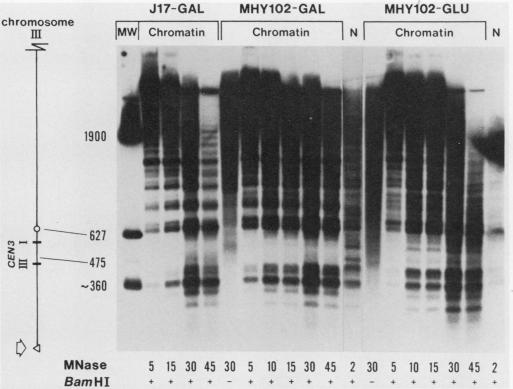
Saccharomyces cerevisiae centromeric DNA is packaged into a highly nuclease-resistant chromatin core of approximately 200 base pairs of DNA. The structure of the centromere in chromosome III is somewhat larger than a 160-base-pair nucleosomal core and encompasses the conserved centromere DNA elements (CDE I, II, and III). Extensive mutational analysis has revealed the sequence requirements for centromere function. Mutations affecting the segregation properties of centromeres also exhibit altered chromatin structures in vivo. Thus the structure, as delineated by nuclease digestion, correlated with functional centromeres. We have determined the contribution of histone proteins to this unique structural organization. Nucleosome depletion by repression of either histone H2B or H4 rendered the cell incapable of chromosome segregation. Histone repression resulted in increased nuclease sensitivity of centromere DNA, with up to 40% of CEN3 DNA molecules becoming accessible to nucleolytic attack. Nucleosome depletion also resulted in an alteration in the distribution of nuclease cutting sites in the DNA surrounding CEN3. These data provide the first indication that authentic nucleosomal subunits flank the centromere and suggest that nucleosomes may be the central core of the centromere itself.
酿酒酵母着丝粒DNA被包装成一个高度耐核酸酶的染色质核心,其包含约200个碱基对的DNA。第三条染色体着丝粒的结构比160个碱基对的核小体核心稍大,并且包含保守的着丝粒DNA元件(CDE I、II和III)。广泛的突变分析揭示了着丝粒功能的序列要求。影响着丝粒分离特性的突变在体内也表现出染色质结构的改变。因此,通过核酸酶消化所描绘的结构与功能性着丝粒相关。我们已经确定了组蛋白对这种独特结构组织的贡献。抑制组蛋白H2B或H4导致核小体缺失,使细胞无法进行染色体分离。组蛋白抑制导致着丝粒DNA对核酸酶的敏感性增加,高达40%的CEN3 DNA分子可被核酸酶攻击。核小体缺失还导致CEN3周围DNA中核酸酶切割位点的分布发生改变。这些数据首次表明,真正的核小体亚基位于着丝粒两侧,并表明核小体可能是着丝粒本身的核心。