Institute of Psychiatry, King's College London, UK.
Lancet Oncol. 2012 Mar;13(3):309-18. doi: 10.1016/S1470-2045(11)70364-3. Epub 2012 Feb 15.
Hot flushes and night sweats (HFNS) affect 65-85% of women after breast cancer treatment; they are distressing, causing sleep problems and decreased quality of life. Hormone replacement therapy is often either undesirable or contraindicated. Safe, effective non-hormonal treatments are needed. We investigated whether cognitive behavioural therapy (CBT) can help breast cancer survivors to effectively manage HFNS.
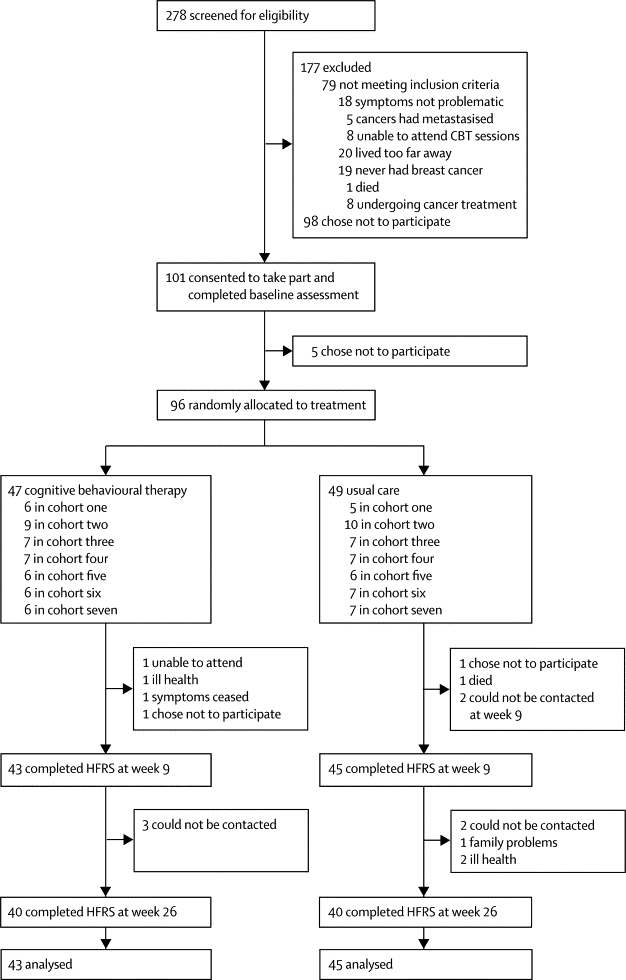
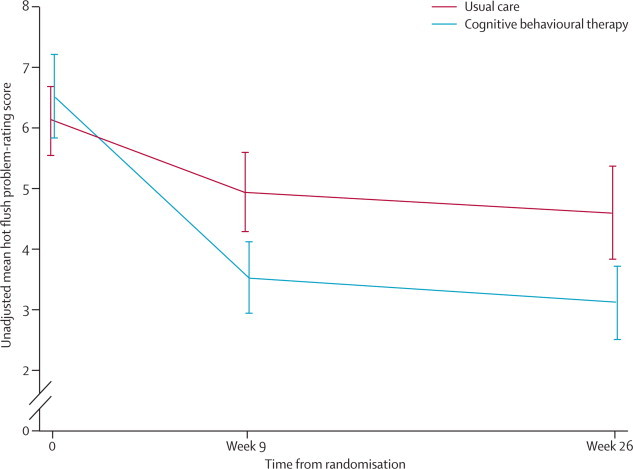
In this randomised controlled trial, we recruited women from breast clinics in London, UK, who had problematic HFNS (minimum ten problematic episodes a week) after breast-cancer treatment. Participants were randomly allocated to receive either usual care or usual care plus group CBT (1:1). Randomisation was done in blocks of 12-20 participants, stratifying by age (younger than 50 years, 50 years or older), and was done with a computer-generated sequence. The trial statistician and researchers collecting outcome measures were masked to group allocation. Group CBT comprised one 90 min session a week for 6 weeks, and included psycho-education, paced breathing, and cognitive and behavioural strategies to manage HFNS. Assessments were done at baseline, 9 weeks, and 26 weeks after randomisation. The primary outcome was the adjusted mean difference in HFNS problem rating (1-10) between CBT and usual care groups at 9 weeks after randomisation. Analysis of the primary endpoint was done by modified intention to treat. The trial is registered, ISRCTN13771934, and was closed March 15, 2011.
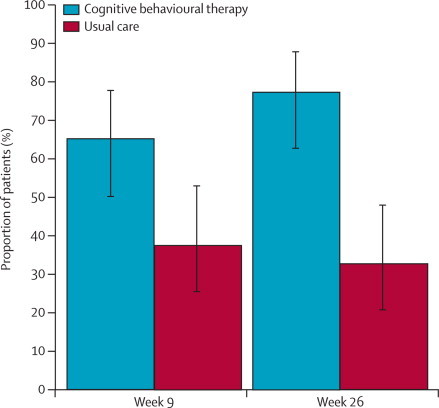
Between May 5, 2009, and Aug 27, 2010, 96 women were randomly allocated to group CBT (n=47) or usual care (n=49). Group CBT significantly reduced HFNS problem rating at 9 weeks after randomisation compared with usual care (mean difference -1·67, 95% CI -2·43 to -0·91; p<0·0001) and improvements were maintained at 26 weeks (mean difference -1·76, -2·54 to -0·99; p<0·0001). We recorded no CBT-related adverse events.
Group CBT seems to be a safe and effective treatment for women who have problematic HFNS after breast cancer treatment with additional benefits to mood, sleep, and quality of life. The treatment could be incorporated into breast cancer survivorship programmes and delivered by trained breast cancer nurses.
Cancer Research UK.
热潮红和盗汗(HFNS)影响 65-85%接受过乳腺癌治疗的女性;它们令人痛苦,导致睡眠问题和生活质量下降。激素替代疗法通常是不可取的或禁忌的。需要安全有效的非激素治疗方法。我们研究了认知行为疗法(CBT)是否可以帮助乳腺癌幸存者有效管理 HFNS。
在这项随机对照试验中,我们从英国伦敦的乳腺癌诊所招募了接受过乳腺癌治疗后出现 HFNS 问题(每周至少有 10 次问题发作)的女性。参与者被随机分配接受常规护理或常规护理加小组 CBT(1:1)。随机分组以块为单位进行,每组 12-20 名参与者,按年龄分层(<50 岁,50 岁或以上),并使用计算机生成的序列进行。试验统计员和收集结果的研究人员对分组分配进行了屏蔽。小组 CBT包括每周一次 90 分钟的课程,为期 6 周,包括心理教育、有节奏的呼吸以及认知和行为策略来管理 HFNS。评估在随机分组后 9 周和 26 周进行。主要结局是在随机分组后 9 周时 CBT 组和常规护理组 HFNS 问题评分(1-10)的调整平均差异。对主要终点的分析采用修改后的意向治疗进行。该试验已注册,ISRCTN83527633,于 2011 年 3 月 15 日关闭。
在 2009 年 5 月 5 日至 2010 年 8 月 27 日期间,96 名女性被随机分配到 CBT 组(n=47)或常规护理组(n=49)。与常规护理相比,CBT 组在随机分组后 9 周时显著降低了 HFNS 问题评分(平均差异-1.67,95%CI-2.43 至-0.91;p<0.0001),并且在 26 周时仍有改善(平均差异-1.76,-2.54 至-0.99;p<0.0001)。我们没有记录到与 CBT 相关的不良事件。
小组 CBT 似乎是一种安全有效的治疗方法,适用于乳腺癌治疗后出现 HFNS 问题的女性,并且对情绪、睡眠和生活质量有额外的益处。该治疗方法可以纳入乳腺癌生存者计划,并由经过培训的乳腺癌护士提供。
英国癌症研究中心。