Yasar Sirin, Mumcuoglu Ceyda Tanzer, Serdar Zehra Asiran, Gunes Pembegul
Department of Dermatology, Haydarpaş Numune Training and Research Hospital, Istansbul, Turkey.
Ann Dermatol. 2011 Dec;23(Suppl 3):S354-9. doi: 10.5021/ad.2011.23.S3.S354. Epub 2011 Dec 27.
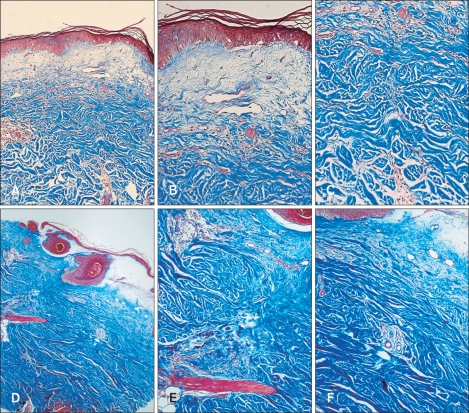
Bullous morphea is a rare form of morphea characterized with bullae on or around atrophic morphea plaques. Whereas lichen sclerosus et atrophicus (LSA) is a disease the etiology of which is not fully known, and which is characterized with sclerosis. Coexistence of morphea and LSA has been identified in some cases. Some authors believe that these two diseases are different manifestations which are on the same spectrum. The 70-year-old patient stated herein, presented to us for 6 months with annular, atrophic plaques, ivory color in the middle, surrounded by living erythema, on the front and back of the trunk. Occasionally bulla formation on the plaques on the trunk lateral was identified. Fibrotic and atrophic plaques of ligneous hardness were present on the front side of tibia of both legs. In the histopathologic examination, the lesions were found concordant with bullous morphea and LSA. With colchicine 1.5 mg/day, pentoxifylline 1,200 mg/day, topical calcipotriol ointment and clobetasol propionate cream, the erythema in the patient's lesions faded and softening in the fibrotic plaques was observed. Concomitance of bullous morphea and LSA is a rarely seen, interesting coexistence which suggests a common, as yet unknown, underlying pathogenesis.
大疱性硬斑病是硬斑病的一种罕见形式,其特征为萎缩性硬斑病斑块上或周围出现大疱。而硬化性萎缩性苔藓(LSA)是一种病因尚未完全明确、以硬化为特征的疾病。在某些病例中已发现硬斑病与LSA并存。一些作者认为这两种疾病是同一谱系上的不同表现形式。本文所述的这位70岁患者,因躯干前后出现环形萎缩性斑块6个月前来就诊,斑块中间呈象牙色,周围有活动性红斑。偶尔在躯干侧面的斑块上发现有大疱形成。双腿胫骨前部有木质硬度的纤维化和萎缩性斑块。组织病理学检查发现病变与大疱性硬斑病和LSA相符。给予秋水仙碱1.5毫克/天、己酮可可碱1200毫克/天、外用卡泊三醇软膏和丙酸氯倍他索乳膏后,患者病变处的红斑消退,纤维化斑块出现软化。大疱性硬斑病与LSA并存是一种罕见且有趣的情况,提示存在一种共同的、尚未明确的潜在发病机制。