Department of Mechanical Engineering, Southern Taiwan University, Tainan 71005, Taiwan.
Sensors (Basel). 2011;11(11):11021-35. doi: 10.3390/s111111021. Epub 2011 Nov 23.
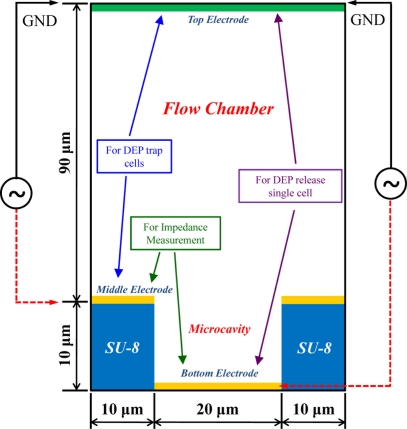
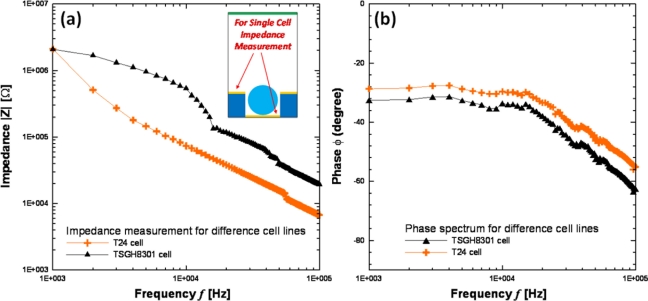
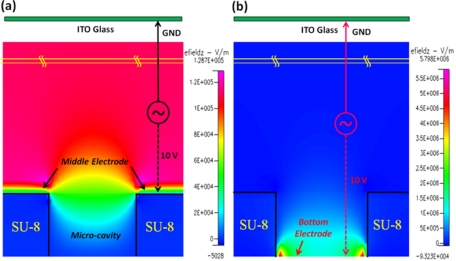
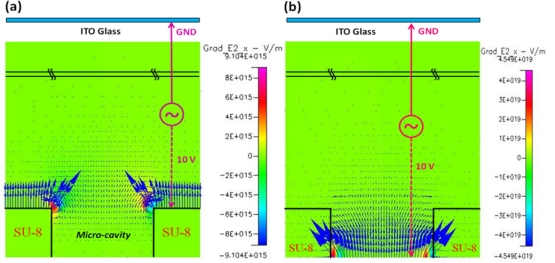
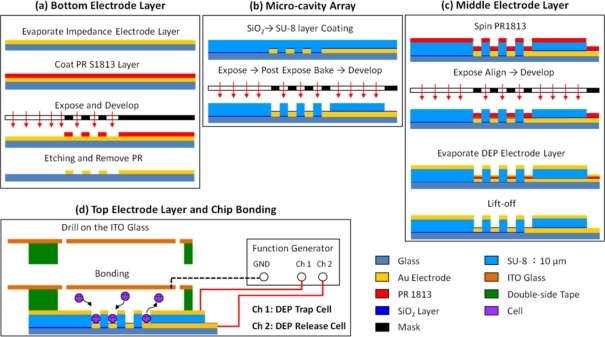
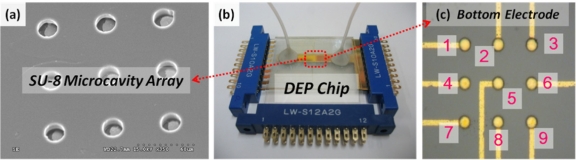
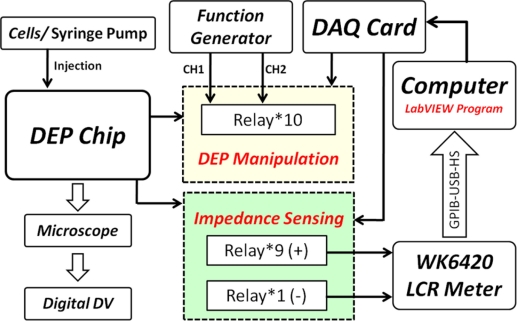
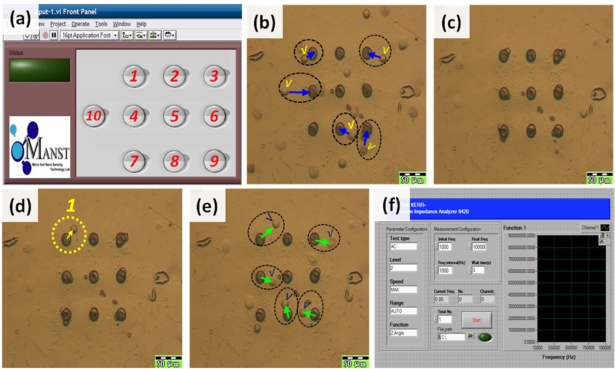
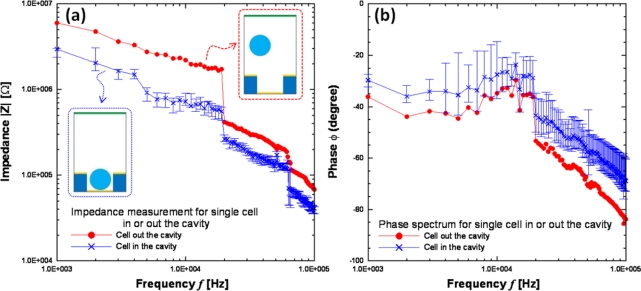
This paper develops a dielectrophoretic (DEP) chip with multi-layer electrodes and a micro-cavity array for programmable manipulations of cells and impedance measurement. The DEP chip consists of an ITO top electrode, flow chamber, middle electrode on an SU-8 surface, micro-cavity arrays of SU-8 and distributed electrodes at the bottom of the micro-cavity. Impedance sensing of single cells could be performed as follows: firstly, cells were trapped in a micro-cavity array by negative DEP force provided by top and middle electrodes; then, the impedance measurement for discrimination of different stage of bladder cancer cells was accomplished by the middle and bottom electrodes. After impedance sensing, the individual releasing of trapped cells was achieved by negative DEP force using the top and bottom electrodes in order to collect the identified cells once more. Both cell manipulations and impedance measurement had been integrated within a system controlled by a PC-based LabVIEW program. In the experiments, two different stages of bladder cancer cell lines (grade III: T24 and grade II: TSGH8301) were utilized for the demonstration of programmable manipulation and impedance sensing; as the results show, the lower-grade bladder cancer cells (TSGH8301) possess higher impedance than the higher-grade ones (T24). In general, the multi-step manipulations of cells can be easily programmed by controlling the electrical signal in our design, which provides an excellent platform technology for lab-on-a-chip (LOC) or a micro-total-analysis-system (Micro TAS).
本文开发了一种具有多层电极和微腔阵列的介电泳(DEP)芯片,用于可编程操作细胞和阻抗测量。DEP 芯片由顶部的 ITO 电极、流腔、SU-8 表面上的中间电极、SU-8 微腔阵列和微腔底部的分布式电极组成。单个细胞的阻抗传感可以如下进行:首先,通过顶部和中间电极提供的负介电泳力将细胞困在微腔阵列中;然后,通过中间和底部电极完成对不同阶段膀胱癌细胞的阻抗测量,以区分不同阶段的膀胱癌细胞。在阻抗传感之后,通过顶部和底部电极使用负介电泳力实现对被困细胞的逐个释放,以便再次收集已识别的细胞。细胞操作和阻抗测量都集成在一个由基于 PC 的 LabVIEW 程序控制的系统中。在实验中,利用两种不同阶段的膀胱癌细胞系(III 级:T24 和 II 级:TSGH8301)进行可编程操作和阻抗传感的演示;结果表明,低级膀胱癌细胞(TSGH8301)的阻抗比高级膀胱癌细胞(T24)高。总的来说,通过控制我们设计中的电信号,可以轻松地对细胞进行多步操作,为片上实验室(LOC)或微全分析系统(Micro TAS)提供了出色的平台技术。