Office of Public Health Genomics, Office of Epidemiology, Surveillance, and Laboratory Services, Centers for Disease Control and Prevention, Atlanta, Georgia, United States of America.
PLoS One. 2012;7(2):e25431. doi: 10.1371/journal.pone.0025431. Epub 2012 Feb 7.
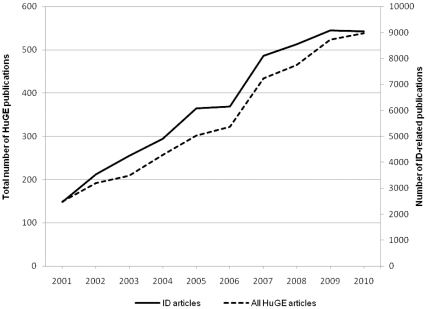
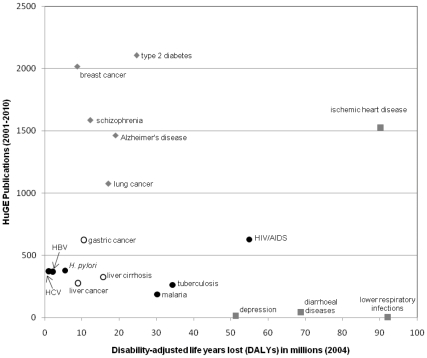
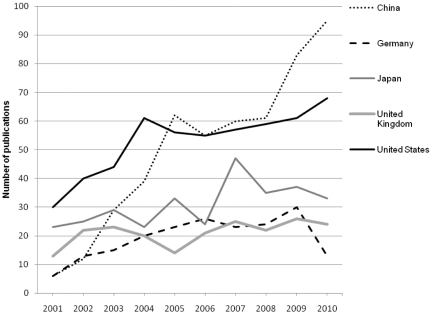
Pathogen genetics is already a mainstay of public health investigation and control efforts; now advances in technology make it possible to investigate the role of human genetic variation in the epidemiology of infectious diseases. To describe trends in this field, we analyzed articles that were published from 2001 through 2010 and indexed by the HuGE Navigator, a curated online database of PubMed abstracts in human genome epidemiology. We extracted the principal findings from all meta-analyses and genome-wide association studies (GWAS) with an infectious disease-related outcome. Finally, we compared the representation of diseases in HuGE Navigator with their contributions to morbidity worldwide. We identified 3,730 articles on infectious diseases, including 27 meta-analyses and 23 GWAS. The number published each year increased from 148 in 2001 to 543 in 2010 but remained a small fraction (about 7%) of all studies in human genome epidemiology. Most articles were by authors from developed countries, but the percentage by authors from resource-limited countries increased from 9% to 25% during the period studied. The most commonly studied diseases were HIV/AIDS, tuberculosis, hepatitis B infection, hepatitis C infection, sepsis, and malaria. As genomic research methods become more affordable and accessible, population-based research on infectious diseases will be able to examine the role of variation in human as well as pathogen genomes. This approach offers new opportunities for understanding infectious disease susceptibility, severity, treatment, control, and prevention.
病原体遗传学已经成为公共卫生调查和控制工作的主要支柱;现在,技术的进步使得研究人类遗传变异在传染病流行病学中的作用成为可能。为了描述这一领域的趋势,我们分析了 2001 年至 2010 年期间发表的并被 HuGE Navigator(一个人类基因组流行病学中 PubMed 摘要的在线数据库)索引的文章。我们从所有与传染病相关的Meta 分析和全基因组关联研究(GWAS)中提取主要发现。最后,我们比较了 HuGE Navigator 中疾病的代表性及其对全球发病率的贡献。我们确定了 3730 篇有关传染病的文章,包括 27 篇 Meta 分析和 23 项 GWAS。每年发表的文章数量从 2001 年的 148 篇增加到 2010 年的 543 篇,但仍只占人类基因组流行病学所有研究的一小部分(约 7%)。大多数文章的作者来自发达国家,但在研究期间,来自资源有限国家的作者的比例从 9%增加到 25%。研究最多的疾病是 HIV/AIDS、结核病、乙型肝炎感染、丙型肝炎感染、败血症和疟疾。随着基因组研究方法变得更加经济实惠和易于获取,基于人群的传染病研究将能够研究人类和病原体基因组中变异的作用。这种方法为理解传染病的易感性、严重程度、治疗、控制和预防提供了新的机会。