Department of Parasitology, Leiden University Medical Center, Leiden, The Netherlands.
PLoS One. 2012;7(2):e30883. doi: 10.1371/journal.pone.0030883. Epub 2012 Feb 8.
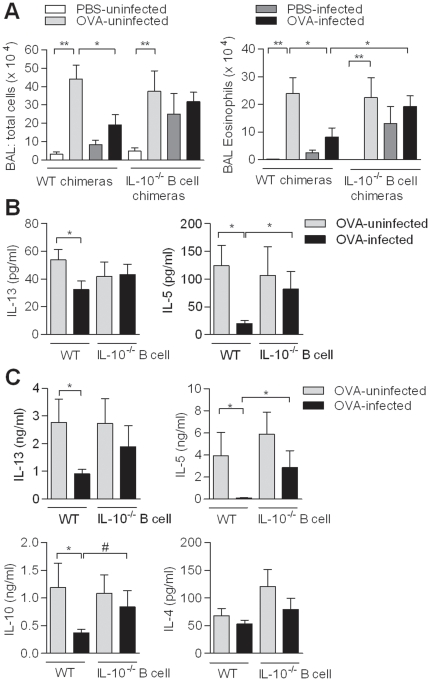
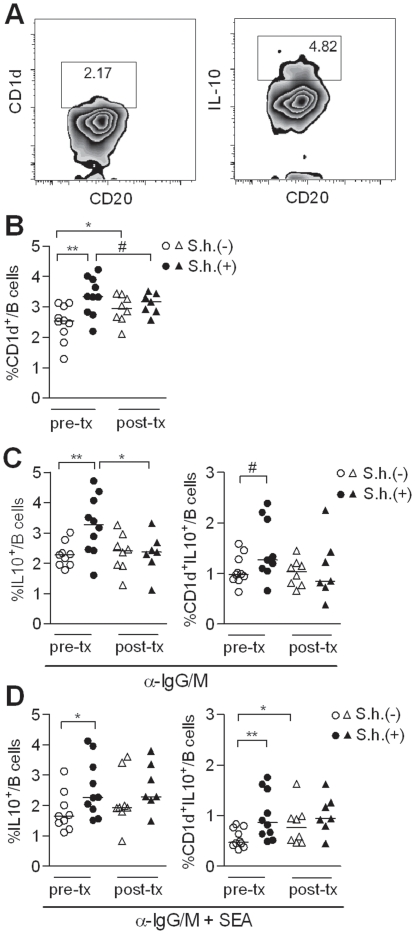
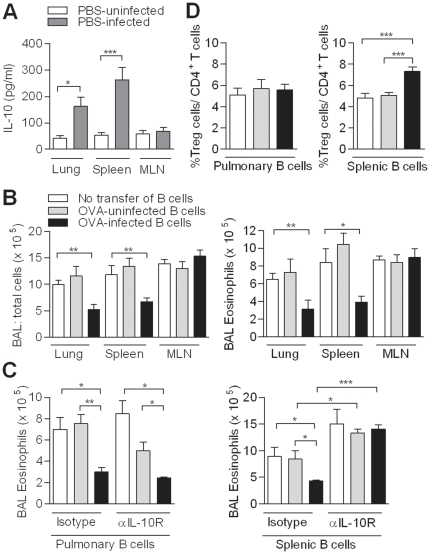
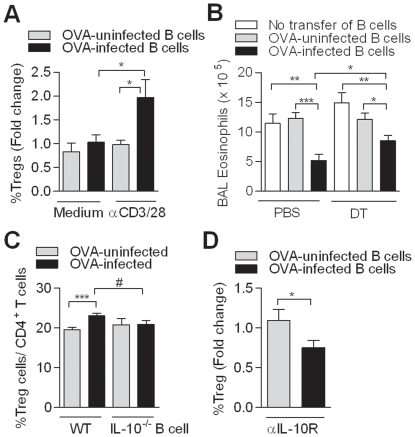
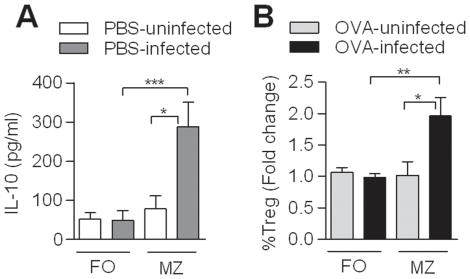
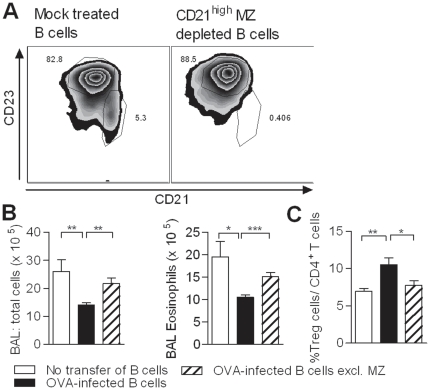
Chronic helminth infections, such as schistosomes, are negatively associated with allergic disorders. Here, using B cell IL-10-deficient mice, Schistosoma mansoni-mediated protection against experimental ovalbumin-induced allergic airway inflammation (AAI) was shown to be specifically dependent on IL-10-producing B cells. To study the organs involved, we transferred B cells from lungs, mesenteric lymph nodes or spleen of OVA-infected mice to recipient OVA-sensitized mice, and showed that both lung and splenic B cells reduced AAI, but only splenic B cells in an IL-10-dependent manner. Although splenic B cell protection was accompanied by elevated levels of pulmonary FoxP3(+) regulatory T cells, in vivo ablation of FoxP3(+) T cells only moderately restored AAI, indicating an important role for the direct suppressory effect of regulatory B cells. Splenic marginal zone CD1d(+) B cells proved to be the responsible splenic B cell subset as they produced high levels of IL-10 and induced FoxP3(+) T cells in vitro. Indeed, transfer of CD1d(+) MZ-depleted splenic B cells from infected mice restored AAI. Markedly, we found a similarly elevated population of CD1d(hi) B cells in peripheral blood of Schistosoma haematobium-infected Gabonese children compared to uninfected children and these cells produced elevated levels of IL-10. Importantly, the number of IL-10-producing CD1d(hi) B cells was reduced after anti-schistosome treatment. This study points out that in both mice and men schistosomes have the capacity to drive the development of IL-10-producing regulatory CD1d(hi) B cells and furthermore, these are instrumental in reducing experimental allergic inflammation in mice.
慢性寄生虫感染,如血吸虫,与过敏疾病呈负相关。在这里,使用 B 细胞 IL-10 缺陷小鼠,我们证明了曼氏血吸虫介导的对实验性卵清蛋白诱导的过敏性气道炎症(AAI)的保护作用专门依赖于产生 IL-10 的 B 细胞。为了研究涉及的器官,我们将来自 OVA 感染小鼠的肺部、肠系膜淋巴结或脾脏的 B 细胞转移到接受 OVA 敏化的小鼠中,结果表明肺部和脾脏的 B 细胞均减轻了 AAI,但只有脾脏的 B 细胞以依赖于 IL-10 的方式。尽管脾脏 B 细胞的保护作用伴随着肺部 FoxP3+调节性 T 细胞水平的升高,但体内消融 FoxP3+T 细胞仅适度恢复了 AAI,表明调节性 B 细胞的直接抑制作用非常重要。脾脏边缘区 CD1d+B 细胞被证明是负责的脾脏 B 细胞亚群,因为它们在体外产生高水平的 IL-10 并诱导 FoxP3+T 细胞。事实上,从感染小鼠转移 CD1d+MZ 耗尽的脾脏 B 细胞恢复了 AAI。值得注意的是,我们在感染了埃及血吸虫的加蓬儿童的外周血中发现了类似数量增加的 CD1d(hi)B 细胞,与未感染的儿童相比,这些细胞产生高水平的 IL-10。重要的是,抗血吸虫治疗后产生 IL-10 的 CD1d(hi)B 细胞数量减少。这项研究表明,在小鼠和人类中,血吸虫都有能力驱动产生 IL-10 的调节性 CD1d(hi)B 细胞的发展,此外,这些细胞在减少实验性过敏炎症方面发挥了重要作用。