MRC Centre of Epidemiology for Child Health, UCL Institute of Child Health, London, United Kingdom.
PLoS One. 2012;7(2):e31132. doi: 10.1371/journal.pone.0031132. Epub 2012 Feb 9.
Knowledge of sedentary behaviour associations with health has relied mainly on television-viewing as a proxy and studies with other measures are less common. To clarify whether sedentary behaviour is associated with disease-risk, we examined associations for television-viewing and sitting at work.
Using the 1958 British birth cohort (n = 7660), we analysed cross-sectional associations between television-viewing and work sitting (four categories, 0-1 to ≥ 3 h/d) with total, high-density lipoprotein (HDL) and low-density lipoprotein (LDL)-cholesterol, triglycerides, blood pressure, glycated haemoglobin, fibrinogen, C-reactive protein, hypertension and metabolic syndrome at 45 y. We adjusted for lifestyle and socio-demographic factors and assessed mediation of associations by body mass index (BMI) and diet. We also assessed whether the sedentary indicators are related similarly to factors linked to disease-risk.
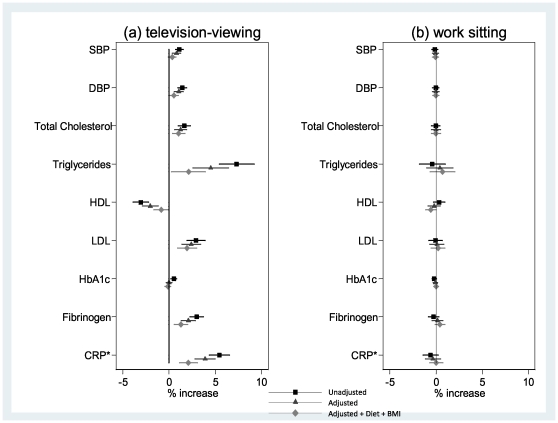
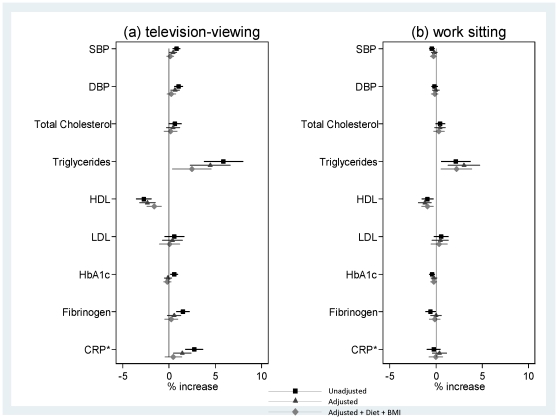
There was a general trend of adverse socio-demographic and lifestyle characteristics with higher h/d television-viewing, but trends in the opposite direction for work sitting. Television-viewing was associated with most biomarkers and associations were mediated by BMI: e.g. for each category increase in television-viewing, HDL-cholesterol in men was lower by 2.3% (95% CI: 1.5%, 3.2%) and, in BMI and diet adjusted analyses, by 1.6% (0.8%, 2.4%); for women, by 2.0% (1.2%, 2.9%) and 0.9% (0.1%, 1.6%) respectively. Few, weaker associations for work sitting were found, in men only: e.g. corresponding values for HDL-cholesterol were 1.2% (0.5%, 1.9%) and 0.9% (0.3%, 1.5%). Odds for metabolic syndrome were elevated by 82% and 33% respectively for men watching television or work sitting for ≥ 3 vs. 0-1 h/d.
Associations with cardiovascular disease and diabetes biomarkers in mid-adulthood differed for television-viewing and work sitting. The role of sedentary behaviour may vary by leisure and work domains or the two indicators reflect differing associations with other disease-related influences.
对久坐行为与健康之间的关联的了解主要依赖于将看电视作为替代指标,而采用其他测量方法的研究则相对较少。为了明确久坐行为是否与疾病风险相关,我们研究了看电视和工作时坐着与总胆固醇、高密度脂蛋白(HDL)胆固醇、低密度脂蛋白(LDL)胆固醇、甘油三酯、血压、糖化血红蛋白、纤维蛋白原、C 反应蛋白、高血压和代谢综合征在 45 岁时的关联。我们调整了生活方式和社会人口统计学因素,并评估了这些关联是否由体重指数(BMI)和饮食来介导。我们还评估了久坐行为指标与与疾病风险相关的因素之间的关联是否相似。
随着每天看电视时间的增加,一般会出现更多的社会人口统计学和生活方式不良特征,但工作时坐着的趋势则相反。看电视与大多数生物标志物有关联,这些关联是由 BMI 介导的:例如,男性中每增加一个看电视的类别,HDL 胆固醇降低 2.3%(95%可信区间:1.5%,3.2%),在调整 BMI 和饮食后降低 1.6%(0.8%,2.4%);女性则分别降低 2.0%(1.2%,2.9%)和 0.9%(0.1%,1.6%)。对于工作时坐着,只在男性中发现了一些较弱的关联:例如,对于 HDL 胆固醇,相应的值分别为 1.2%(0.5%,1.9%)和 0.9%(0.3%,1.5%)。与每天看电视或工作时坐着 0-1 小时相比,看电视或工作时坐着≥3 小时的男性患代谢综合征的几率分别升高了 82%和 33%。
在中年时期,与心血管疾病和糖尿病生物标志物的关联因看电视和工作时坐着而不同。久坐行为的作用可能因休闲和工作领域而异,或者这两个指标反映了与其他与疾病相关的影响的不同关联。