Physical Activity, Metabolic & Vascular Physiology and Behavioural Epidemiology Laboratories, Baker Heart and Diabetes Institute, Level 4, 99 Commercial Rd, Melbourne, VIC, 3004, Australia.
Centre for Urban Transitions, Swinburne University of Technology, Melbourne, VIC, Australia.
Int J Behav Nutr Phys Act. 2018 Nov 20;15(1):114. doi: 10.1186/s12966-018-0748-3.
High volumes of sitting time are associated with an elevated risk of type 2 diabetes and cardiovascular disease, and with adverse cardiometabolic risk profiles. However, previous studies have predominately evaluated only total sitting or television (TV) viewing time, limiting inferences about the specific cardiometabolic health impacts of sitting accumulated in different contexts. We examined associations of sitting time in four contexts with cardiometabolic risk biomarkers in Australian adults.
Participants (n = 3429; mean ± SD age 58 ± 10 years) were adults without clinically diagnosed diabetes or cardiovascular disease from the 2011-2012 Australian Diabetes, Obesity and Lifestyle (AusDiab) study. Multiple linear regressions examined associations of self-reported context-specific sitting time (occupational, transportation, TV-viewing and leisure-time computer use) with a clustered cardiometabolic risk score (CMR) and with individual cardiometabolic risk biomarkers (waist circumference, BMI, resting blood pressure, triglycerides, HDL- and LDL-cholesterol, and fasting and 2-h post-load plasma glucose).
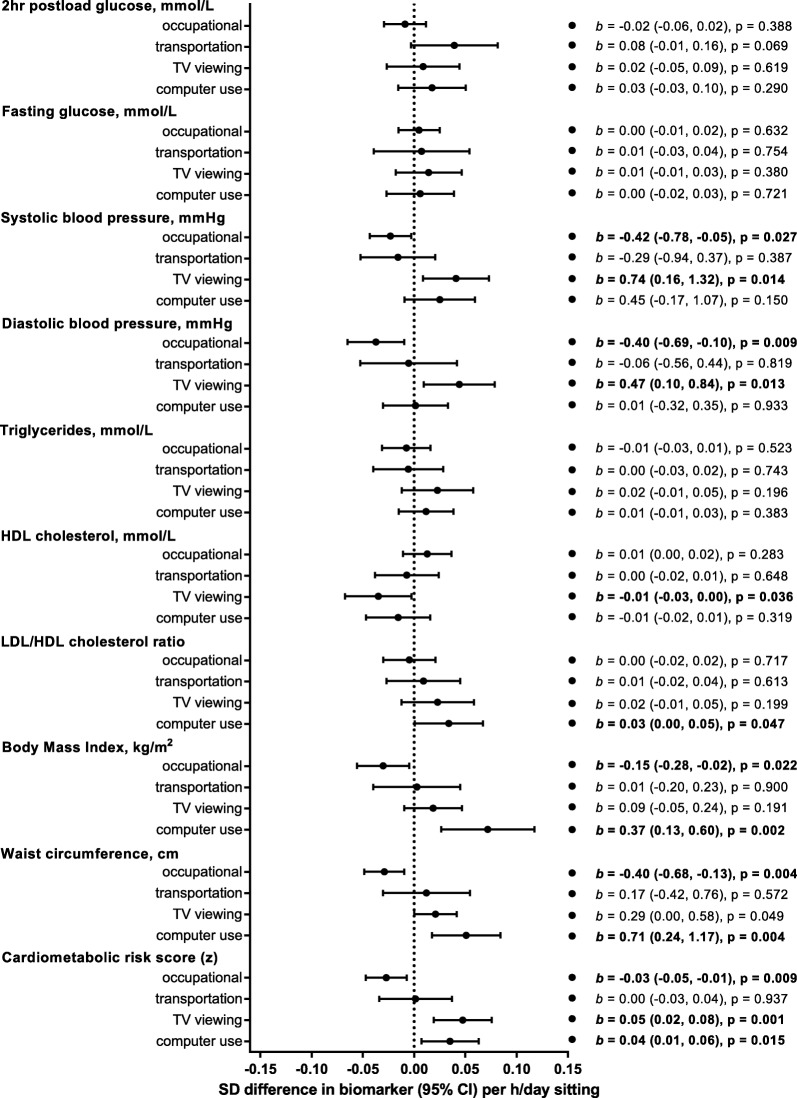
Higher CMR was significantly associated with greater TV-viewing and computer sitting time (b [95%CI] = 0.07 [0.04, 0.09] and 0.06 [0.03, 0.09]), and tended to be associated with higher occupational and transport sitting time (0.01 [- 0.01, 0.03] and 0.03 [- 0.00, 0.06]), after adjustment for potential confounders. Furthermore, keeping total sitting time constant, accruing sitting via TV-viewing and computer use was associated with significantly higher CMR (0.05 [0.02, 0.08] and 0.04 [0.01, 0.06]), accruing sitting in an occupational context was associated with significantly lower CMR (- 0.03 [- 0.05, - 0.01]), while no significant association was seen for transport sitting (0.00 [- 0.03, 0.04]). Results varied somewhat between the respective biomarkers; however, higher sitting time in each domain tended to be associated detrimentally with individual biomarkers except for fasting glucose (non-significant associations) and systolic blood pressure (a beneficial association was observed). Overall, associations were stronger for TV-viewing and computer use, and weaker for occupational sitting.
Higher context-specific sitting times tended to be detrimentally associated, albeit modestly, with CMR and several cardiometabolic risk biomarkers. There was some evidence suggesting that the context in which people sit is relevant above and beyond total sitting time. Methodological issues notwithstanding, these findings may assist in identifying priorities for sitting-reduction initiatives, in order to achieve optimal cardiometabolic health benefits.
大量的久坐时间与 2 型糖尿病和心血管疾病风险的增加以及不良的心血管代谢风险特征有关。然而,以前的研究主要评估了总的久坐时间或看电视(TV)时间,限制了对不同环境中累积的与久坐相关的心血管代谢健康影响的推断。我们研究了澳大利亚成年人中四种不同情况下的久坐时间与心血管代谢风险生物标志物之间的关系。
参与者(n=3429;平均年龄 58±10 岁)来自 2011-2012 年澳大利亚糖尿病、肥胖和生活方式(AusDiab)研究,无临床诊断的糖尿病或心血管疾病。多元线性回归分析了自我报告的特定环境下的久坐时间(职业、交通、看电视和休闲时间使用电脑)与心血管代谢风险综合评分(CMR)和个体心血管代谢风险生物标志物(腰围、BMI、静息血压、甘油三酯、高密度脂蛋白和低密度脂蛋白胆固醇以及空腹和餐后 2 小时血糖)之间的关系。
更高的 CMR 与更高的电视观看时间和电脑使用时间显著相关(b [95%CI] = 0.07 [0.04, 0.09] 和 0.06 [0.03, 0.09]),并且在调整了潜在混杂因素后,与更高的职业和交通时间也有一定的相关性(0.01 [-0.01, 0.03] 和 0.03 [-0.00, 0.06])。此外,在保持总久坐时间不变的情况下,通过看电视和使用电脑累积的久坐时间与 CMR 显著升高相关(0.05 [0.02, 0.08] 和 0.04 [0.01, 0.06]),在职业环境中累积的久坐时间与 CMR 显著降低相关(-0.03 [-0.05, -0.01]),而交通时间的相关性则不显著(0.00 [-0.03, 0.04])。结果在各生物标志物之间略有不同;然而,除了空腹血糖(无显著相关性)和收缩压(观察到有益的相关性)外,每个领域的久坐时间越高,往往与个体生物标志物呈负相关。总体而言,看电视和使用电脑的相关性更强,而职业坐姿的相关性较弱。
特定环境下的久坐时间越高,与 CMR 和一些心血管代谢风险生物标志物的相关性越差,尽管幅度较小。有一些证据表明,人们所处的环境比总久坐时间更重要。尽管存在方法学问题,但这些发现可能有助于确定减少久坐时间的优先事项,以获得最佳的心血管代谢健康益处。