Department of Health Statistics, Second Military Medical University, Shanghai, China.
PLoS One. 2012;7(2):e31642. doi: 10.1371/journal.pone.0031642. Epub 2012 Feb 13.
Aspirin and clopidogrel monotherapies are effective treatments for preventing vascular disease. However, new evidence has emerged regarding the use of combined aspirin and clopidogrel therapy to prevent cardiovascular events. We therefore performed a comprehensive systematic review and meta-analysis to evaluate the benefits and harms of combined aspirin and clopidogrel therapy on major cardiovascular outcomes.
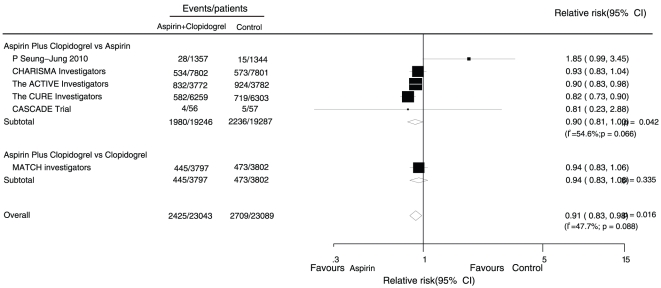
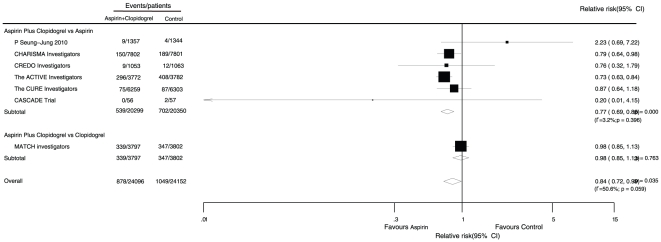
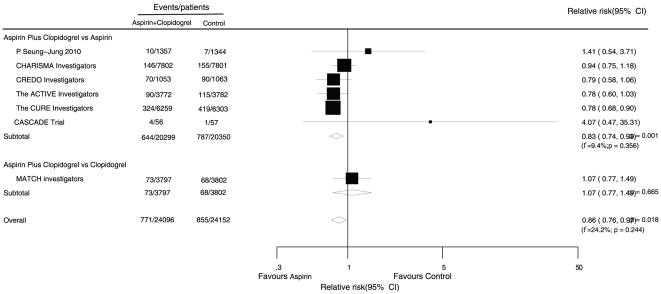
METHODOLOGY/PRINCIPAL FINDINGS: We systematically searched Medline, Embase, the Cochrane Central Register of Controlled Trials, reference lists of articles, and proceedings of major meetings to identify studies to fit our analysis. Eligible studies were randomized controlled trials assessing the effect of combined aspirin and clopidogrel therapy compared with aspirin or clopidogrel monotherapy. We identified 7 trials providing data with a total of 48248 patients. These studies reported 5134 major cardiovascular events, 1626 myocardial infarctions, 1927 strokes, and 1147 major bleeding events. Overall, the addition of aspirin to clopidogrel therapy as compared to single drug therapy resulted in a 9% RR reduction (95%CI, 2 to 17) in major cardiovascular events, 14% RR reduction (95%CI, 3 to 24) in myocardial infarction, 16% RR reduction (95%CI, 1 to 28) in stroke, and 62% RR increase (95%CI, 26 to 108) in major bleeding events. We also present the data as ARR to explore net value as the reduction in cardiovascular events. Overall, we observed that combined therapy yielded 1.06% decrease (95%CI, 0.23% to 1.99%) in major cardiovascular events and 1.23% increase (95%CI, 0.52% to 2.14%) in major bleeding events.
CONCLUSION/SIGNIFICANCE: Although the addition of aspirin to clopidogrel resulted in small relative reductions in major cardiovascular events, myocardial infarction, and stroke, it also resulted in a relative increase in major bleeding events. In absolute terms the benefits of combined therapy, a 1.06% reduction in major cardiovascular events, does not outweigh the harms, a 1.23% increase in major bleeding events.
阿司匹林和氯吡格雷单药治疗可有效预防血管疾病。然而,新的证据表明,联合应用阿司匹林和氯吡格雷治疗可预防心血管事件。因此,我们进行了全面的系统评价和荟萃分析,以评估联合应用阿司匹林和氯吡格雷治疗对主要心血管结局的益处和危害。
方法/主要发现:我们系统地检索了 Medline、Embase、Cochrane 对照试验中心注册库、文章的参考文献列表和主要会议的会议记录,以确定符合我们分析的研究。合格的研究是评估联合应用阿司匹林和氯吡格雷治疗与阿司匹林或氯吡格雷单药治疗效果的随机对照试验。我们确定了 7 项提供了 48248 例患者数据的研究。这些研究报告了 5134 例主要心血管事件、1626 例心肌梗死、1927 例卒中和 1147 例大出血事件。总的来说,与单药治疗相比,将阿司匹林加入氯吡格雷治疗可使主要心血管事件的 RR 降低 9%(95%CI,2 至 17),心肌梗死的 RR 降低 14%(95%CI,3 至 24),卒中的 RR 降低 16%(95%CI,1 至 28),大出血事件的 RR 增加 62%(95%CI,26 至 108)。我们还以 ARR 呈现数据,以探索净收益,即心血管事件减少的程度。总的来说,我们观察到联合治疗使主要心血管事件的发生率降低了 1.06%(95%CI,0.23%至 1.99%),大出血事件的发生率增加了 1.23%(95%CI,0.52%至 2.14%)。
结论/意义:尽管将阿司匹林加入氯吡格雷治疗可使主要心血管事件、心肌梗死和卒中等相对减少,但也会导致大出血事件的相对增加。就绝对而言,联合治疗的益处,即主要心血管事件减少 1.06%,并不能超过危害,即大出血事件增加 1.23%。