Stoolmiller Mike, Wills Thomas A, McClure Auden C, Tanski Susanne E, Worth Keilah A, Gerrard Meg, Sargent James D
College of Education, University of Oregon, Eugene, Oregon, USA.
BMJ Open. 2012 Feb 20;2(1):e000543. doi: 10.1136/bmjopen-2011-000543. Print 2012.
To compare media/marketing exposures and family factors in predicting adolescent alcohol use.
Cohort study.
Confidential telephone survey of adolescents in their homes.
Representative sample of 6522 US adolescents, aged 10-14 years at baseline and surveyed four times over 2 years.
Time to alcohol onset and progression to binge drinking were assessed with two survival models. Predictors were movie alcohol exposure (MAE), ownership of alcohol-branded merchandise and characteristics of the family (parental alcohol use, home availability of alcohol and parenting). Covariates included sociodemographics, peer drinking and personality factors.
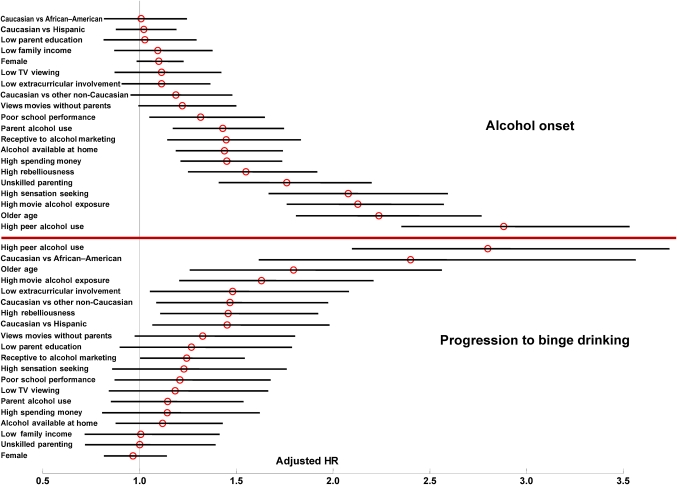
Over the study period, the prevalence of adolescent ever use and binge drinking increased from 11% to 25% and from 4% to 13%, respectively. At baseline, the median estimated MAE from a population of 532 movies was 4.5 h and 11% owned alcohol-branded merchandise at time 2. Parental alcohol use (greater than or equal to weekly) was reported by 23% and 29% of adolescents could obtain alcohol from home. Peer drinking, MAE, alcohol-branded merchandise, age and rebelliousness were associated with both alcohol onset and progression to binge drinking. The adjusted hazard ratios for alcohol onset and binge drinking transition for high versus low MAE exposure were 2.13 (95% CI 1.76 to 2.57) and 1.63 (1.20 to 2.21), respectively, and MAE accounted for 28% and 20% of these transitions, respectively. Characteristics of the family were associated with alcohol onset but not with progression.
The results suggest that family focused interventions would have a larger impact on alcohol onset while limiting media and marketing exposure could help prevent both onset and progression.
比较媒体/营销曝光及家庭因素在预测青少年饮酒行为方面的作用。
队列研究。
对青少年家中进行的保密电话调查。
6522名美国青少年的代表性样本,基线年龄为10 - 14岁,在2年时间内进行了4次调查。
采用两种生存模型评估首次饮酒时间及发展为狂饮的情况。预测因素包括电影中酒精曝光(MAE)、酒精品牌商品拥有情况及家庭特征(父母饮酒情况、家中酒精可获得性及养育方式)。协变量包括社会人口统计学因素、同伴饮酒情况及个性因素。
在研究期间,青少年饮酒和狂饮的患病率分别从11%增至25%以及从4%增至13%。基线时,532部电影的总体MAE中位数估计为4.5小时,11%的青少年在时间2时拥有酒精品牌商品。23%的青少年报告父母饮酒(每周至少一次),29%的青少年能从家中获取酒精。同伴饮酒、MAE、酒精品牌商品、年龄及叛逆性与首次饮酒及发展为狂饮均相关。高MAE暴露组与低MAE暴露组相比,首次饮酒和狂饮转变的调整后风险比分别为2.13(95%CI 1.76至2.57)和1.63(1.20至2.21),MAE分别占这些转变的28%和20%。家庭特征与首次饮酒相关,但与发展进程无关。
结果表明,以家庭为重点的干预措施对首次饮酒的影响更大,而限制媒体和营销曝光有助于预防饮酒行为的开始及发展。