Evolution, Ecology and Genetics, Research School of Biology, Australian National University, Canberra, Australia.
PLoS One. 2012;7(2):e30408. doi: 10.1371/journal.pone.0030408. Epub 2012 Feb 15.
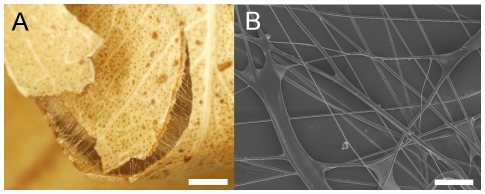
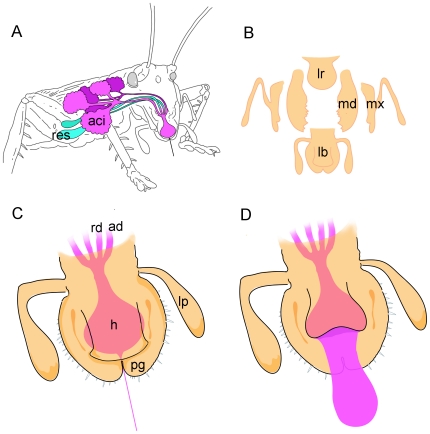
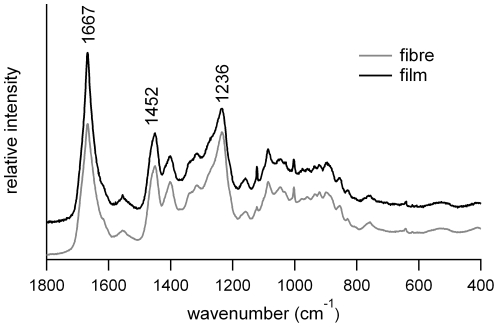
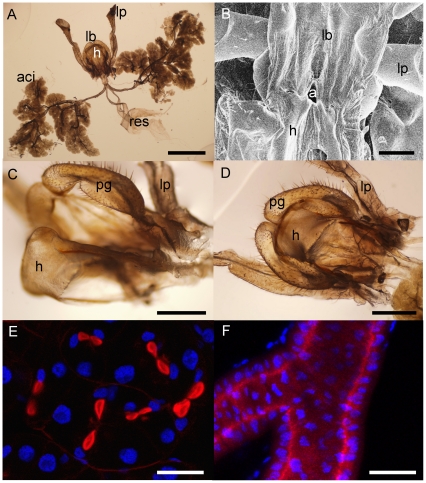
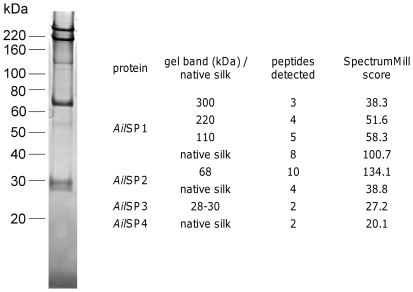
Raspy crickets (Orthoptera: Gryllacrididae) are unique among the orthopterans in producing silk, which is used to build shelters. This work studied the material composition and the fabrication of cricket silk for the first time. We examined silk-webs produced in captivity, which comprised cylindrical fibers and flat films. Spectra obtained from micro-Raman experiments indicated that the silk is composed of protein, primarily in a beta-sheet conformation, and that fibers and films are almost identical in terms of amino acid composition and secondary structure. The primary sequences of four silk proteins were identified through a mass spectrometry/cDNA library approach. The most abundant silk protein was large in size (300 and 220 kDa variants), rich in alanine, glycine and serine, and contained repetitive sequence motifs; these are features which are shared with several known beta-sheet forming silk proteins. Convergent evolution at the molecular level contrasts with development by crickets of a novel mechanism for silk fabrication. After secretion of cricket silk proteins by the labial glands they are fabricated into mature silk by the labium-hypopharynx, which is modified to allow the controlled formation of either fibers or films. Protein folding into beta-sheet structure during silk fabrication is not driven by shear forces, as is reported for other silks.
粗糙蟋蟀(直翅目:蟋蟀科)是在产生用于构建庇护所的丝方面与直翅目昆虫不同的昆虫。本研究首次研究了蟋蟀丝的材料组成和制造。我们检查了在圈养环境中产生的丝网,其由圆柱形纤维和平板膜组成。微拉曼实验获得的光谱表明,丝由蛋白质组成,主要为β-折叠构象,并且纤维和薄膜在氨基酸组成和二级结构方面几乎相同。通过质谱/ cDNA 文库方法鉴定了四种丝蛋白的一级序列。最丰富的丝蛋白尺寸较大(300 和 220 kDa 变体),富含丙氨酸、甘氨酸和丝氨酸,并含有重复序列基序;这些与几种已知的β-折叠形成丝蛋白共享。分子水平上的趋同进化与蟋蟀通过新颖的丝制造机制的发展形成对比。蟋蟀的唇部腺分泌丝蛋白后,由唇-咽头将其制成成熟的丝,该结构经过修饰,可允许控制纤维或薄膜的形成。与其他丝不同,丝制造过程中的蛋白折叠成β-折叠结构不是由剪切力驱动的。