Department of Physiology, Chungbuk National University School of Medicine, Korea.
Korean J Physiol Pharmacol. 2011 Dec;15(6):415-22. doi: 10.4196/kjpp.2011.15.6.415. Epub 2011 Dec 27.
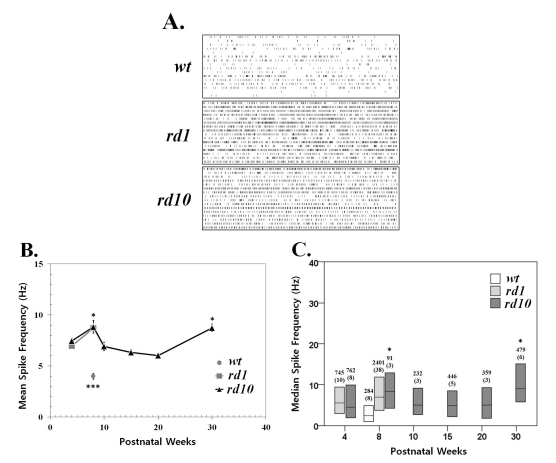
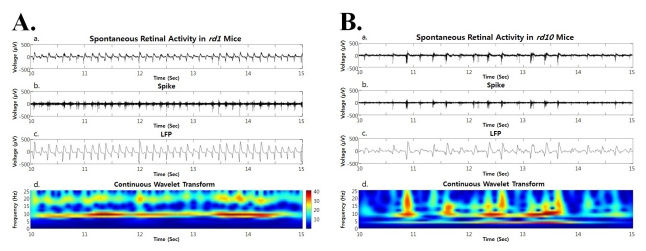
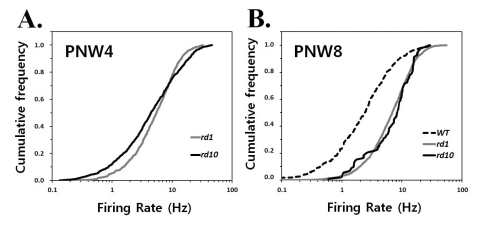
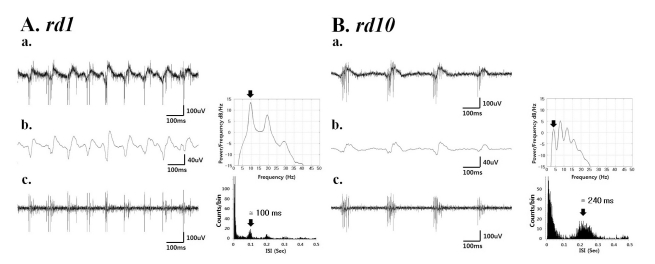
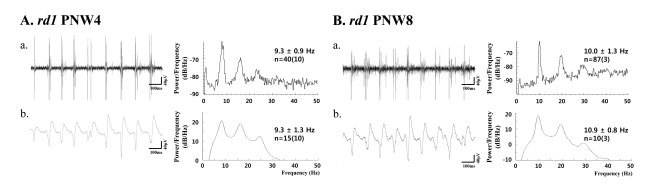
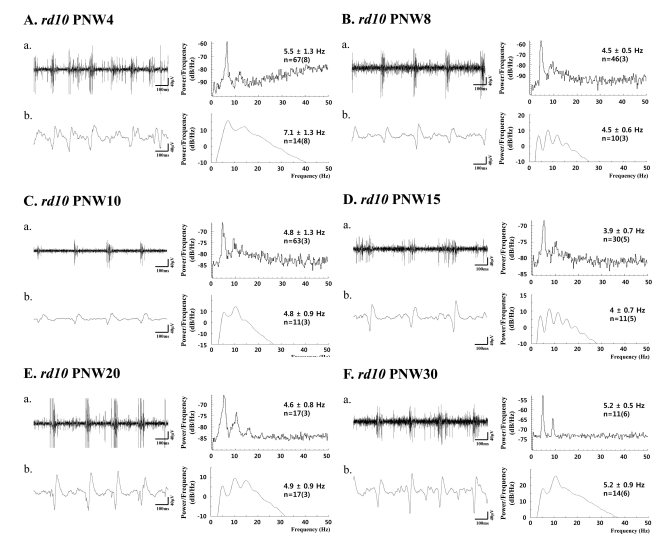
Previously, we reported that besides retinal ganglion cell (RGC) spike, there is ~ 10 Hz oscillatory rhythmic activity in local field potential (LFP) in retinal degeneration model, rd1 mice. The more recently identified rd10 mice have a later onset and slower rate of photoreceptor degeneration than the rd1 mice, providing more therapeutic potential. In this study, before adapting rd10 mice as a new animal model for our electrical stimulation study, we investigated electrical characteristics of rd10 mice. From the raw waveform of recording using 8×8 microelectrode array (MEA) from in vitro-whole mount retina, RGC spikes and LFP were isolated by using different filter setting. Fourier transform was performed for detection of frequency of bursting RGC spikes and oscillatory field potential (OFP). In rd1 mice, 10 Hz rhythmic burst of spontaneous RGC spikes is always phase-locked with the OFP and this phase-locking property is preserved regardless of postnatal ages. However, in rd10 mice, there is a strong phase-locking tendency between the spectral peak of bursting RGC spikes (5 Hz) and the first peak of OFP (5 Hz) across different age groups. But this phase-locking property is not robust as in rd1 retina, but maintains for a few seconds. Since rd1 and rd10 retina show phase-locking property at different frequency (10 Hz vs. ~5 Hz), we expect different response patterns to electrical stimulus between rd1 and rd10 retina. Therefore, to extract optimal stimulation parameters in rd10 retina, first we might define selection criteria for responding rd10 ganglion cells to electrical stimulus.
先前,我们报道在视网膜变性模型 rd1 小鼠的局部场电位(LFP)中除了神经节细胞(RGC)尖峰外,还有约 10 Hz 的振荡节律性活动。最近发现的 rd10 小鼠的感光细胞变性起始较晚,速度较慢,为治疗提供了更多的潜力。在这项研究中,我们在将 rd10 小鼠作为电刺激研究的新动物模型之前,研究了 rd10 小鼠的电特性。通过使用 8×8 微电极阵列(MEA)从体外全层视网膜记录的原始波形,使用不同的滤波设置来分离 RGC 尖峰和 LFP。进行傅立叶变换以检测爆发性 RGC 尖峰和振荡场电位(OFP)的频率。在 rd1 小鼠中,自发 RGC 尖峰的约 10 Hz 节律性爆发始终与 OFP 相位锁定,并且这种相位锁定特性不受出生后年龄的影响。然而,在 rd10 小鼠中,在不同年龄组中,爆发性 RGC 尖峰的频谱峰值(5 Hz)与 OFP 的第一峰值(5 Hz)之间存在强烈的相位锁定趋势。但是,这种相位锁定特性不如 rd1 视网膜那样稳健,只能维持几秒钟。由于 rd1 和 rd10 视网膜在不同频率(10 Hz 与5 Hz)下显示出相位锁定特性,我们预计 rd1 和 rd10 视网膜对电刺激的反应模式会有所不同。因此,为了在 rd10 视网膜中提取最佳刺激参数,我们首先可能为对电刺激有反应的 rd10 神经节细胞定义选择标准。