School of Nursing, Duke University, Durham, NC 27710, USA.
Implement Sci. 2012 Feb 29;7:11. doi: 10.1186/1748-5908-7-11.
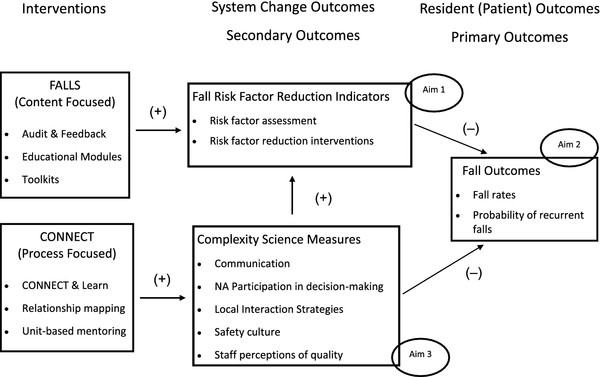
Quality improvement (QI) programs focused on mastery of content by individual staff members are the current standard to improve resident outcomes in nursing homes. However, complexity science suggests that learning is a social process that occurs within the context of relationships and interactions among individuals. Thus, QI programs will not result in optimal changes in staff behavior unless the context for social learning is present. Accordingly, we developed CONNECT, an intervention to foster systematic use of management practices, which we propose will enhance effectiveness of a nursing home Falls QI program by strengthening the staff-to-staff interactions necessary for clinical problem-solving about complex problems such as falls. The study aims are to compare the impact of the CONNECT intervention, plus a falls reduction QI intervention (CONNECT + FALLS), to the falls reduction QI intervention alone (FALLS), on fall-related process measures, fall rates, and staff interaction measures.
METHODS/DESIGN: Sixteen nursing homes will be randomized to one of two study arms, CONNECT + FALLS or FALLS alone. Subjects (staff and residents) are clustered within nursing homes because the intervention addresses social processes and thus must be delivered within the social context, rather than to individuals. Nursing homes randomized to CONNECT + FALLS will receive three months of CONNECT first, followed by three months of FALLS. Nursing homes randomized to FALLS alone receive three months of FALLs QI and are offered CONNECT after data collection is completed. Complexity science measures, which reflect staff perceptions of communication, safety climate, and care quality, will be collected from staff at baseline, three months after, and six months after baseline to evaluate immediate and sustained impacts. FALLS measures including quality indicators (process measures) and fall rates will be collected for the six months prior to baseline and the six months after the end of the intervention. Analysis will use a three-level mixed model.
By focusing on improving local interactions, CONNECT is expected to maximize staff's ability to implement content learned in a falls QI program and integrate it into knowledge and action. Our previous pilot work shows that CONNECT is feasible, acceptable and appropriate.
ClinicalTrials.gov: NCT00636675.
以个体员工掌握内容为重点的质量改进(QI)计划是提高养老院居民预后的当前标准。然而,复杂性科学表明,学习是一个发生在个体之间的关系和互动背景下的社会过程。因此,除非存在社会学习的背景,否则 QI 计划不会导致员工行为的最佳改变。因此,我们开发了 CONNECT,这是一种促进系统使用管理实践的干预措施,我们建议通过加强跌倒等复杂问题临床解决所需的员工之间的互动,增强护理院跌倒 QI 计划的有效性。该研究的目的是比较 CONNECT 干预(CONNECT + FALLS)与单独的跌倒减少 QI 干预(FALLS)对与跌倒相关的过程措施、跌倒率和员工互动措施的影响。
方法/设计:将 16 家养老院随机分为两个研究组之一,即 CONNECT + FALLS 或 FALLS 单独组。受试者(员工和居民)按养老院进行聚类,因为干预措施针对的是社会过程,因此必须在社会背景下进行,而不是针对个人。被随机分配到 CONNECT + FALLS 的养老院将首先接受三个月的 CONNECT,然后再接受三个月的 FALLS。单独接受 FALLS 的养老院将在基线后三个月接受三个月的 FALLS QI,并在数据收集完成后提供 CONNECT。复杂性科学措施将从基线、三个月后和六个月后收集员工的沟通、安全氛围和护理质量的员工感知,以评估即时和持续的影响。FALLS 措施包括质量指标(过程指标)和跌倒率,将在基线前六个月和干预结束后六个月收集。分析将使用三级混合模型。
通过专注于改善当地互动,CONNECT 有望最大限度地提高员工实施跌倒 QI 计划中学到的内容并将其融入知识和行动的能力。我们之前的试点工作表明,CONNECT 是可行的、可接受的和适当的。
ClinicalTrials.gov:NCT00636675。