Department of Tropical Pediatrics, Faculty of Tropical Medicine, Mahidol University, Bangkok, Thailand.
PLoS Negl Trop Dis. 2012;6(2):e1520. doi: 10.1371/journal.pntd.0001520. Epub 2012 Feb 28.
Dengue infection is one of the most important mosquito-borne diseases. More data regarding the disease burden and the prevalence of each clinical spectrum among symptomatic infections and the clinical manifestations are needed. This study aims to describe the incidence and clinical manifestations of symptomatic dengue infection in Thai children during 2006 through 2008.
This study is a school-based prospective open cohort study with a 9,448 person-year follow-up in children aged 3-14 years. Active surveillance for febrile illnesses was done in the studied subjects. Subjects who had febrile illness were asked to visit the study hospital for clinical and laboratory evaluation, treatment, and serological tests for dengue infection. The clinical data from medical records, diary cards, and data collection forms were collected and analyzed.
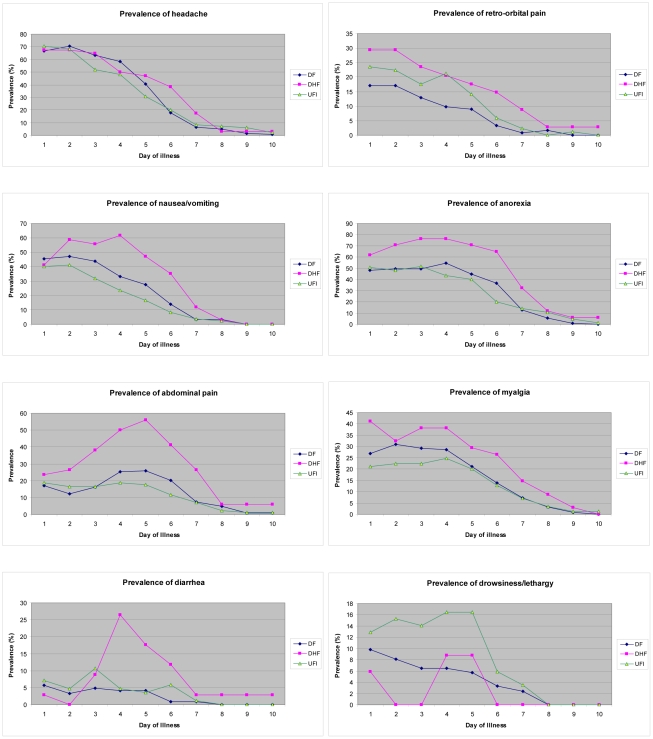
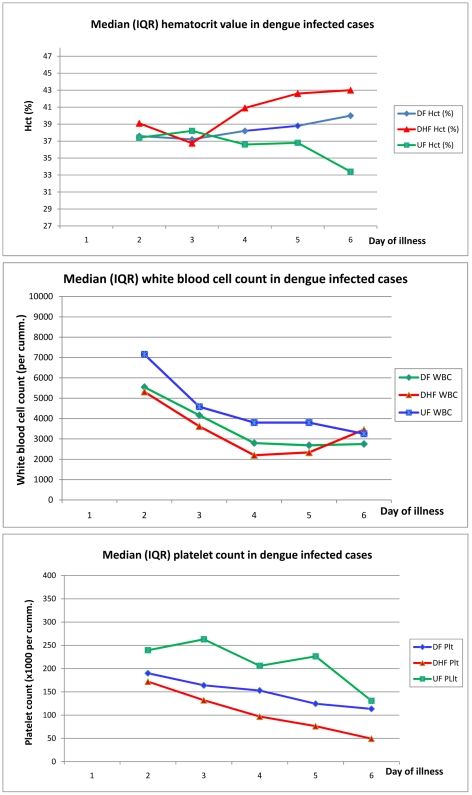
Dengue infections were the causes of 12.1% of febrile illnesses attending the hospital, including undifferentiated fever (UF) (49.8%), dengue fever (DF) (39.3%) and dengue hemorrhagic fever (DHF) (10.9%). Headache, anorexia, nausea/vomiting and myalgia were common symptoms occurring in more than half of the patients. The more severe dengue spectrum (i.e., DHF) had higher temperature, higher prevalence of nausea/vomiting, abdominal pain, rash, diarrhea, petechiae, hepatomegaly and lower platelet count. DHF cases also had significantly higher prevalence of anorexia, nausea/vomiting and abdominal pain during day 3-6 and diarrhea during day 4-6 of illness. The absence of nausea/vomiting, abdominal pain, diarrhea, petechiae, hepatomegaly and positive tourniquet test may predict non-DHF.
Among symptomatic dengue infection, UF is most common followed by DF and DHF. Some clinical manifestations may be useful to predict the more severe disease (i.e., DHF). This study presents additional information in the clinical spectra of symptomatic dengue infection.
登革热感染是最重要的蚊媒传染病之一。需要更多关于疾病负担以及各临床谱在有症状感染中的流行率以及临床表现的数据。本研究旨在描述 2006 年至 2008 年泰国儿童中症状性登革热感染的发病率和临床表现。
这是一项基于学校的前瞻性开放队列研究,对 3-14 岁儿童进行了 9448 人年的随访。对研究对象进行发热疾病的主动监测。有发热病的对象被要求到研究医院进行临床和实验室评估、治疗以及登革热感染的血清学检测。从病历、日记卡和数据收集表中收集和分析临床数据。
登革热感染是医院就诊发热病的 12.1%的病因,包括未分化发热(UF)(49.8%)、登革热(DF)(39.3%)和登革出血热(DHF)(10.9%)。头痛、食欲不振、恶心/呕吐和肌痛是超过一半患者常见的症状。更严重的登革热谱(即 DHF)体温更高,恶心/呕吐、腹痛、皮疹、腹泻、瘀点、肝肿大和血小板计数较低的发生率更高。DHF 病例在疾病第 3-6 天恶心/呕吐、腹痛和第 4-6 天腹泻的发生率也显著更高。无恶心/呕吐、腹痛、腹泻、瘀点、肝肿大和阳性止血带试验可能预测非 DHF。
在有症状的登革热感染中,UF 最常见,其次是 DF 和 DHF。一些临床表现可能有助于预测更严重的疾病(即 DHF)。本研究提供了有关症状性登革热感染的临床谱的更多信息。