Storfer-Isser A, Patel S R, Babineau D C, Redline S
Statistical Research Consultants, LLC, Perrysburg, OH, USA.
Pediatr Obes. 2012 Feb;7(1):53-64. doi: 10.1111/j.2047-6310.2011.00008.x. Epub 2011 Dec 1.
The objectives of this study were to (i) compare the strength of associations between sleep duration and body mass index (BMI) in middle childhood, and early and late adolescence; (ii) determine whether sleep duration in middle childhood predicts BMI in early or late adolescence; and (iii) examine the consistency of these associations by sex.
Subjects included 313 children/adolescents aged 8-19 participating in a longitudinal cohort study on sleep and health. Participants were assessed at three time points approximately 4 years apart: ages 8-11, 12-15 and 16-19. BMI z-score (BMIz) was calculated using age and sex normative data from the Centers for Disease Control. Sleep duration was reported by the parent (ages 8-15) or the adolescent (ages 16-19).
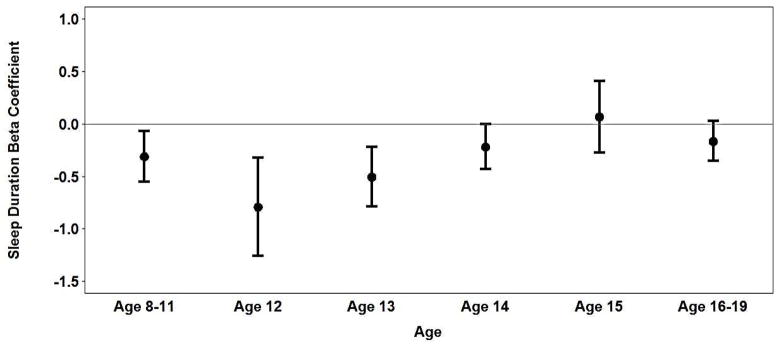
[corrected] Half of the participants were male and 79% were Caucasian. Sleep duration had a negative linear association with BMIz for boys but not girls, and the magnitude of this association decreased with age. Sleep duration at age 8-11 predicted BMIz in early and late adolescence for boys but not girls, and associations were largely attenuated after adjusting for BMIz at age 8-11. The strongest predictor of adolescent BMIz was BMIz at age 8-11 for both boys and girls.
We conclude that the association between sleep duration and BMIz varies by sex and age, with stronger associations in boys and in middle childhood compared with adolescence.
本研究的目的是:(i)比较童年中期、青春期早期和晚期睡眠时间与体重指数(BMI)之间关联的强度;(ii)确定童年中期的睡眠时间是否能预测青春期早期或晚期的BMI;以及(iii)按性别检验这些关联的一致性。
研究对象包括313名8 - 19岁的儿童/青少年,他们参与了一项关于睡眠与健康的纵向队列研究。在大约相隔4年的三个时间点对参与者进行评估:8 - 11岁、12 - 15岁和16 - 19岁。使用疾病控制中心的年龄和性别标准数据计算BMI z评分(BMIz)。睡眠时间由父母报告(8 - 15岁)或青少年自己报告(16 - 19岁)。
[校正后]一半的参与者为男性,79%为白种人。睡眠时间与男孩的BMIz呈负线性关联,与女孩则无此关联,且这种关联的强度随年龄降低。8 - 11岁时的睡眠时间可预测男孩青春期早期和晚期的BMIz,对女孩则无此作用,并且在对8 - 11岁时的BMIz进行校正后,这种关联大多减弱。对于男孩和女孩,青少年BMIz的最强预测因素均为8 - 11岁时的BMIz。
我们得出结论,睡眠时间与BMIz之间的关联因性别和年龄而异,与青春期相比,男孩及童年中期的关联更强。