The Cardiovascular Center, the First Hospital of Jilin University, Changchun, China.
J Cell Mol Med. 2012 Oct;16(10):2530-8. doi: 10.1111/j.1582-4934.2012.01569.x.
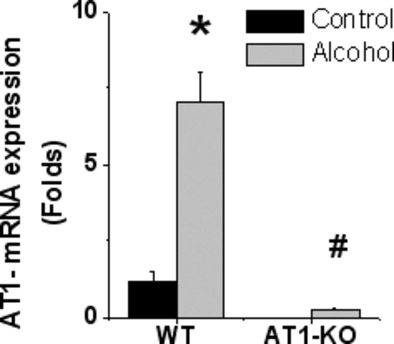
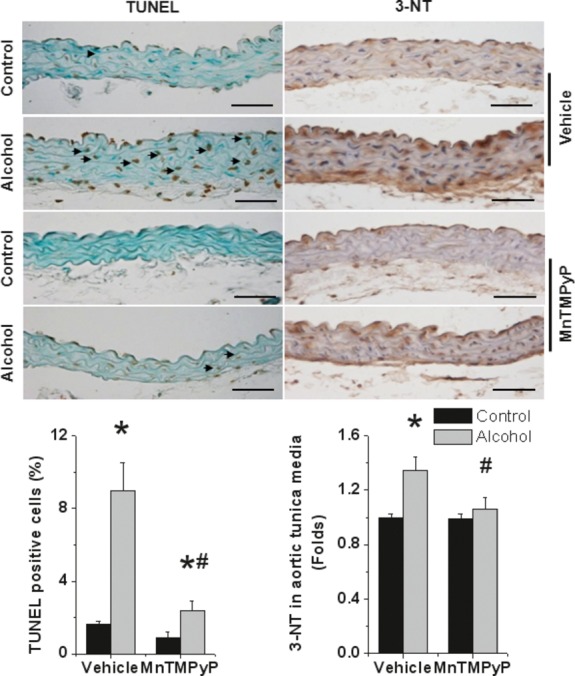
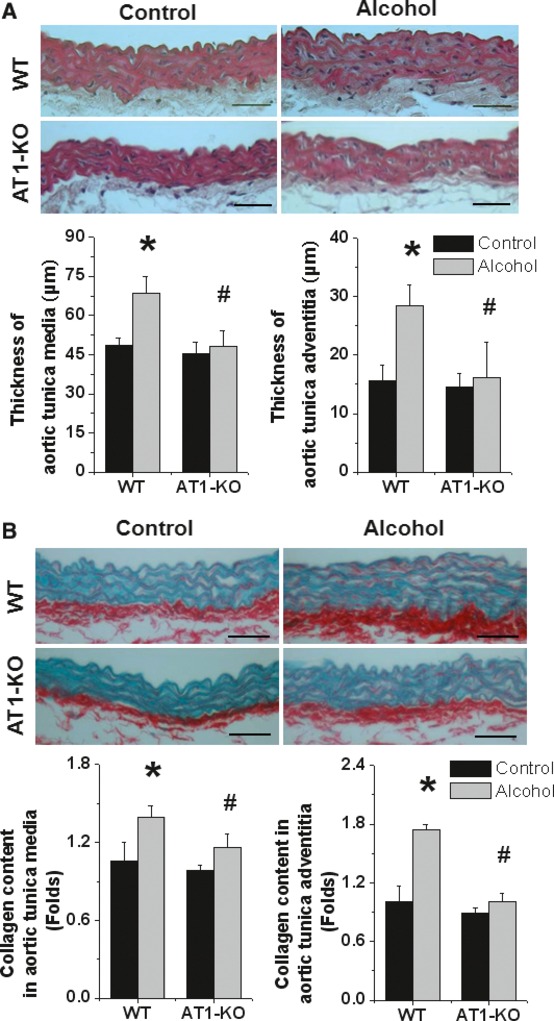
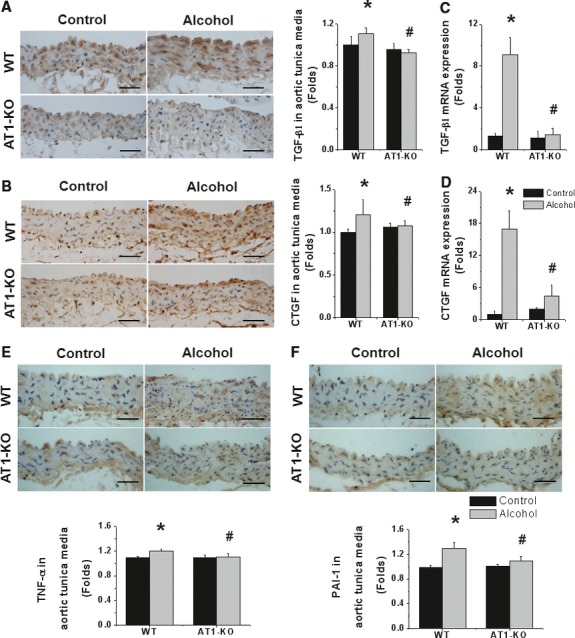
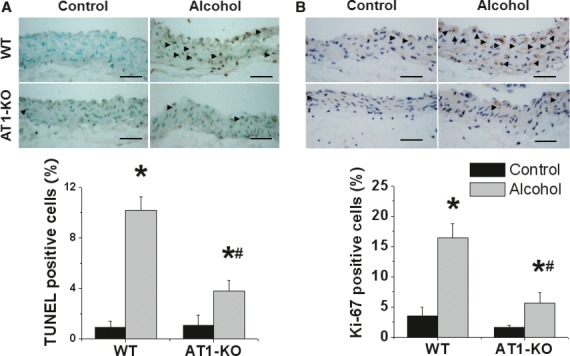
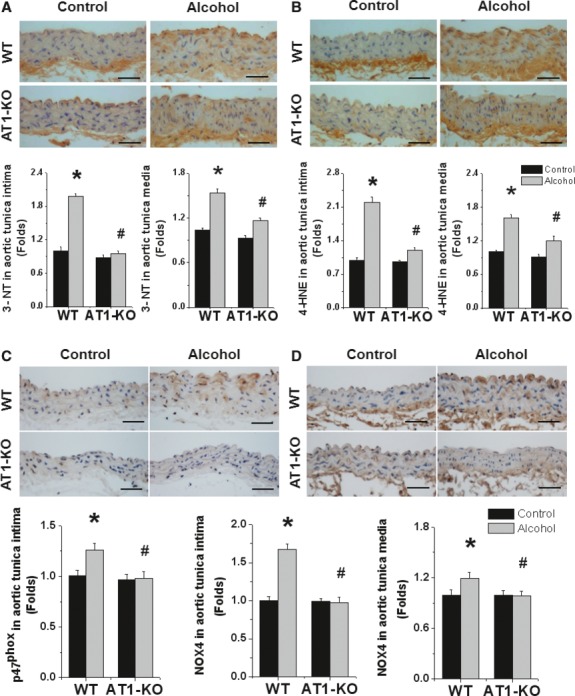
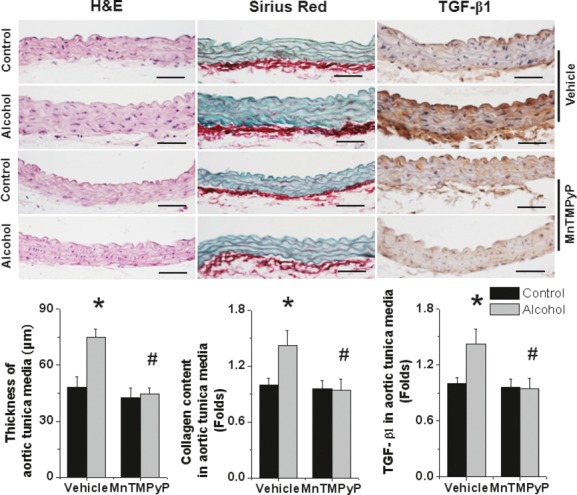
To investigate whether chronic alcohol consumption induces vascular injury via angiotensin II (Ang II) type 1 (AT1) receptor-dependent superoxide generation, male transgenic mice with knockout of AT1 gene (AT1-KO) and age-matched wild-type (WT) C57BL/6 mice were pair-fed a modified Lieber-DeCarli alcohol or isocaloric maltose dextrin control liquid diet for 2 months. Ethanol content (%, W/V) in the diet was 4.8 (34% of total calories) at initiation, and gradually increased up to 5.4 (38% of total calories). For some WT mice with and without alcohol treatment, superoxide dismutase mimetic (MnTMPyP) was given simultaneously by intraperitoneal injection at 5 mg/kg body weight daily for 2 months. At the end of studies, aortas were harvested for histopathological and immunohistochemical examination. Significant increases in the wall thickness and structural disarrangement of aorta were found in alcohol group, along with significant increases in aortic oxidative and/or nitrosative damage, expressions of NADPH oxidases (NOXs), inflammatory response, cell death and proliferation, and remodelling (fibrosis). However, these pathological changes were completely attenuated in alcohol-treated AT1-KO mice or in alcohol-treated WT mice that were also simultaneously treated with MnTMPyP for 2 months. These results suggest that chronic alcohol consumption may activate NOX via Ang II/AT1 receptor, to generate superoxide and associated peroxynitrite that in turn causes aortic nitrosative damage, inflammation, cell death and proliferation, and remodelling. Therefore, blocking Ang II/AT1 system or scavenging superoxide may become a potential preventive and/therapeutic approach to alcoholic vascular damage.
为了研究慢性酒精摄入是否通过血管紧张素 II(Ang II)1 型(AT1)受体依赖性超氧生成诱导血管损伤,我们将雄性 AT1 基因敲除(AT1-KO)转基因小鼠和年龄匹配的野生型(WT)C57BL/6 小鼠进行配对喂养,给予改良的 Lieber-DeCarli 酒精或等热量麦芽糊精对照液体饮食 2 个月。饮食中的乙醇含量(%,W/V)在开始时为 4.8(总热量的 34%),逐渐增加至 5.4(总热量的 38%)。对于一些给予和未给予酒精处理的 WT 小鼠,同时通过腹腔内注射给予超氧化物歧化酶模拟物(MnTMPyP),剂量为 5mg/kg 体重,每天 1 次,共 2 个月。在研究结束时,采集主动脉进行组织病理学和免疫组织化学检查。在酒精组中发现主动脉壁厚度和结构紊乱显著增加,同时主动脉氧化和/或硝化损伤、NADPH 氧化酶(NOXs)表达、炎症反应、细胞死亡和增殖以及重塑(纤维化)显著增加。然而,这些病理变化在酒精处理的 AT1-KO 小鼠或同时给予 MnTMPyP 2 个月的酒精处理的 WT 小鼠中完全减弱。这些结果表明,慢性酒精摄入可能通过 Ang II/AT1 受体激活 NOX,产生超氧和相关的过氧亚硝酸盐,进而导致主动脉硝化损伤、炎症、细胞死亡和增殖以及重塑。因此,阻断 Ang II/AT1 系统或清除超氧可能成为预防和/治疗酒精性血管损伤的潜在方法。