• 文献检索
  • 文档翻译
  • 深度研究
  • 学术资讯
  • Suppr Zotero 插件Zotero 插件
  • 邀请有礼
  • 套餐&价格
  • 历史记录
应用&插件
Suppr Zotero 插件Zotero 插件浏览器插件Mac 客户端Windows 客户端微信小程序
定价
高级版会员购买积分包购买API积分包
服务
文献检索文档翻译深度研究API 文档MCP 服务
关于我们
关于 Suppr公司介绍联系我们用户协议隐私条款
关注我们

Suppr 超能文献

核心技术专利:CN118964589B侵权必究
粤ICP备2023148730 号-1Suppr @ 2026

文献检索

告别复杂PubMed语法,用中文像聊天一样搜索,搜遍4000万医学文献。AI智能推荐,让科研检索更轻松。

立即免费搜索

文件翻译

保留排版,准确专业,支持PDF/Word/PPT等文件格式,支持 12+语言互译。

免费翻译文档

深度研究

AI帮你快速写综述,25分钟生成高质量综述,智能提取关键信息,辅助科研写作。

立即免费体验

日本川崎病的流行病学特征:2009-2010 年全国调查结果。

Epidemiologic features of Kawasaki disease in Japan: results of the 2009-2010 nationwide survey.

机构信息

Department of Public Health, Jichi Medical University, Shimotsuke, Tochigi, Japan.

出版信息

J Epidemiol. 2012;22(3):216-21. doi: 10.2188/jea.je20110126. Epub 2012 Mar 10.

DOI:10.2188/jea.je20110126
PMID:22447211
原文链接:https://pmc.ncbi.nlm.nih.gov/articles/PMC3798622/
Abstract

BACKGROUND

Although the number of patients and incidence rate of Kawasaki disease (KD) are increasing in Japan, the most recent epidemiologic features of KD are not known.

METHODS

The 21st nationwide survey of KD was conducted in 2011 and included patients treated for the disease in 2009 and 2010. Hospitals specializing in pediatrics, and hospitals with a total of 100 or more beds and a pediatric department, were asked to report all patients with KD during the 2 survey years.

RESULTS

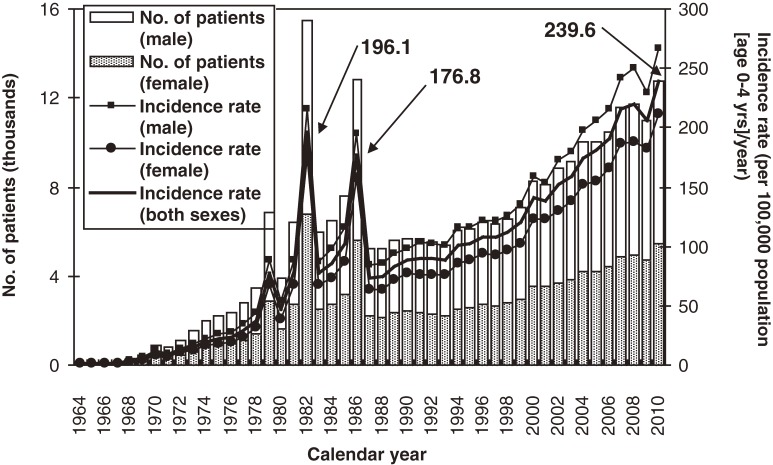
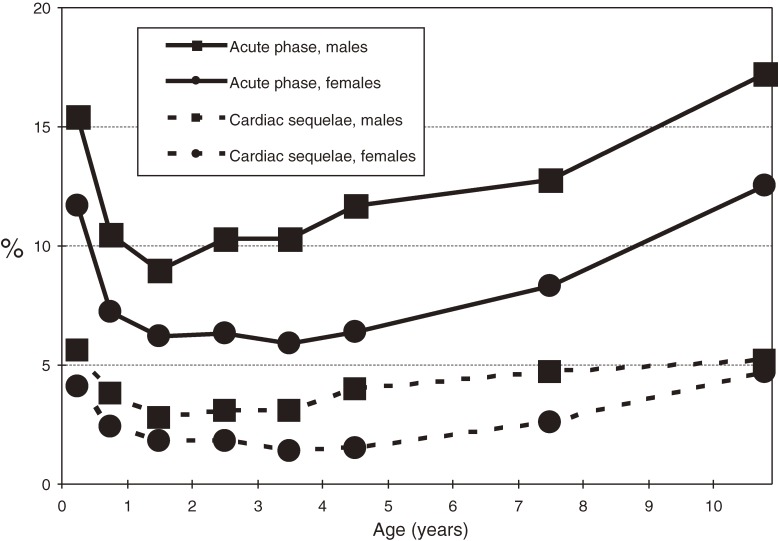
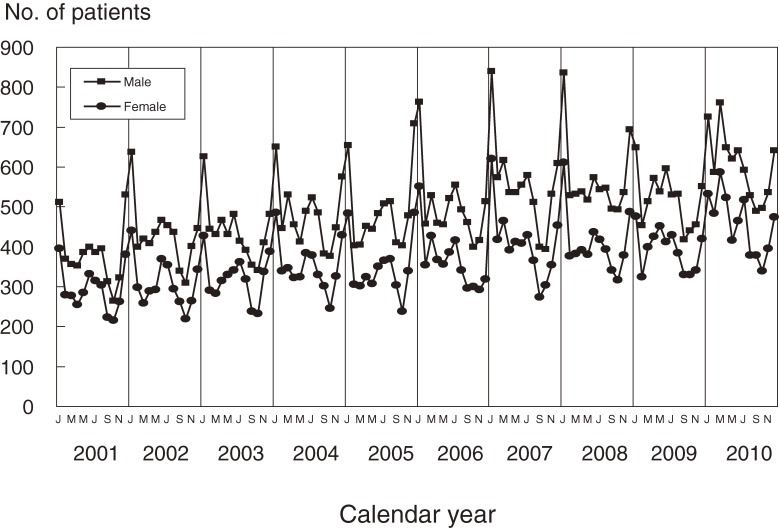
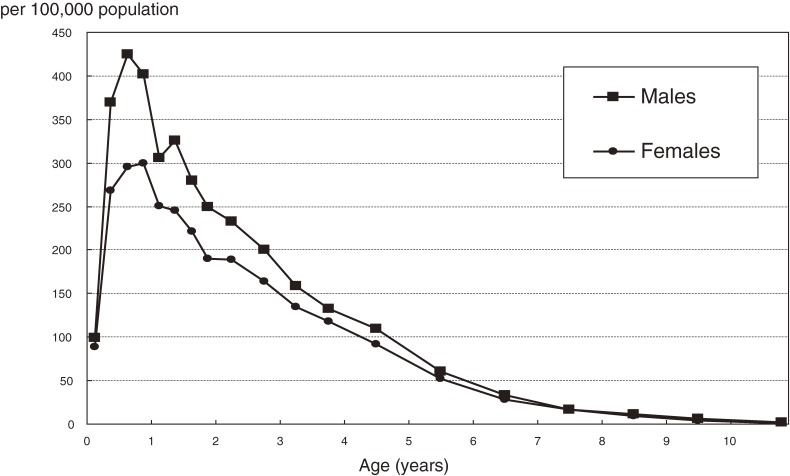
A total of 1445 departments and hospitals reported 23,730 KD patients (10,975 in 2009 and 12,755 in 2010): 13,515 boys and 10 215 girls. The annual incidence rates were 206.2 and 239.6 per 100,000 children aged 0 to 4 years in 2009 and 2010, respectively; the 2010 rate was the highest ever reported in Japan. Monthly number of patients peaked during winter to spring months; lower peaks were noted during summer months. However, the seasonal patterns in 2009 and 2010 differed from those of previous years. The age-specific incidence rate had a monomodal distribution, with a peak during the latter half of the year of birth. The prevalences of cardiac lesions during acute KD and cardiac sequelae were higher among infants and older age groups. Despite a decrease in prevalence, the proportion of patients with giant coronary aneurysms-the most severe sequela of KD-did not substantially decrease.

CONCLUSIONS

The incidence rate and number of patients with KD continue to increase in Japan.

摘要

背景

尽管日本川崎病(KD)的患者人数和发病率正在增加,但最近的 KD 流行病学特征尚不清楚。

方法

2011 年进行了第 21 次全国 KD 调查,包括 2009 年和 2010 年接受治疗的患者。专门的儿科医院和共有 100 张或更多床位和儿科病房的医院被要求报告在这 2 年调查期间所有 KD 患者。

结果

共有 1445 个科室和医院报告了 23730 例 KD 患者(2009 年 10975 例,2010 年 12755 例):男 13515 例,女 10215 例。2009 年和 2010 年,年龄在 0 至 4 岁的儿童中每 100,000 人发病率分别为 206.2 和 239.6;2010 年的发病率是日本有记录以来最高的。患者人数每月最高峰值出现在冬春季节;夏季月份的峰值较低。然而,2009 年和 2010 年的季节性模式与前几年不同。特定年龄的发病率呈单峰分布,在下半年出生的儿童中达到峰值。急性 KD 时心脏病变和心脏后遗症的患病率在婴儿和年龄较大的人群中较高。尽管患病率有所下降,但 KD 最严重后遗症巨大冠状动脉瘤的患者比例并未大幅下降。

结论

日本 KD 的发病率和患者人数持续增加。

https://cdn.ncbi.nlm.nih.gov/pmc/blobs/1f55/3798622/49d2721a41e8/je-22-216-g004.jpg
https://cdn.ncbi.nlm.nih.gov/pmc/blobs/1f55/3798622/1d6b55966691/je-22-216-g001.jpg
https://cdn.ncbi.nlm.nih.gov/pmc/blobs/1f55/3798622/61c6ac62a4fd/je-22-216-g002.jpg
https://cdn.ncbi.nlm.nih.gov/pmc/blobs/1f55/3798622/0504314acebc/je-22-216-g003.jpg
https://cdn.ncbi.nlm.nih.gov/pmc/blobs/1f55/3798622/49d2721a41e8/je-22-216-g004.jpg
https://cdn.ncbi.nlm.nih.gov/pmc/blobs/1f55/3798622/1d6b55966691/je-22-216-g001.jpg
https://cdn.ncbi.nlm.nih.gov/pmc/blobs/1f55/3798622/61c6ac62a4fd/je-22-216-g002.jpg
https://cdn.ncbi.nlm.nih.gov/pmc/blobs/1f55/3798622/0504314acebc/je-22-216-g003.jpg
https://cdn.ncbi.nlm.nih.gov/pmc/blobs/1f55/3798622/49d2721a41e8/je-22-216-g004.jpg

相似文献

1
Epidemiologic features of Kawasaki disease in Japan: results of the 2009-2010 nationwide survey.日本川崎病的流行病学特征:2009-2010 年全国调查结果。
J Epidemiol. 2012;22(3):216-21. doi: 10.2188/jea.je20110126. Epub 2012 Mar 10.
2
Epidemiologic features of Kawasaki disease in Japan: results of the 2007-2008 nationwide survey.日本川崎病的流行病学特征:2007-2008 年全国调查结果。
J Epidemiol. 2010;20(4):302-7. doi: 10.2188/jea.je20090180. Epub 2010 Jun 5.
3
Descriptive epidemiology of Kawasaki disease in Japan, 2011-2012: from the results of the 22nd nationwide survey.2011 - 2012年日本川崎病的描述性流行病学:来自第22次全国性调查结果
J Epidemiol. 2015;25(3):239-45. doi: 10.2188/jea.JE20140089. Epub 2015 Feb 7.
4
Epidemiologic pictures of Kawasaki disease in Japan: from the nationwide incidence survey in 1991 and 1992.日本川崎病的流行病学情况:基于1991年和1992年全国发病率调查
Pediatrics. 1995 Apr;95(4):475-9.
5
Incidence of Kawasaki disease in Japan: the nationwide surveys of 1999-2002.日本川崎病的发病率:1999 - 2002年全国性调查
Pediatr Int. 2006 Aug;48(4):356-61. doi: 10.1111/j.1442-200X.2006.02221.x.
6
Nationwide epidemiologic survey of Kawasaki disease in Japan, 2015-2016.2015 - 2016年日本川崎病全国流行病学调查
Pediatr Int. 2019 Apr;61(4):397-403. doi: 10.1111/ped.13809. Epub 2019 Apr 16.
7
Update of the epidemiology of Kawasaki disease in Japan--from the results of 1993-94 nationwide survey.日本川崎病流行病学的最新情况——基于1993 - 1994年全国调查结果
J Epidemiol. 1996 Sep;6(3):148-57. doi: 10.2188/jea.6.148.
8
Epidemiological observations of Kawasaki disease in Japan, 2013-2014.2013 - 2014年日本川崎病的流行病学观察
Pediatr Int. 2018 Jun;60(6):581-587. doi: 10.1111/ped.13544.
9
Epidemiologic features of Kawasaki disease in Japan: results from the nationwide survey in 2005-2006.日本川崎病的流行病学特征:2005 - 2006年全国性调查结果
J Epidemiol. 2008;18(4):167-72. doi: 10.2188/jea.je2008001. Epub 2008 Jul 18.
10
Epidemiology, Treatments, and Cardiac Complications in Patients with Kawasaki Disease: The Nationwide Survey in Japan, 2017-2018.2017-2018 年日本全国川崎病患者的流行病学、治疗方法和心脏并发症调查。
J Pediatr. 2020 Oct;225:23-29.e2. doi: 10.1016/j.jpeds.2020.05.034. Epub 2020 May 23.

引用本文的文献

1
Development of mild encephalitis with a reversible splenial lesion prior to the diagnosis of Kawasaki disease: a pediatric case report.川崎病诊断前出现伴有可逆性胼胝体病变的轻度脑炎:一例儿科病例报告
Front Pediatr. 2025 Aug 13;13:1652101. doi: 10.3389/fped.2025.1652101. eCollection 2025.
2
Indeterminate QuantiFERON Results in Pediatric Kawasaki Disease: Inflammatory Predictors and Diagnostic Implications.儿童川崎病中QuantiFERON检测结果不确定:炎症预测因素及诊断意义
Cureus. 2025 Jul 15;17(7):e88042. doi: 10.7759/cureus.88042. eCollection 2025 Jul.
3
Public Health Impact of Kawasaki Disease in India: Projections for 2030.

本文引用的文献

1
Kawasaki disease in dizygotic twins in Turkey.土耳其双卵双胞胎中的川崎病。
J Rheumatol. 2011 Aug;38(8):1812-3. doi: 10.3899/jrheum.110286.
2
The 2011 magnitude 9.0 Tohoku-Oki earthquake: mosaicking the megathrust from seconds to centuries.2011 年 9.0 级东日本大地震:从秒到世纪拼接巨型逆冲断层。
Science. 2011 Jun 17;332(6036):1421-5. doi: 10.1126/science.1206731. Epub 2011 May 19.
3
Acute coronary syndrome in adult patients with coronary artery lesions caused by Kawasaki disease: review of case reports.川崎病所致冠状动脉病变成年患者的急性冠状动脉综合征:病例报告综述
川崎病对印度公共卫生的影响:2030年预测
Indian Pediatr. 2025 Jun 17. doi: 10.1007/s13312-025-00121-6.
4
Role of long non-coding RNAs and circular RNAs in kawasaki disease: a systematic review.长链非编码RNA和环状RNA在川崎病中的作用:一项系统综述
Pediatr Rheumatol Online J. 2025 Jun 13;23(1):65. doi: 10.1186/s12969-025-01087-2.
5
Similarity of immune-associated markers in COVID-19 and Kawasaki disease: analyses from bioinformatics and machine learning.新型冠状病毒肺炎与川崎病中免疫相关标志物的相似性:来自生物信息学和机器学习的分析
BMC Pediatr. 2025 May 19;25(1):400. doi: 10.1186/s12887-025-05752-z.
6
Assessing large language models as assistive tools in medical consultations for Kawasaki disease.评估大型语言模型作为川崎病医疗咨询辅助工具的作用。
Front Artif Intell. 2025 Mar 31;8:1571503. doi: 10.3389/frai.2025.1571503. eCollection 2025.
7
Specific Morphology of Coronary Artery Aneurysms in Mainly White Patients With Kawasaki Disease: Initial Data From the Cardiac Catheterization in Kawasaki Disease Registry.川崎病患者中以白种人为主的冠状动脉瘤的特定形态:川崎病血管造影登记研究的初步数据。
J Am Heart Assoc. 2024 Nov 5;13(21):e034248. doi: 10.1161/JAHA.124.034248. Epub 2024 Oct 25.
8
Association between maternal heavy metal exposure and Kawasaki Disease, the Japan Environment and Children's Study (JECS).母亲重金属暴露与川崎病的关系:日本环境与儿童研究(JECS)
Sci Rep. 2024 Apr 30;14(1):9947. doi: 10.1038/s41598-024-60830-z.
9
A bibliometric analysis of Kawasaki disease from 1974 to 2022.1974年至2022年川崎病的文献计量分析。
Heliyon. 2024 Mar 4;10(5):e27290. doi: 10.1016/j.heliyon.2024.e27290. eCollection 2024 Mar 15.
10
Epidemiology of Kawasaki Disease, Its Incomplete Form and Outcomes: A Single-Institution Experience in the United Arab Emirates.川崎病及其不完全型的流行病学与转归:阿拉伯联合酋长国一家机构的经验
Cureus. 2023 Dec 30;15(12):e51320. doi: 10.7759/cureus.51320. eCollection 2023 Dec.
Cardiol Young. 2011 Feb;21(1):74-82. doi: 10.1017/S1047951110001502. Epub 2010 Nov 12.
4
Guidelines for diagnosis and management of cardiovascular sequelae in Kawasaki disease (JCS 2008)--digest version.川崎病心血管后遗症诊断与管理指南(2008年日本循环学会版)——摘要版
Circ J. 2010 Sep;74(9):1989-2020. doi: 10.1253/circj.cj-10-74-0903. Epub 2010 Aug 18.
5
Long-term prognosis of Kawasaki disease: increased cardiovascular risk?川崎病的长期预后:心血管风险增加?
Curr Opin Pediatr. 2010 Oct;22(5):587-92. doi: 10.1097/MOP.0b013e32833e12f7.
6
Plasma clusterin levels in predicting the occurrence of coronary artery lesions in patients with Kawasaki disease.血浆簇集素水平对川崎病患者冠状动脉病变发生的预测作用
Pediatr Cardiol. 2010 Nov;31(8):1151-6. doi: 10.1007/s00246-010-9769-7. Epub 2010 Aug 15.
7
The 2009 A (H1N1) influenza virus pandemic: A review.2009 年甲型 H1N1 流感大流行:综述。
Vaccine. 2010 Jul 12;28(31):4895-902. doi: 10.1016/j.vaccine.2010.05.031. Epub 2010 May 27.
8
Epidemiologic features of Kawasaki disease in Japan: results of the 2007-2008 nationwide survey.日本川崎病的流行病学特征:2007-2008 年全国调查结果。
J Epidemiol. 2010;20(4):302-7. doi: 10.2188/jea.je20090180. Epub 2010 Jun 5.
9
Intercostal artery aneurysm in a child with Kawasaki disease and known coronary artery aneurysms.一名患有川崎病且已知有冠状动脉瘤的儿童出现肋间动脉瘤。
J Vasc Interv Radiol. 2010 Jun;21(6):952-3. doi: 10.1016/j.jvir.2010.01.045.
10
Epidemiologic features of Kawasaki disease in Taiwan, 2003-2006.2003 - 2006年台湾川崎病的流行病学特征
Pediatrics. 2009 Mar;123(3):e401-5. doi: 10.1542/peds.2008-2187. Epub 2009 Feb 23.