Department of Veterinary Pathology, Key Laboratory of Zoonosis of Ministry of Agriculture, College of Veterinary Medicine, China Agricultural University, Beijing, China.
PLoS One. 2012;7(3):e33480. doi: 10.1371/journal.pone.0033480. Epub 2012 Mar 23.
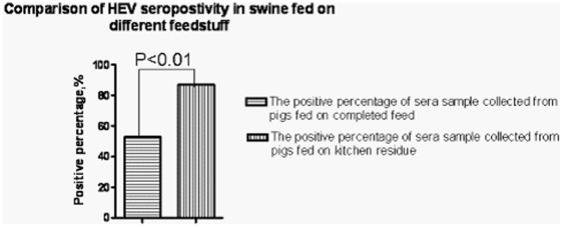
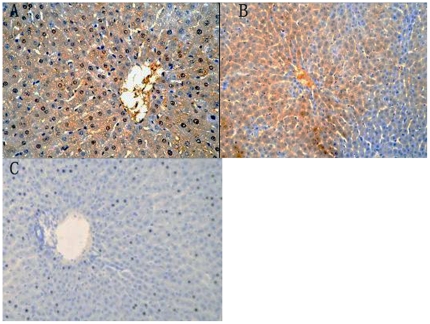
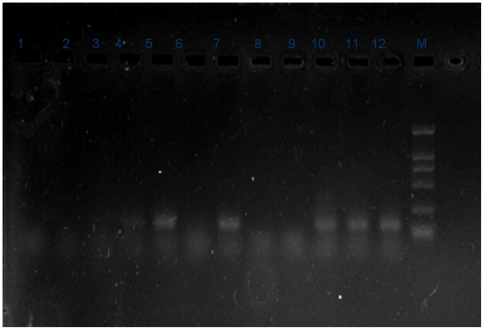
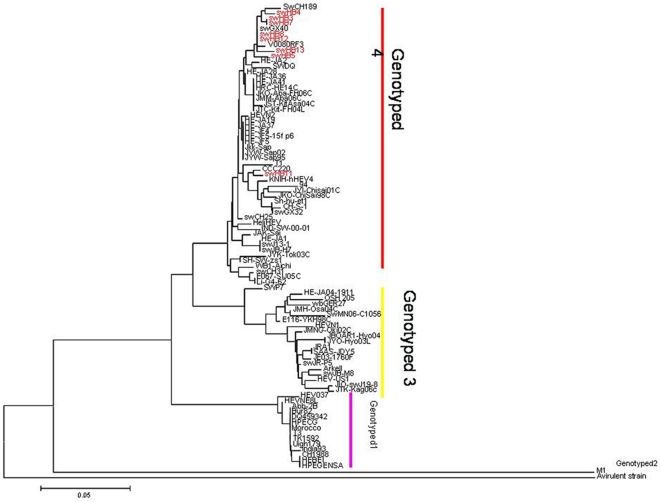
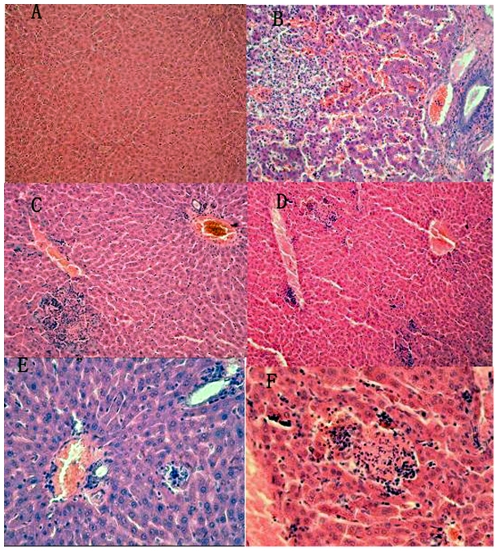
The aim of this study was to investigate the prevalence of swine hepatitis E virus (HEV) in pigs fed different feedstuffs (kitchen residue or mixed feeds) and genetic identification of HEV isolated in Hebei province, China. Serum and fecal samples were collected from adult swine. Anti-HEV antibody was evaluated by double sandwich antigen enzyme immunoassay. HEV RNA was extracted from fecal samples and amplified by nested RT-PCR. The reaction products were sequenced, and the sequence analyzed. Virus-like particles were distinguishable by negative staining in the electron microscope. Histopathological observation and immunohistochemical localization were used in the animal models. Overall, the anti-HEV positive percentage of serum samples from pigs fed on kitchen residue was 87.10% (27/31), and 53.06% (130/245) from pigs fed on complete feed. The HEV RNA positivity rate of fecal samples from pigs fed on kitchen residue was 61.54% (8/13), but zero for pigs fed on complete feed. Sequence analysis of these eight samples and comparison with the published sequence showed that there were eight groups that belonged to genotype 4 d and the nucleotide identity was 95.6-99.3%. swHE11 is most closely related to strain CCC220, and the other seven HEV isolates were most closely related to strains swGX40, SwCH189 and V0008ORF3, which are isolates from human and pigs. Histopathological observation showed that there was liver damage in the experimental group, and immunohistochemistry indicated that the HEV antigens were strongly positive at 7 days after infection. The results demonstrated that the prevalence of HEV in pigs fed on kitchen residue was higher than in those fed on complete feed (P<0.05).
本研究旨在调查中国河北省不同饲料(厨余或混合饲料)喂养的猪中猪戊型肝炎病毒(HEV)的流行情况,并对分离的 HEV 进行基因鉴定。采集成年猪的血清和粪便样本。采用双夹心抗原酶免疫法检测抗-HEV 抗体。从粪便样本中提取 HEV RNA,并用巢式 RT-PCR 扩增。对反应产物进行测序,并对序列进行分析。电镜下可通过负染观察到病毒样颗粒。在动物模型中,进行组织病理学观察和免疫组织化学定位。总体而言,厨余喂养猪的血清样本抗-HEV 阳性率为 87.10%(27/31),全价饲料喂养猪的阳性率为 53.06%(130/245)。厨余喂养猪的粪便样本 HEV RNA 阳性率为 61.54%(8/13),而全价饲料喂养猪则为零。对这 8 个样本的序列分析并与已发表的序列进行比较表明,有 8 个样本属于基因型 4d,核苷酸同一性为 95.6-99.3%。swHE11 与 CCC220 株最为密切相关,其余 7 株 HEV 分离株与从人和猪分离的 swGX40、SwCH189 和 V0008ORF3 株最为密切相关。组织病理学观察显示实验组有肝损伤,免疫组化显示感染后 7 天 HEV 抗原强阳性。结果表明,厨余喂养猪的 HEV 流行率高于全价饲料喂养猪(P<0.05)。