Department of Psychology, University at Buffalo, State University of New York, Park 206, Buffalo, NY 14260, USA.
Psychopharmacology (Berl). 2012 Sep;223(1):107-16. doi: 10.1007/s00213-012-2698-9. Epub 2012 Apr 4.
Varenicline is believed to work, in part, by reducing craving responses to smoking cues and by reducing general levels of craving; however, these hypotheses have never been evaluated with craving assessed in the natural environments of treatment-seeking smokers.
Ecological momentary assessment procedures were used to assess the impact of varenicline on cue-specific and general craving in treatment-seeking smokers prior to quitting.
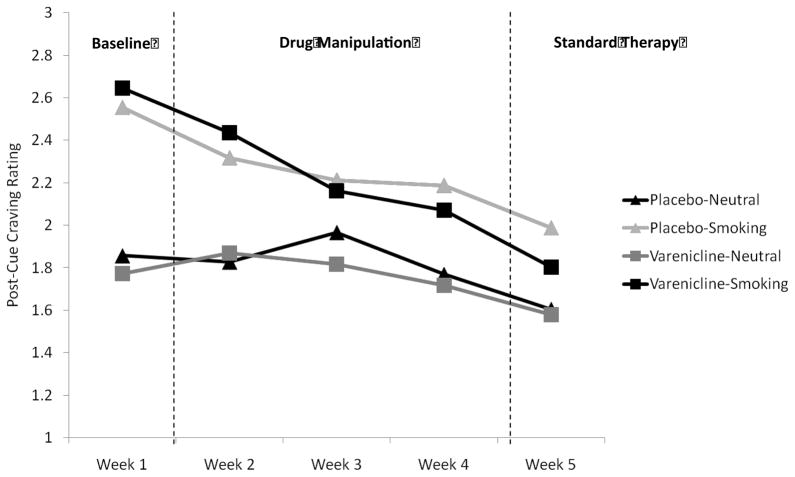
For 5 weeks prior to quitting, 60 smokers carried personal digital assistants that assessed their response to smoking or neutral cues. During week 1 (baseline), participants did not receive medication; during weeks 2-4 (drug manipulation), participants were randomized to receive varenicline or placebo; during week 5 (standard therapy), all participants received varenicline. Craving was assessed before each cue; cue-specific craving and attention to cue were assessed after each cue.
During all phases, smoking cues elicited greater craving than neutral cues; the magnitude of this effect declined after the first week. General craving declined across each phase of the study. Relative to the placebo condition, varenicline was associated with a greater decline in general craving over the drug manipulation phase. Varenicline did not significantly attenuate cue-specific craving during any phase of the study.
Smoking cues delivered in the natural environment elicited strong craving responses in treatment-seeking smokers, but cue-specific craving was not affected by varenicline administered prior to the quit attempt. These findings suggest that the clinical efficacy of varenicline is not mediated by changes in cue-specific craving during the pre-quit period of treatment-seeking smokers.
维拉唑酮被认为通过减少对吸烟线索的渴望反应和减少一般的渴望水平起作用;然而,这些假设从未在寻求治疗的吸烟者的治疗环境中评估过渴望。
使用生态瞬时评估程序来评估在寻求治疗的吸烟者戒烟前,维拉唑酮对吸烟线索特异性和一般渴望的影响。
在戒烟前的 5 周内,60 名吸烟者携带个人数字助理,评估他们对吸烟或中性线索的反应。在第 1 周(基线),参与者未接受药物治疗;在第 2-4 周(药物处理),参与者被随机分配接受维拉唑酮或安慰剂;在第 5 周(标准治疗),所有参与者接受维拉唑酮。在每次线索前评估渴望;在每次线索后评估线索特异性渴望和对线索的注意力。
在所有阶段,吸烟线索引起的渴望都大于中性线索;这种效应的大小在第一周后下降。一般渴望在研究的每个阶段都下降。与安慰剂条件相比,维拉唑酮与药物处理阶段的一般渴望下降幅度更大。在研究的任何阶段,维拉唑酮都没有显著减轻线索特异性渴望。
在自然环境中提供的吸烟线索在寻求治疗的吸烟者中引起强烈的渴望反应,但在戒烟前的治疗期间,维拉唑酮对线索特异性渴望没有影响。这些发现表明,在寻求治疗的吸烟者的戒烟前治疗期间,维拉唑酮的临床疗效不是通过改变线索特异性渴望来介导的。