Department of Microbiology, Yong Loo Lin School of Medicine, National University of Singapore, Singapore.
PLoS Biol. 2012;10(3):e1001290. doi: 10.1371/journal.pbio.1001290. Epub 2012 Mar 27.
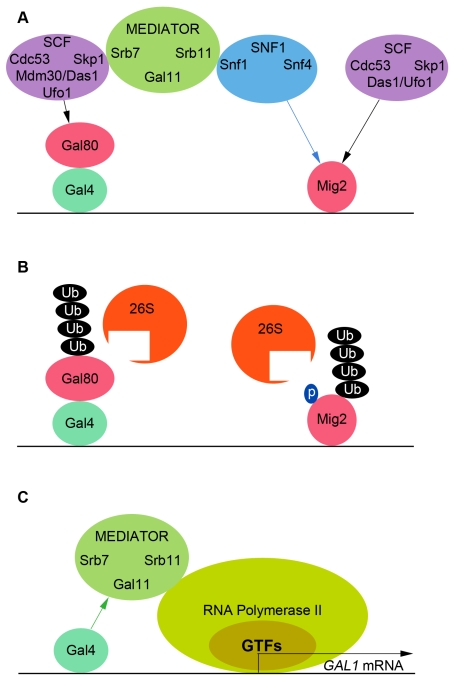
The proteasome inhibitor MG132 had been shown to prevent galactose induction of the S. cerevisiae GAL1 gene, demonstrating that ubiquitin proteasome-dependent degradation of transcription factors plays an important role in the regulation of gene expression. The deletion of the gene encoding the F-box protein Mdm30 had been reported to stabilize the transcriptional activator Gal4 under inducing conditions and to lead to defects in galactose utilization, suggesting that recycling of Gal4 is required for its function. Subsequently, however, it was argued that Gal4 remains stably bound to the enhancer under inducing conditions, suggesting that proteolytic turnover of Gal4 might not be required for its function. We have performed an alanine-scanning mutagenesis of ubiquitin and isolated a galactose utilization-defective ubiquitin mutant. We have used it for an unbiased suppressor screen and identified the inhibitor Gal80 as a suppressor of the transcriptional defects of the ubiquitin mutant, indicating that the protein degradation of the inhibitor Gal80, and not of the activator Gal4, is required for galactose induction of the GAL genes. We also show that in the absence of Gal80, Mdm30 is not required for Gal4 function, strongly supporting this hypothesis. Furthermore, we have found that Mediator controls the galactose-induced protein degradation of Gal80, which places Mediator genetically upstream of the activator Gal4. Mediator had originally been isolated by its ability to respond to transcriptional activators, and here we have discovered a leading role for Mediator in the process of transcription. The protein kinase Snf1 senses the inducing conditions and transduces the signal to Mediator, which initiates the degradation of the inhibitor Gal80 with the help of the E3 ubiquitin ligase SCF(Mdm30). The ability of Mediator to control the protein degradation of transcriptional inhibitors indicates that Mediator is actually able to direct its own recruitment to gene promoters.
蛋白酶体抑制剂 MG132 已被证明可阻止半乳糖诱导酿酒酵母 GAL1 基因的表达,这表明泛素蛋白酶体依赖性的转录因子降解在基因表达调控中起着重要作用。已有报道称,编码 F-box 蛋白 Mdm30 的基因缺失会导致诱导条件下转录激活因子 Gal4 的稳定性增加,并导致半乳糖利用缺陷,这表明 Gal4 的循环回收对于其功能是必需的。然而,随后有人认为 Gal4 在诱导条件下仍稳定结合于增强子,这表明 Gal4 的蛋白水解周转可能不是其功能所必需的。我们对泛素进行了丙氨酸扫描诱变,并分离出一种半乳糖利用缺陷型泛素突变体。我们用它进行了无偏抑制子筛选,并鉴定出抑制剂 Gal80 是泛素突变体转录缺陷的抑制子,这表明抑制剂 Gal80 的蛋白降解,而不是激活子 Gal4 的蛋白降解,是半乳糖诱导 GAL 基因表达所必需的。我们还表明,在没有 Gal80 的情况下,Mdm30 对于 Gal4 功能不是必需的,这强烈支持了这一假说。此外,我们发现中介体控制 Gal80 的半乳糖诱导蛋白降解,这将中介体在转录激活因子的作用中置于 Gal4 的上游。中介体最初是因其能够响应转录激活因子而被分离出来的,而在这里,我们发现中介体在转录过程中发挥了主导作用。蛋白激酶 Snf1 感知诱导条件,并将信号转导至中介体,后者在 E3 泛素连接酶 SCF(Mdm30)的帮助下启动抑制剂 Gal80 的降解。中介体控制转录抑制剂的蛋白降解的能力表明,中介体实际上能够直接指导其自身被募集到基因启动子上。