Leboeuf-Yde Charlotte, Fejer René, Nielsen Jan, Kyvik Kirsten O, Hartvigsen Jan
The Research Department, the Spine Centre of Southern Denmark, Hospital Lillebaelt, Middelfart, Denmark.
Chiropr Man Therap. 2012 Apr 5;20:11. doi: 10.1186/2045-709X-20-11.
Studies of back pain are typically based on the assumption that symptoms from different parts of the spine are distinctive entities. Recently, however, the assumption that back pain is a site-specific disorder has been challenged, suggesting that localized back pain should be seen as part of a general musculoskeletal syndrome.
To describe and compare the patterns of reporting of pain and consequences of pain in the three spinal regions.
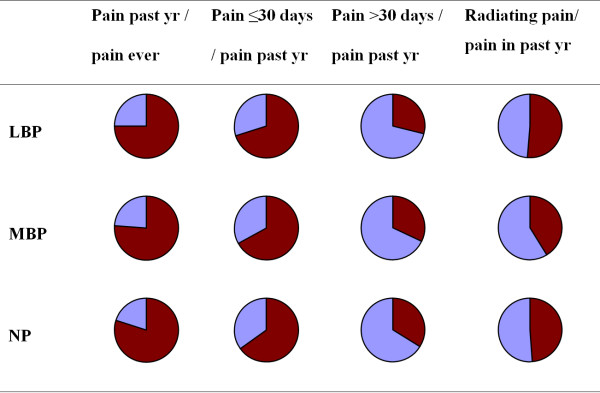
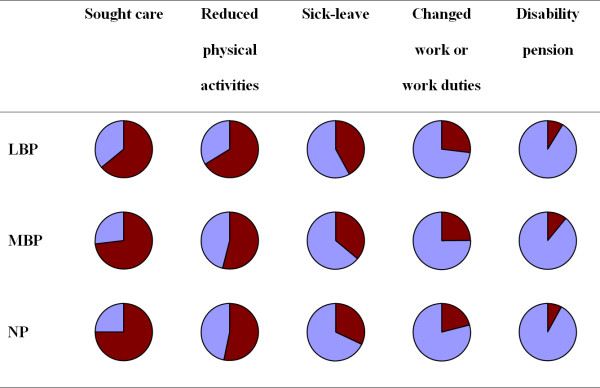
In all, 34,902 (74%) twin individuals representative of the general Danish population, aged 20 to 71, participated in a cross-sectional nation-wide survey. Identical questions from the Standardised Nordic Questionnaire for each of the three spinal regions were used for lumbar, mid-back and neck pain respectively: Pain past year, pain ever, radiating pain, and consequences of back pain (care-seeking, reduced physical activities, sick-leave, change of work/work duties and disability pension). The relative prevalence estimates of these variables were compared for the three spinal regions.
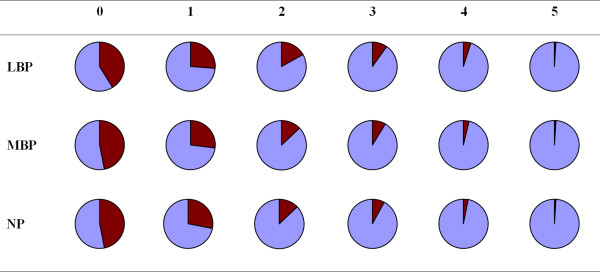
The relative proportions of individuals with pain ever, who also reported to have had pain in the past year varied between 75% and 80%, for the three spinal regions. The proportions of individuals with pain in the past year and for various pain durations were also very similar. Regardless if pain was reported in the lumbar, thoracic or cervical regions, the proportions of individuals reporting radiating pain were equally large. The relative number of consequences was the same across the spinal regions, as were the relative proportions of each these consequences. However, low back pain resulted more often in some kind of consequence compared to the consequences of pain in the neck and mid back.
Back pain and its consequences share many characteristics and may, at least in a general population, be regarded as the same condition regardless of where the pain happens to manifest itself. However, because some exceptions were noted for the lumbar spine, separate entities for a smaller group of individuals with back pain cannot be ruled out.
背痛研究通常基于这样一种假设,即来自脊柱不同部位的症状是不同的实体。然而,最近,背痛是一种部位特异性疾病的假设受到了挑战,这表明局部背痛应被视为一般肌肉骨骼综合征的一部分。
描述和比较三个脊柱区域疼痛报告模式及疼痛后果。
共有34902名(74%)年龄在20至71岁、代表丹麦普通人群的双胞胎个体参与了一项全国性横断面调查。分别对三个脊柱区域使用来自标准化北欧问卷的相同问题来询问腰背痛、中背痛和颈痛:过去一年的疼痛、曾经的疼痛、放射性疼痛以及背痛的后果(寻求医疗、身体活动减少、病假、工作/工作职责改变和残疾抚恤金)。比较这三个脊柱区域这些变量的相对患病率估计值。
在这三个脊柱区域中,曾经有过疼痛且报告过去一年也有疼痛的个体相对比例在75%至80%之间。过去一年有疼痛以及不同疼痛持续时间的个体比例也非常相似。无论疼痛报告在腰椎、胸椎还是颈椎区域,报告放射性疼痛的个体比例都一样大。脊柱各区域后果的相对数量相同,每种后果的相对比例也相同。然而,与颈部和中背部疼痛的后果相比,下背痛导致某种后果的情况更常见。
背痛及其后果有许多共同特征,至少在普通人群中,无论疼痛出现在何处,都可被视为同一种情况。然而,由于腰椎存在一些例外情况,不能排除一小部分背痛个体存在不同情况的可能性。