Carrasco-Gallardo Carlos, Guzmán Leonardo, Maccioni Ricardo B
Laboratory of Cellular and Molecular Neurosciences, International Center for Biomedicine (ICC) and University of Chile, Millennium Building, Las Encinas 3370, Ñuñoa, 780023 Santiago, Chile.
Int J Alzheimers Dis. 2012;2012:674142. doi: 10.1155/2012/674142. Epub 2012 Feb 23.
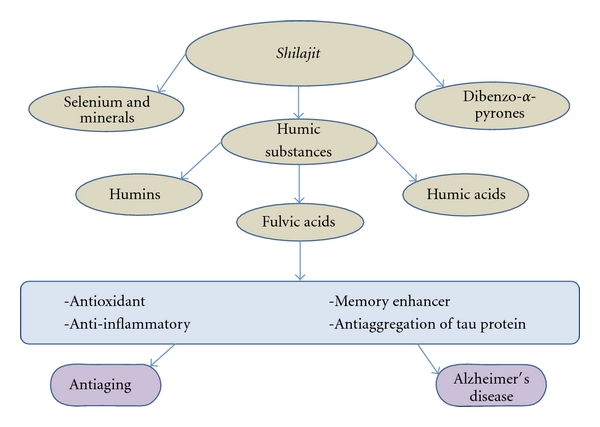
Shilajit is a natural substance found mainly in the Himalayas, formed for centuries by the gradual decomposition of certain plants by the action of microorganisms. It is a potent and very safe dietary supplement, restoring the energetic balance and potentially able to prevent several diseases. Recent investigations point to an interesting medical application toward the control of cognitive disorders associated with aging, and cognitive stimulation. Thus, fulvic acid, the main active principle, blocks tau self-aggregation, opening an avenue toward the study of Alzheimer's therapy. In essence, this is a nutraceutical product of demonstrated benefits for human health. Considering the expected impact of shilajit usage in the medical field, especially in the neurological sciences, more investigations at the basic biological level as well as clinical trials are necessary, in order to understand how organic molecules of shilajit and particularly fulvic acid, one of the active principles, and oligoelements act at both the molecular and cellular levels and in the whole organism.
希拉季特是一种主要在喜马拉雅山脉发现的天然物质,它是由某些植物在微生物作用下逐渐分解形成的,历经了数百年时间。它是一种强效且非常安全的膳食补充剂,能恢复能量平衡,还可能预防多种疾病。最近的研究表明其在控制与衰老相关的认知障碍及认知刺激方面有有趣的医学应用。因此,其主要活性成分富里酸可阻止tau蛋白自我聚集,为阿尔茨海默病治疗的研究开辟了一条途径。从本质上讲,这是一种已证明对人类健康有益的营养保健品。鉴于希拉季特在医学领域,尤其是神经科学领域的预期影响,有必要在基础生物学层面开展更多研究以及进行临床试验,以了解希拉季特的有机分子,特别是其中一种活性成分富里酸和微量元素在分子、细胞水平以及整个生物体中的作用方式。