Department of Environmental Health, Harvard School of Public Health, Boston, Massachusetts 02115, USA.
Environ Health Perspect. 2012 Jul;120(7):978-83. doi: 10.1289/ehp.1104307. Epub 2012 Apr 6.
Bisphenol A (BPA) is a synthetic chemical widely used in the production of polycarbonate plastic and epoxy resins found in numerous consumer products. In experimental animals, BPA increases embryo implantation failure and reduces litter size.
We evaluated the association of urinary BPA concentrations with implantation failure among women undergoing in vitro fertilization (IVF).
We used online solid phase extraction-high performance liquid chromatography-isotope dilution tandem mass spectrometry to measure urinary BPA concentrations in 137 women in a prospective cohort study among women undergoing IVF at the Massachusetts General Hospital Fertility Center in Boston, Massachusetts. We used logistic regression to evaluate the association of cycle-specific urinary BPA concentrations with implantation failure, accounting for correlation among multiple IVF cycles in the same woman using generalized estimating equations. Implantation failure was defined as a negative serum β-human chorionic gonadotropin test (β-hCG < 6 IU/L) 17 days after egg retrieval.
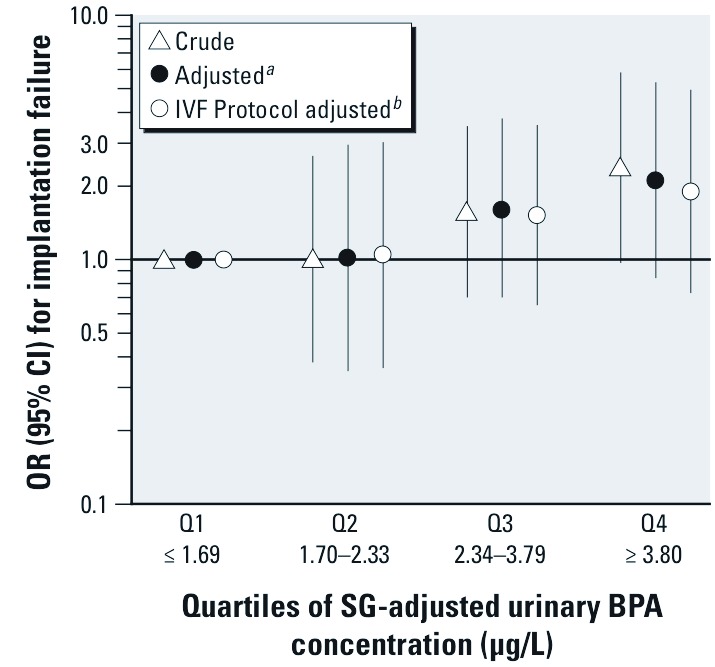
Among 137 women undergoing 180 IVF cycles, urinary BPA concentrations had a geometric mean (SD) of 1.53 (2.22) µg/L. Overall, 42% (n = 75) of the IVF cycles resulted in implantation failure. In adjusted models, there was an increased odds of implantation failure with higher quartiles of urinary BPA concentrations {odds ratio (OR) 1.02 [95% confidence interval (CI): 0.35, 2.95}, 1.60 (95% CI: 0.70, 3.78), and 2.11 (95% CI: 0.84, 5.31) for quartiles 2, 3, and 4, respectively, compared with the lowest quartile (p-trend = 0.06).
There was a positive linear dose-response association between BPA urinary concentrations and implantation failure.
双酚 A(BPA)是一种广泛用于生产聚碳酸酯塑料和环氧树脂的合成化学物质,存在于众多消费品中。在实验动物中,BPA 会增加胚胎着床失败率并减少胎仔数量。
我们评估了接受体外受精(IVF)的女性尿液中 BPA 浓度与着床失败的关系。
我们使用在线固相萃取-高效液相色谱-同位素稀释串联质谱法,在马萨诸塞州波士顿市马萨诸塞州综合医院生育中心接受 IVF 的 137 名女性的前瞻性队列研究中测量了尿液中 BPA 浓度。我们使用逻辑回归评估了特定周期的尿 BPA 浓度与着床失败的关系,使用广义估计方程来考虑同一女性中多个 IVF 周期之间的相关性。着床失败的定义为取卵后 17 天血清β-人绒毛膜促性腺激素检测呈阴性(β-hCG<6IU/L)。
在 137 名接受 180 个 IVF 周期的女性中,尿液 BPA 浓度的几何平均值(SD)为 1.53(2.22)μg/L。总体而言,42%(n=75)的 IVF 周期发生着床失败。在调整后的模型中,随着尿 BPA 浓度四分位值的升高,着床失败的几率增加{比值比(OR)1.02[95%置信区间(CI):0.35, 2.95],1.60(95%CI:0.70, 3.78)和 2.11(95%CI:0.84, 5.31),分别与最低四分位值相比(p 趋势=0.06)。
BPA 尿浓度与着床失败之间呈正线性剂量反应关系。