School of Psychological Sciences, University of Manchester, Manchester M13 9PL, UK.
BMJ. 2012 Apr 5;344:e2233. doi: 10.1136/bmj.e2233.
To determine whether cognitive therapy is effective in preventing the worsening of emerging psychotic symptoms experienced by help seeking young people deemed to be at risk for serious conditions such as schizophrenia.
Multisite single blind randomised controlled trial.
Diverse services at five UK sites.
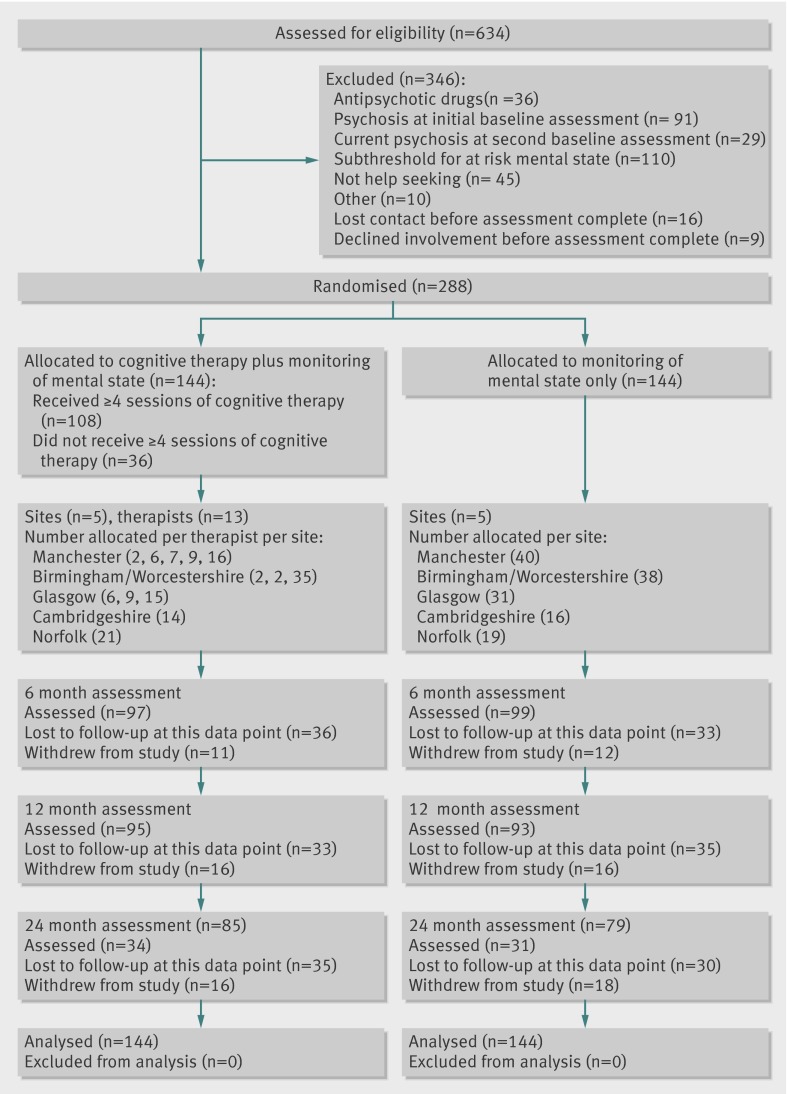
288 participants aged 14-35 years (mean 20.74, SD 4.34 years) at high risk of psychosis: 144 were assigned to cognitive therapy plus monitoring of mental state and 144 to monitoring of mental state only. Participants were followed-up for a minimum of 12 months and a maximum of 24 months.
Cognitive therapy (up to 26 (mean 9.1) sessions over six months) plus monitoring of mental state compared with monitoring of mental state only.
Primary outcome was scores on the comprehensive assessment of at risk mental states (CAARMS), which provides a dichotomous transition to psychosis score and ordinal scores for severity of psychotic symptoms and distress. Secondary outcomes included emotional dysfunction and quality of life.
Transition to psychosis based on intention to treat was analysed using discrete time survival models. Overall, the prevalence of transition was lower than expected (23/288; 8%), with no significant difference between the two groups (proportional odds ratio 0.73, 95% confidence interval 0.32 to 1.68). Changes in severity of symptoms and distress, as well as secondary outcomes, were analysed using random effects regression (analysis of covariance) adjusted for site and baseline symptoms. Distress from psychotic symptoms did not differ (estimated difference at 12 months -3.00, 95% confidence interval -6.95 to 0.94) but their severity was significantly reduced in the group assigned to cognitive therapy (estimated between group effect size at 12 months -3.67, -6.71 to -0.64, P=0.018).
Cognitive therapy plus monitoring did not significantly reduce transition to psychosis or symptom related distress but reduced the severity of psychotic symptoms in young people at high risk. Most participants in both groups improved over time. The results have important implications for the at risk mental state concept.
Current Controlled Trials ISRCTN56283883.
确定认知疗法是否能有效预防寻求帮助的年轻人出现新的精神病症状恶化,这些年轻人被认为有患精神分裂症等严重疾病的风险。
多地点单盲随机对照试验。
英国五个地点的不同服务。
288 名年龄在 14-35 岁(平均 20.74,SD 4.34 岁)的高危精神病患者:144 名被分配到认知疗法加精神状态监测,144 名仅接受精神状态监测。参与者的随访时间至少为 12 个月,最长为 24 个月。
认知疗法(6 个月内最多 26 次(平均 9.1 次))加精神状态监测与仅精神状态监测相比。
主要结局是高危精神状态综合评估(CAARMS)的评分,该评分提供了向精神病转变的二分法评分和精神病症状严重程度和痛苦的序贯评分。次要结局包括情绪功能障碍和生活质量。
基于意向治疗的向精神病转变采用离散时间生存模型进行分析。总体而言,向精神病转变的发生率低于预期(23/288;8%),两组之间无显著差异(比例优势比 0.73,95%置信区间 0.32 至 1.68)。症状和痛苦严重程度的变化以及次要结局采用随机效应回归(协方差分析)进行分析,调整了地点和基线症状。精神病症状引起的痛苦没有差异(12 个月时的估计差异-3.00,95%置信区间-6.95 至 0.94),但认知疗法组的严重程度显著降低(12 个月时的组间效应大小估计值-3.67,-6.71 至-0.64,P=0.018)。
认知疗法加监测并不能显著降低向精神病转变或与症状相关的痛苦,但能降低高危年轻人的精神病症状严重程度。大多数参与者在两组中都随着时间的推移而有所改善。结果对高危精神状态概念具有重要意义。
当前对照试验 ISRCTN56283883。