Vanin Anatoly F, Burbaev Dosymzhan Sh
N. N. Semyonov Institute of Chemical Physics, Russian Academy of Sciences, Kosygin Street 4, Moscow 119991, Russia.
J Biophys. 2011;2011:878236. doi: 10.1155/2011/878236. Epub 2012 Feb 14.
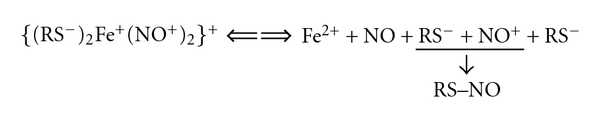
The ability of mononuclear dinitrosyl iron commplexes (M-DNICs) with thiolate ligands to act as NO donors and to trigger S-nitrosation of thiols can be explain only in the paradigm of the model of the [Fe(+)(NO(+))(2)] core ({Fe(NO)(2)}(7) according to the Enemark-Feltham classification). Similarly, the {(RS(-))(2)Fe(+)(NO(+))(2)}(+) structure describing the distribution of unpaired electron density in M-DNIC corresponds to the low-spin (S = 1/2) state with a d(7) electron configuration of the iron atom and predominant localization of the unpaired electron on MO(d(z2)) and the square planar structure of M-DNIC. On the other side, the formation of molecular orbitals of M-DNIC including orbitals of the iron atom, thiolate and nitrosyl ligands results in a transfer of electron density from sulfur atoms to the iron atom and nitrosyl ligands. Under these conditions, the positive charge on the nitrosyl ligands diminishes appreciably, the interaction of the ligands with hydroxyl ions or with thiols slows down and the hydrolysis of nitrosyl ligands and the S-nitrosating effect of the latter are not manifested. Most probably, the S-nitrosating effect of nitrosyl ligands is a result of weak binding of thiolate ligands to the iron atom under conditions favoring destabilization of M-DNIC.
具有硫醇盐配体的单核二亚硝基铁配合物(M-DNICs)作为一氧化氮供体并引发硫醇的S-亚硝基化的能力,只能在[Fe(+)(NO(+))(2)]核心模型(根据埃纳马克-费尔瑟姆分类为{Fe(NO)(2)}(7))的范式中得到解释。同样,描述M-DNIC中未成对电子密度分布的{(RS(-))(2)Fe(+)(NO(+))(2)}(+)结构对应于铁原子具有d(7)电子构型的低自旋(S = 1/2)状态,且未成对电子主要定域在MO(d(z2))上以及M-DNIC的平面正方形结构。另一方面,M-DNIC的分子轨道形成,包括铁原子、硫醇盐和亚硝基配体的轨道,导致电子密度从硫原子转移到铁原子和亚硝基配体上。在这些条件下,亚硝基配体上的正电荷明显减少,配体与氢氧根离子或硫醇的相互作用减慢,亚硝基配体的水解及其S-亚硝基化作用未表现出来。很可能,亚硝基配体的S-亚硝基化作用是在有利于M-DNIC去稳定化的条件下硫醇盐配体与铁原子弱结合的结果。