Lependu Paea, Iyer Srinivasan V, Fairon Cédrick, Shah Nigam H
Stanford Center for Biomedical Informatics Research, Stanford University, USA.
J Biomed Semantics. 2012 Apr 24;3 Suppl 1(Suppl 1):S5. doi: 10.1186/2041-1480-3-S1-S5.
The electronic surveillance for adverse drug events is largely based upon the analysis of coded data from reporting systems. Yet, the vast majority of electronic health data lies embedded within the free text of clinical notes and is not gathered into centralized repositories. With the increasing access to large volumes of electronic medical data-in particular the clinical notes-it may be possible to computationally encode and to test drug safety signals in an active manner.
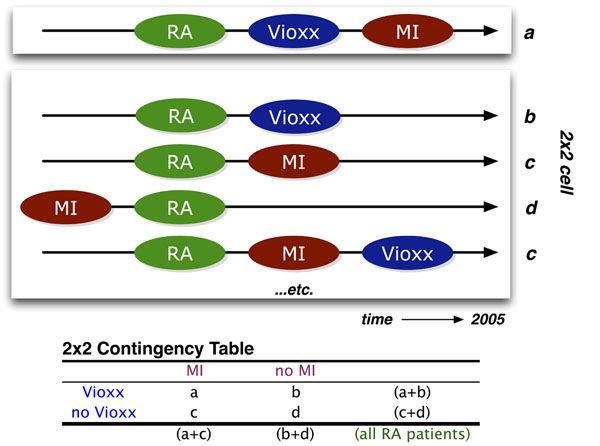
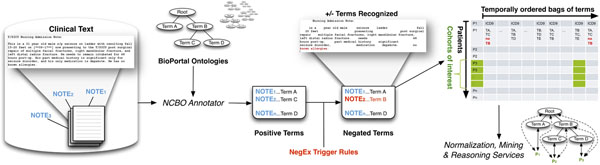
We describe the application of simple annotation tools on clinical text and the mining of the resulting annotations to compute the risk of getting a myocardial infarction for patients with rheumatoid arthritis that take Vioxx. Our analysis clearly reveals elevated risks for myocardial infarction in rheumatoid arthritis patients taking Vioxx (odds ratio 2.06) before 2005.
Our results show that it is possible to apply annotation analysis methods for testing hypotheses about drug safety using electronic medical records.
药物不良事件的电子监测很大程度上基于对报告系统编码数据的分析。然而,绝大多数电子健康数据都包含在临床记录的自由文本中,并未被收集到集中的存储库中。随着获取大量电子医疗数据(尤其是临床记录)的机会不断增加,有可能通过计算对其进行编码并以主动方式测试药物安全信号。
我们描述了在临床文本上应用简单注释工具以及对所得注释进行挖掘,以计算服用万络的类风湿关节炎患者发生心肌梗死的风险。我们的分析清楚地揭示,在2005年之前,服用万络的类风湿关节炎患者发生心肌梗死的风险升高(优势比为2.06)。
我们的结果表明,使用电子病历应用注释分析方法来检验关于药物安全性的假设是可行的。