Department of Cell and Molecular Biology, Uppsala University, Uppsala, Sweden.
PLoS Comput Biol. 2012;8(5):e1002502. doi: 10.1371/journal.pcbi.1002502. Epub 2012 May 10.
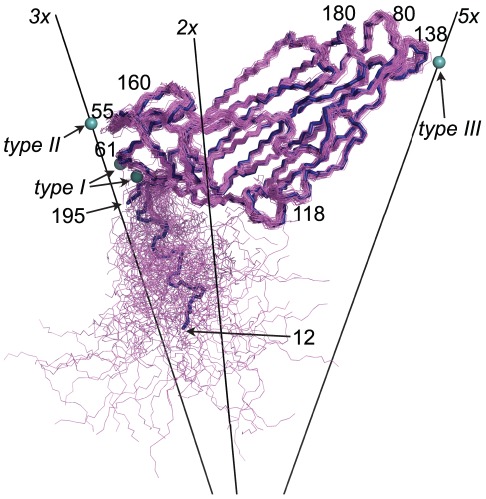
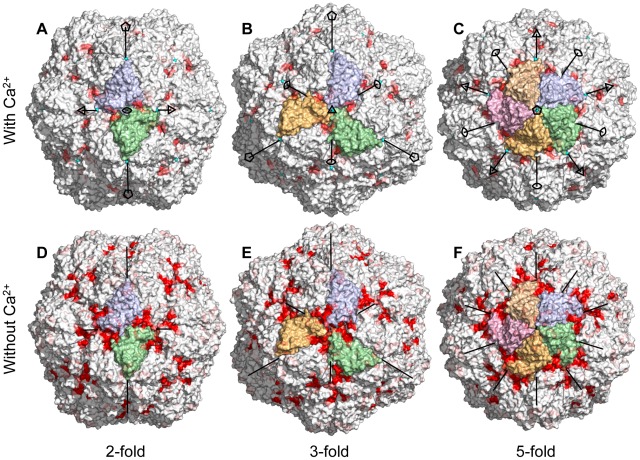
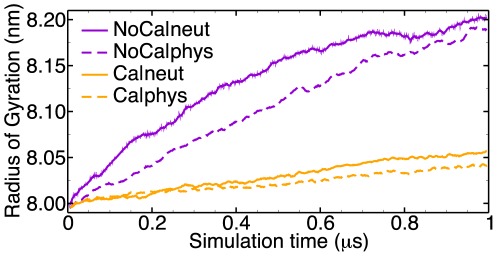
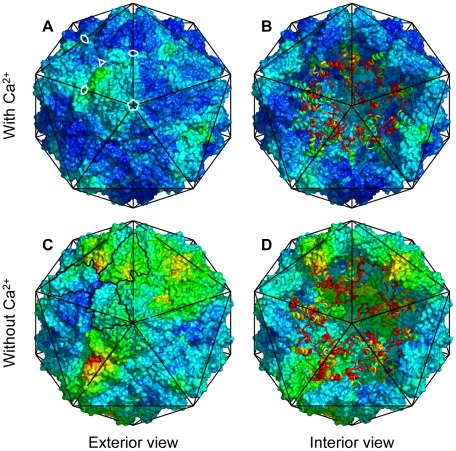
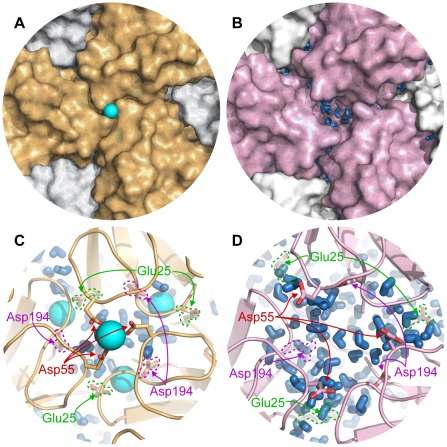
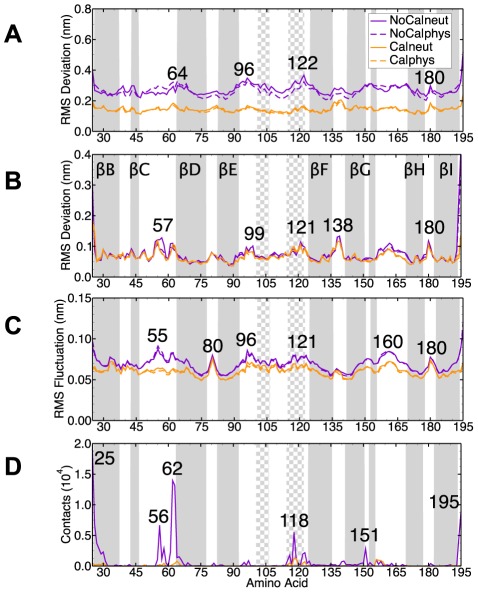
Dissolution of many plant viruses is thought to start with swelling of the capsid caused by calcium removal following infection, but no high-resolution structures of swollen capsids exist. Here we have used microsecond all-atom molecular simulations to describe the dynamics of the capsid of satellite tobacco necrosis virus with and without the 92 structural calcium ions. The capsid expanded 2.5% upon removal of the calcium, in good agreement with experimental estimates. The water permeability of the native capsid was similar to that of a phospholipid membrane, but the permeability increased 10-fold after removing the calcium, predominantly between the 2-fold and 3-fold related subunits. The two calcium binding sites close to the icosahedral 3-fold symmetry axis were pivotal in the expansion and capsid-opening process, while the binding site on the 5-fold axis changed little structurally. These findings suggest that the dissociation of the capsid is initiated at the 3-fold axis.
许多植物病毒的溶解被认为是从感染后钙的去除引起的衣壳肿胀开始的,但目前还没有肿胀衣壳的高分辨率结构。在这里,我们使用微秒全原子分子模拟来描述卫星烟草坏死病毒衣壳的动力学,包括有和没有 92 个结构钙的情况。钙去除后,衣壳膨胀了 2.5%,与实验估计值吻合较好。天然衣壳的水渗透性与磷脂膜相似,但去除钙后渗透性增加了 10 倍,主要发生在 2 倍和 3 倍相关亚基之间。靠近二十面体 3 倍对称轴的两个钙结合位点在膨胀和衣壳打开过程中起着关键作用,而 5 倍轴上的结合位点结构变化很小。这些发现表明,衣壳的解离是从 3 倍轴开始的。