Xu Jinfeng, Yuan Ao, Zheng Gang
Department of Statistics and Applied Probability, National University of Singapore, Singapore.
Ann Hum Genet. 2012 Jul;76(4):301-11. doi: 10.1111/j.1469-1809.2012.00714.x. Epub 2012 May 21.
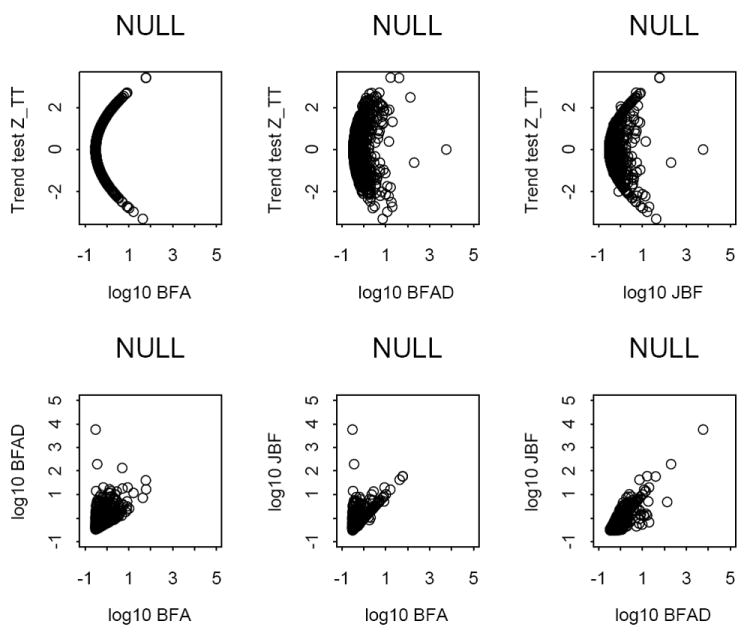
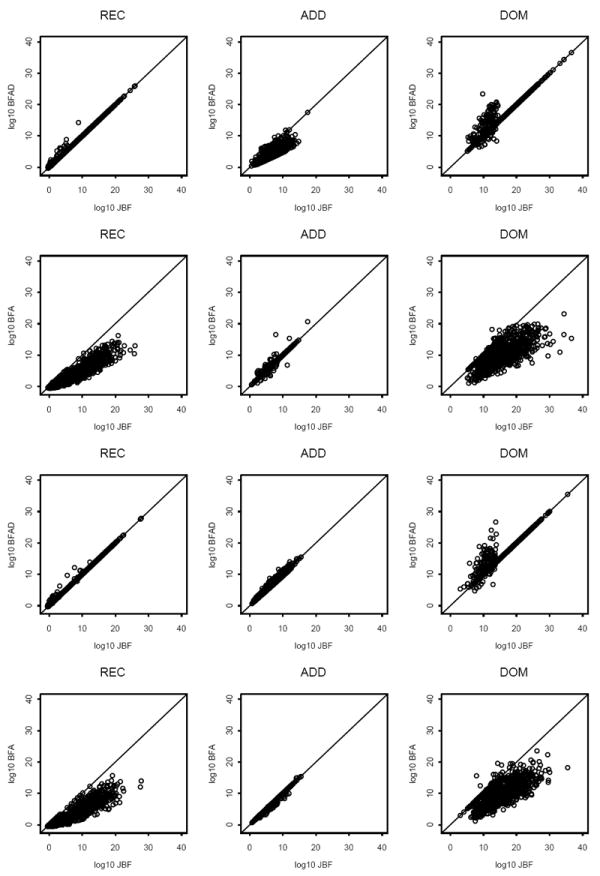
In the analysis of case-control genetic association, the trend test and Pearson's test are the two most commonly used tests. In genome-wide association studies (GWAS), Bayes factor (BF) is a useful tool to support significant P-values, and a better measure than P-value when results are compared across studies with different sample sizes. When reporting the P-value of the trend test, we propose a BF directly based on the trend test. To improve the power to detect association under recessive or dominant genetic models, we propose a BF based on the trend test and incorporating Hardy-Weinberg disequilibrium in cases. When the true model is unknown, or both the trend test and Pearson's test or other robust tests are applied in genome-wide scans, we propose a joint BF, combining the previous two BFs. All three BFs studied in this paper have closed forms and are easy to compute without integrations, so they can be reported along with P-values, especially in GWAS. We discuss how to use each of them and how to specify priors. Simulation studies and applications to three GWAS are provided to illustrate their usefulness to detect nonadditive gene susceptibility in practice.
在病例对照基因关联分析中,趋势检验和Pearson检验是最常用的两种检验方法。在全基因组关联研究(GWAS)中,贝叶斯因子(BF)是支持显著P值的有用工具,并且在比较不同样本量研究的结果时,是比P值更好的衡量指标。在报告趋势检验的P值时,我们直接基于趋势检验提出了一个贝叶斯因子。为了提高在隐性或显性遗传模型下检测关联的效能,我们基于趋势检验并纳入病例中的哈迪-温伯格不平衡提出了一个贝叶斯因子。当真实模型未知,或者在全基因组扫描中同时应用趋势检验和Pearson检验或其他稳健检验时,我们提出了一个联合贝叶斯因子,它结合了前两个贝叶斯因子。本文研究的所有三个贝叶斯因子都有封闭形式,无需积分即可轻松计算,因此可以与P值一起报告,尤其是在GWAS中。我们讨论了如何使用它们中的每一个以及如何指定先验。提供了模拟研究以及对三个GWAS的应用,以说明它们在实际中检测非加性基因易感性的有用性。