National Primate Research Center, University of Washington, Seattle, WA, USA.
Am J Primatol. 2012 Jul;74(7):676-86. doi: 10.1002/ajp.22022.
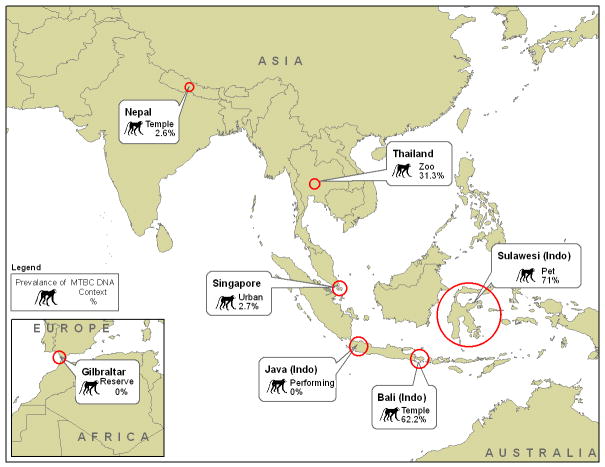
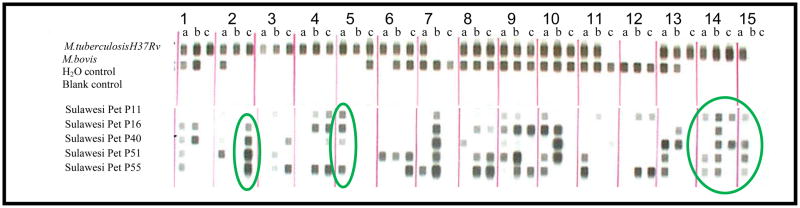
Although the Mycobacterium tuberculosis complex (MTBC) infects a third of all humans, little is known regarding the prevalence of mycobacterial infection in nonhuman primates (NHP). For more than a century, tuberculosis has been regarded as a serious infectious threat to NHP species. Advances in the detection of MTBC open new possibilities for investigating the effects of this poorly understood pathogen in diverse populations of NHP. Here, we report results of a cross-sectional study using well-described molecular methods to detect a nucleic acid sequence (IS6110) unique to the MTBC. Sample collection was focused on the oral cavity, the presumed route of transmission of MTBC. Buccal swabs were collected from 263 macaques representing 11 species in four Asian countries and Gibraltar. Contexts of contact with humans included free ranging, pets, performing monkeys, zoos, and monkey temples. Following DNA isolation from buccal swabs, the polymerase chain reaction (PCR) amplified IS6110 from 84 (31.9%) of the macaques. In general, prevalence of MTBC DNA was higher among NHP in countries where the World Health Organization reports higher prevalence of humans infected with MTBC. This is the first demonstration of MTBC DNA in the mouths of macaques. Further research is needed to establish the significance of this finding at both the individual and population levels. PCR of buccal samples holds promise as a method to elucidate the mycobacterial landscape among NHP, particularly macaques that thrive in areas of high human MTBC prevalence.
虽然结核分枝杆菌复合群(MTBC)感染了全球三分之一的人口,但关于非人类灵长类动物(NHP)中分枝杆菌感染的流行情况知之甚少。一个多世纪以来,结核病一直被认为是 NHP 物种的严重传染病威胁。MTBC 检测技术的进步为研究这种了解甚少的病原体在 NHP 不同种群中的影响开辟了新的可能性。在这里,我们报告了一项使用描述良好的分子方法检测 MTBC 特有核酸序列(IS6110)的横断面研究结果。样本采集集中在口腔,这是 MTBC 传播的假定途径。我们从来自四个亚洲国家和直布罗陀的 11 个物种的 263 只猕猴中采集了颊拭子。与人类接触的背景包括自由放养、宠物、表演猴、动物园和猴庙。从颊拭子中提取 DNA 后,聚合酶链反应(PCR)从 84 只(31.9%)猕猴中扩增出了 IS6110。一般来说,在世界卫生组织报告 MTBC 感染人类流行率较高的国家,NHP 中 MTBC DNA 的流行率更高。这是首次在猕猴口腔中检测到 MTBC DNA。需要进一步研究以确定个体和群体水平上这一发现的意义。颊拭子 PCR 有望成为阐明 NHP 中分枝杆菌状况的一种方法,特别是在 MTBC 流行率高的地区生存的猕猴。