Laboratory of Infectious Diseases, NIAID, Bethesda, Maryland, USA.
mBio. 2012 May 29;3(3). doi: 10.1128/mBio.00120-12. Print 2012.
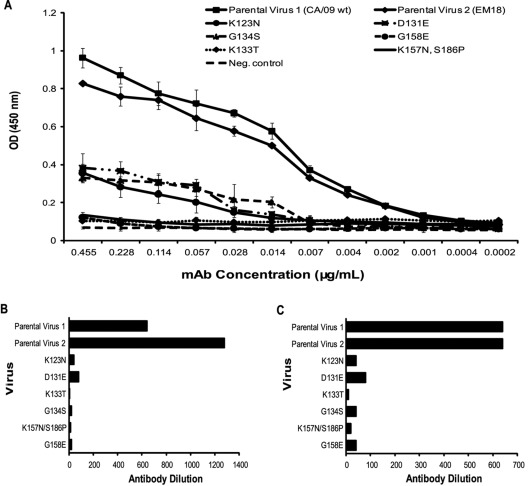
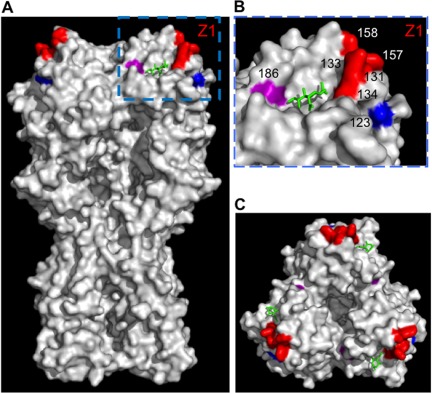
In 2009, a novel H1N1 influenza A virus (2009 pH1N1) emerged and caused a pandemic. A human monoclonal antibody (hMAb; EM4C04), highly specific for the 2009 pH1N1 virus hemagglutinin (HA), was isolated from a severely ill 2009 pH1N1 virus-infected patient. We postulated that under immune pressure with EM4C04, the 2009 pH1N1 virus would undergo antigenic drift and mutate at sites that would identify the antibody binding site. To do so, we infected MDCK cells in the presence of EM4C04 and generated 11 escape mutants, displaying 7 distinct amino acid substitutions in the HA. Six substitutions greatly reduced MAb binding (K123N, D131E, K133T, G134S, K157N, and G158E). Residues 131, 133, and 134 are contiguous with residues 157 and 158 in the globular domain structure and contribute to a novel pH1N1 antibody epitope. One mutation near the receptor binding site, S186P, increased the binding affinity of the HA to the receptor. 186P and 131E are present in the highly virulent 1918 virus HA and were recently identified as virulence determinants in a mouse-passaged pH1N1 virus. We found that pH1N1 escape variants expressing these substitutions enhanced replication and lethality in mice compared to wild-type 2009 pH1N1 virus. The increased virulence of these viruses was associated with an increased affinity for α2,3 sialic acid receptors. Our study demonstrates that antibody pressure by an hMAb targeting a novel epitope in the Sa region of 2009 pH1N1 HA is able to inadvertently drive the development of a more virulent virus with altered receptor binding properties. This broadens our understanding of antigenic drift.
Influenza viruses accumulate amino acid substitutions to evade the antibody response in a process known as antigenic drift, making it necessary to vaccinate against influenza annually. Mapping human monoclonal antibody (hMAb) epitopes is a necessary step towards understanding antigenic drift in humans. We defined the specificity of an hMAb that specifically targeted the 2009 pH1N1 virus and describe a novel epitope. In addition, we identified a previously unappreciated potential for antibody escape to enhance the pathogenicity of a virus. The escape mutation that we identified with in vitro immune pressure was independently reported by other investigators using in vivo selection in nonimmune mice. Although in vitro generation of escape mutants is unlikely to recapitulate antigenic drift in its entirety, the data demonstrate that pressure by a human monoclonal antibody targeting a novel epitope in the hemagglutinin of the 2009 pandemic H1N1 virus can inadvertently drive the development of escape mutants, of which a subset have increased virulence and altered receptor binding properties.
2009 年,一种新型 H1N1 流感病毒(2009 pH1N1)出现并引发大流行。从一名严重感染 2009 pH1N1 病毒的患者中分离出一种针对该病毒血凝素(HA)的高度特异性人源单克隆抗体(hMAb;EM4C04)。我们推测,在 EM4C04 的免疫压力下,2009 pH1N1 病毒将发生抗原漂移,并在抗体结合位点发生突变。为此,我们在存在 EM4C04 的情况下感染 MDCK 细胞,并生成了 11 种逃逸突变体,HA 中有 7 个不同的氨基酸取代。6 个取代大大降低了 MAb 的结合能力(K123N、D131E、K133T、G134S、K157N 和 G158E)。残基 131、133 和 134 与球形结构域中的残基 157 和 158 连续,并构成一个新的 pH1N1 抗体表位。受体结合位点附近的一个突变 S186P 增加了 HA 与受体的结合亲和力。186P 和 131E 存在于高致病性 1918 病毒 HA 中,最近被鉴定为在经过小鼠传代的 pH1N1 病毒中具有毒力决定因素。我们发现,与野生型 2009 pH1N1 病毒相比,表达这些取代的 pH1N1 逃逸变体在小鼠中的复制和致死率更高。这些病毒的毒力增加与对α2,3 唾液酸受体的亲和力增加有关。我们的研究表明,针对 2009 pH1N1 HA 中 Sa 区新表位的 hMAb 产生的抗体压力能够无意中导致具有改变的受体结合特性的更具毒力的病毒的发展。这拓宽了我们对抗原漂移的理解。
流感病毒会积累氨基酸取代,以逃避抗体反应,这一过程称为抗原漂移,因此每年都需要接种流感疫苗。绘制人类单克隆抗体(hMAb)表位图谱是了解人类抗原漂移的必要步骤。我们确定了一种专门针对 2009 pH1N1 病毒的 hMAb 的特异性,并描述了一个新的表位。此外,我们还发现了一种以前未被认识到的抗体逃逸潜力,可以增强病毒的致病性。我们通过体外免疫压力鉴定的逃逸突变,其他研究人员也使用非免疫小鼠体内选择独立报道。尽管体外产生逃逸突变不太可能完全再现抗原漂移,但数据表明,针对 2009 年大流行 H1N1 病毒血凝素中新型表位的人源单克隆抗体的压力会无意中导致逃逸突变的发展,其中一部分具有更高的毒力和改变的受体结合特性。