Pamukkale University, Faculty of Medicine, Department of Physiology, Kinikli, Denizli, Turkey.
Med Sci Monit. 2012 Jun;18(6):CR351-60. doi: 10.12659/msm.882878.
This study aimed to explore the effects of progressive resistance exercise training (PRET) on hemorheology.
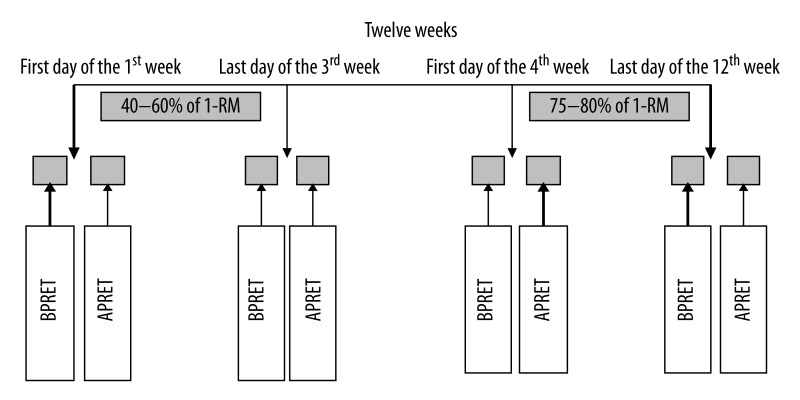
MATERIAL/METHODS: Exercise sessions included 1-3 sets of 8-12 repetitions at 40-60% of 1-repetition maximum (1-RM) for 3 weeks and at 75-80% of 1-RM during weeks 4-12. Red blood cell (RBC) deformability and aggregation were determined by ektacytometry, plasma and whole blood viscosities (WBV) by rotational viscometry. Lactate concentration was evaluated by an analyzer and fibrinogen was evaluated by coagulometry. Plasma total oxidant/antioxidant status was measured by colorimetry.
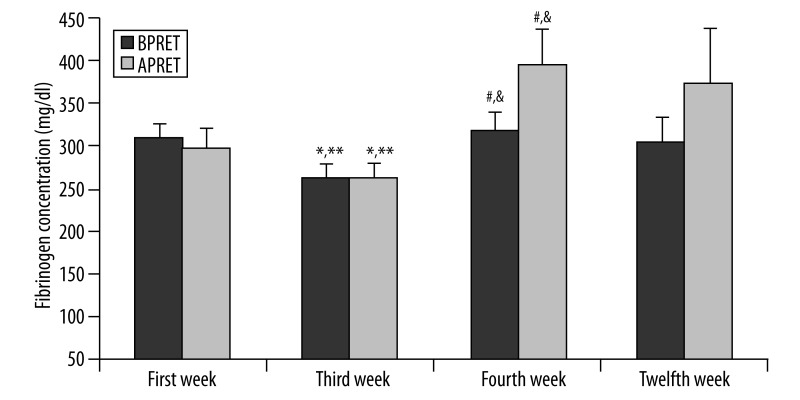
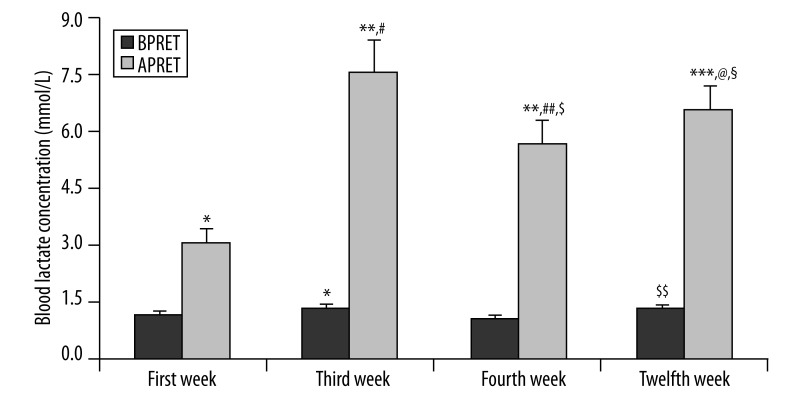
Following an acute increase after exercise on the first day, RBC deformability was elevated during weeks 3 and 4 (p=0.028; p=0.034, respectively). The last exercise protocol applied in week 12 again caused an acute increase in this parameter (p=0.034). RBC aggregation was increased acutely on the first day, but decreased after that throughout the protocol (p<0.05). At weeks 4 and 12 pre-exercise measurements of WBV at standard hematocrit and plasma viscosity were decreased (p=0.05; p=0.041, respectively), while post-exercise values were increased (p=0.005; p=0.04, respectively). Post-exercise WBV at autologous hematocrit measured at week 12 was increased (p=0.01). Lactate was elevated after each exercise session (p<0.05). Fibrinogen was decreased on the third week (p<0.01), while it was increased on the 4th week (p=0.005). Plasma antioxidant status was increased at week 3 (p=0.034) and oxidative stress index was decreased at week 4 (p=0.013) after exercise.
The results of this study indicate that PRET may have positive effects on hemorheological parameters.
本研究旨在探讨渐进式抗阻运动训练(PRET)对血液流变学的影响。
材料/方法:运动方案包括 3 周内以 1-RM 的 40-60%进行 1-3 组 8-12 次重复,以及第 4-12 周以 1-RM 的 75-80%进行。通过 ektacytometry 测定红细胞(RBC)变形性和聚集性,通过旋转粘度计测定血浆和全血粘度(WBV)。通过分析仪评估乳酸浓度,通过凝血仪评估纤维蛋白原。通过比色法测量血浆总氧化剂/抗氧化剂状态。
运动后第 1 天急性增加后,第 3 周和第 4 周 RBC 变形性升高(p=0.028;p=0.034)。第 12 周最后一次应用的运动方案再次导致该参数急性增加(p=0.034)。RBC 聚集性在第 1 天急性增加,但此后整个方案中逐渐减少(p<0.05)。在第 4 周和第 12 周,标准红细胞压积和血浆粘度的运动前测量值降低(p=0.05;p=0.041),而运动后测量值升高(p=0.005;p=0.04)。第 12 周测量的自体红细胞压积的运动后 WBV 增加(p=0.01)。每次运动后乳酸升高(p<0.05)。纤维蛋白原在第 3 周降低(p<0.01),而在第 4 周升高(p=0.005)。运动后第 3 周血浆抗氧化状态升高(p=0.034),第 4 周氧化应激指数降低(p=0.013)。
本研究结果表明,PRET 可能对血液流变学参数有积极影响。