Department of Pharmacology, Oxford University Oxford, UK.
Front Mol Neurosci. 2012 May 31;5:68. doi: 10.3389/fnmol.2012.00068. eCollection 2012.
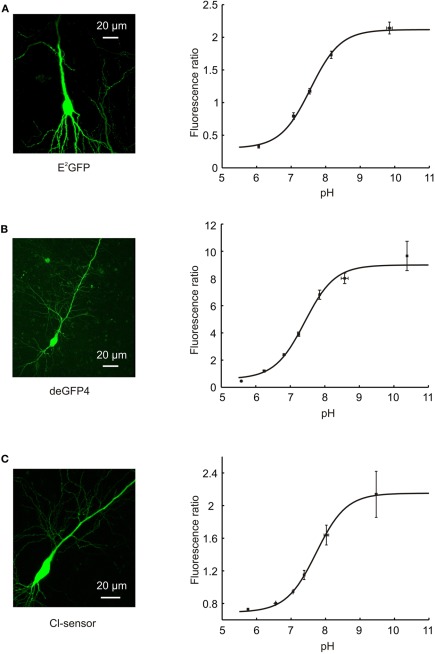
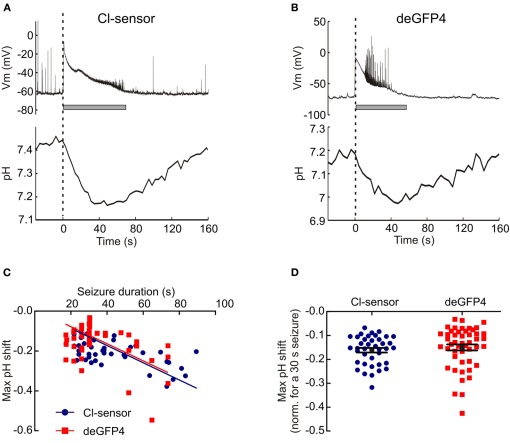
The regulation of hydrogen ion concentration (pH) is fundamental to cell viability, metabolism, and enzymatic function. Within the nervous system, the control of pH is also involved in diverse and dynamic processes including development, synaptic transmission, and the control of network excitability. As pH affects neuronal activity, and can also itself be altered by neuronal activity, the existence of tools to accurately measure hydrogen ion fluctuations is important for understanding the role pH plays under physiological and pathological conditions. Outside of their use as a marker of synaptic release, genetically encoded pH sensors have not been utilized to study hydrogen ion fluxes associated with network activity. By combining whole-cell patch clamp with simultaneous two-photon or confocal imaging, we quantified the amplitude and time course of neuronal, intracellular, acidic transients evoked by epileptiform activity in two separate in vitro models of temporal lobe epilepsy. In doing so, we demonstrate the suitability of three genetically encoded pH sensors: deGFP4, E(2)GFP, and Cl-sensor for investigating activity-dependent pH changes at the level of single neurons.
氢离子浓度(pH 值)的调节对细胞活力、代谢和酶功能至关重要。在神经系统中,pH 值的控制还涉及到多种动态过程,包括发育、突触传递和网络兴奋性的控制。由于 pH 值会影响神经元活动,而且神经元活动本身也可以改变 pH 值,因此拥有准确测量氢离子波动的工具对于理解 pH 值在生理和病理条件下所起的作用非常重要。除了作为突触释放的标志物之外,遗传编码的 pH 传感器尚未用于研究与网络活动相关的氢离子通量。通过将全细胞膜片钳与双光子或共聚焦成像同时结合使用,我们在两种不同的颞叶癫痫体外模型中量化了癫痫样活动引起的神经元、细胞内酸性瞬变的幅度和时程。通过这样做,我们证明了三种遗传编码 pH 传感器:deGFP4、E(2)GFP 和 Cl-sensor 适用于研究单个神经元水平上的活性依赖性 pH 值变化。