Universidade Estadual Paulista, Campus de Botucatu-UNESP, São Paulo, Brazil.
PLoS One. 2012;7(5):e37694. doi: 10.1371/journal.pone.0037694. Epub 2012 May 30.
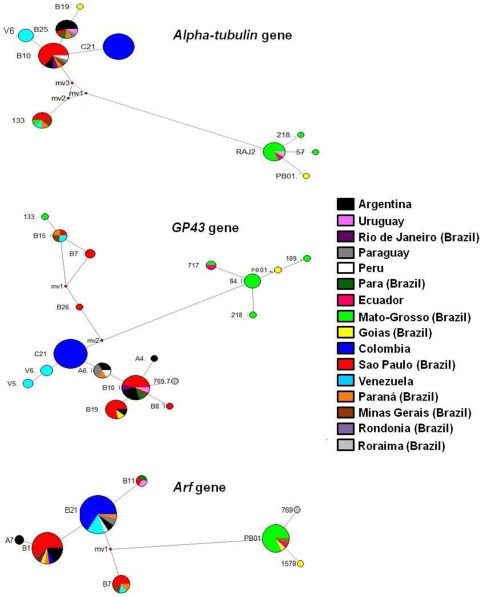
Paracoccidioidomycosis is a systemic mycosis caused by Paracoccidioides brasiliensis (species S1, PS2, PS3), and Paracoccidioides lutzii. This work aimed to differentiate species within the genus Paracoccidioides, without applying multilocus sequencing, as well as to obtain knowledge of the possible speciation processes.
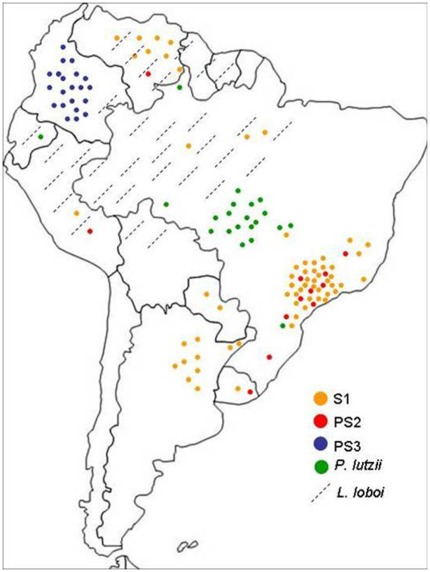
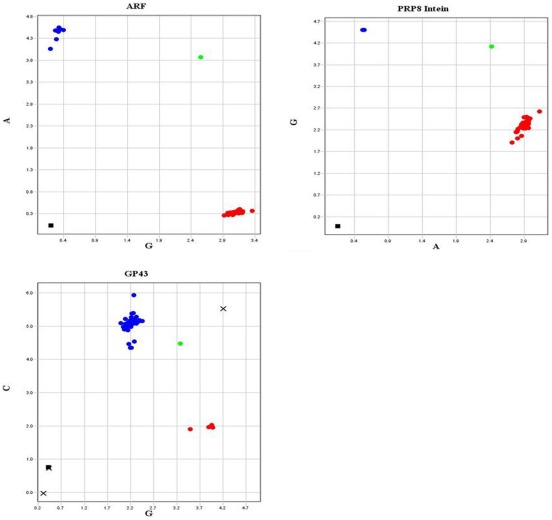
METHODOLOGY/PRINCIPAL FINDINGS: Single nucleotide polymorphism analysis on GP43, ARF and PRP8 intein genes successfully distinguished isolates into four different species. Morphological evaluation indicated that elongated conidia were observed exclusively in P. lutzii isolates, while all other species (S1, PS2 and PS3) were indistinguishable. To evaluate the biogeographic events that led to the current geographic distribution of Paracoccidioides species and their sister species, Nested Clade and Likelihood Analysis of Geographic Range Evolution (LAGRANGE) analyses were applied. The radiation of Paracoccidioides started in northwest South America, around 11-32 million years ago, as calculated on the basis of ARF substitution rate, in the BEAST program. Vicariance was responsible for the divergence among S1, PS2 and P. lutzii and a recent dispersal generated the PS3 species, restricted to Colombia. Taking into account the ancestral areas revealed by the LAGRANGE analysis and the major geographic distribution of L. loboi in the Amazon basin, a region strongly affected by the Andes uplift and marine incursions in the Cenozoic era, we also speculate about the effect of these geological events on the vicariance between Paracoccidioides and L. loboi.
CONCLUSIONS/SIGNIFICANCE: The use of at least 3 SNPs, but not morphological criteria, as markers allows us to distinguish among the four cryptic species of the genus Paracoccidioides. The work also presents a biogeographic study speculating on how these species might have diverged in South America, thus contributing to elucidating evolutionary aspects of the genus Paracoccidioides.
球孢子菌病是一种系统性真菌病,由巴西副球孢子菌(S1、PS2、PS3 种)和卢氏副球孢子菌引起。本研究旨在不进行多位点测序的情况下对副球孢子菌属内的种进行区分,并获得关于可能的物种形成过程的知识。
方法/主要发现:对 GP43、ARF 和 PRP8 内含子基因的单核苷酸多态性分析成功地将分离株分为四个不同的种。形态学评估表明,伸长的分生孢子仅在卢氏副球孢子菌分离株中观察到,而其他所有种(S1、PS2 和 PS3)则无法区分。为了评估导致目前副球孢子菌种及其姐妹种地理分布的生物地理事件,应用嵌套支系和地理范围进化的似然分析(LAGRANGE)分析。基于 ARF 取代率,在 BEAST 程序中计算出,副球孢子菌的辐射始于 11-3200 万年前的南美洲西北部。分歧是 S1、PS2 和卢氏副球孢子菌之间的原因,而最近的扩散产生了仅限于哥伦比亚的 PS3 种。考虑到 LAGRANGE 分析揭示的祖先区和亚马逊盆地中 L. loboi 的主要地理分布,该地区强烈受到新生代安第斯山脉隆起和海洋入侵的影响,我们还推测这些地质事件对副球孢子菌和 L. loboi 之间的分歧的影响。
结论/意义:使用至少 3 个 SNP 作为标记,而不是形态学标准,允许我们区分副球孢子菌属的四个隐种。该研究还进行了生物地理研究,推测这些物种在南美洲是如何分化的,从而有助于阐明副球孢子菌属的进化方面。