Departamento de Fisiologia e Biofísica, Instituto de Ciências Biomédicas, Universidade de São Paulo-USP, São Paulo/SP, Brazil.
Lipids Health Dis. 2012 Jul 10;11:67. doi: 10.1186/1476-511X-11-67.
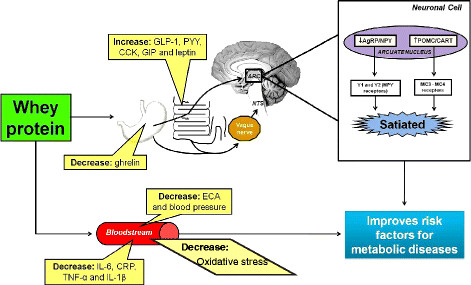
Obesity and type 2 diabetes mellitus (DM) have grown in prevalence around the world, and recently, related diseases have been considered epidemic. Given the high cost of treatment of obesity/DM-associated diseases, strategies such as dietary manipulation have been widely studied; among them, the whey protein diet has reached popularity because it has been suggested as a strategy for the prevention and treatment of obesity and DM in both humans and animals. Among its main actions, the following activities stand out: reduction of serum glucose in healthy individuals, impaired glucose tolerance in DM and obese patients; reduction in body weight; maintenance of muscle mass; increases in the release of anorectic hormones such as cholecystokinin, leptin, and glucagon like-peptide 1 (GLP-1); and a decrease in the orexigenic hormone ghrelin. Furthermore, studies have shown that whey protein can also lead to reductions in blood pressure, inflammation, and oxidative stress.
肥胖症和 2 型糖尿病(DM)在全球范围内的患病率不断增加,最近,相关疾病已被认为是流行疾病。鉴于肥胖/ DM 相关疾病的治疗费用高昂,人们广泛研究了饮食控制等策略;其中,乳清蛋白饮食因其被认为是预防和治疗人类和动物肥胖和 DM 的策略而受到关注。在其主要作用中,以下活动值得注意:降低健康个体的血清葡萄糖水平,降低 DM 和肥胖患者的葡萄糖耐量;降低体重;维持肌肉质量;增加胆囊收缩素、瘦素和胰高血糖素样肽 1(GLP-1)等厌食激素的释放;以及降低食欲激素胃饥饿素。此外,研究表明,乳清蛋白还可以降低血压、炎症和氧化应激。