United States Salinity Laboratory, United States Department of Agriculture-Agriculture Research Service, Riverside, California, United States of America.
PLoS One. 2012;7(4):e28519. doi: 10.1371/journal.pone.0028519. Epub 2012 May 4.
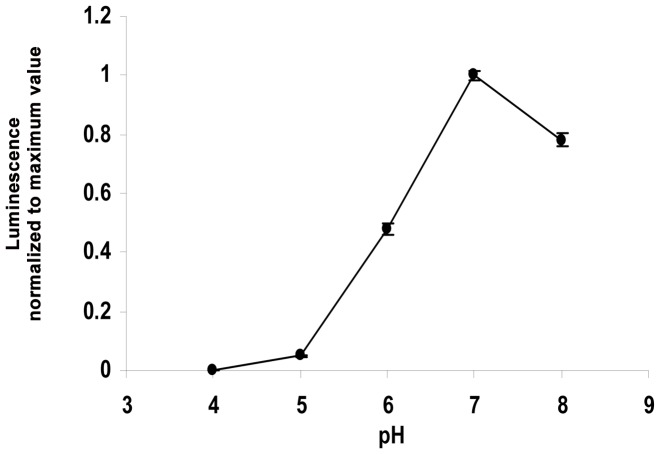
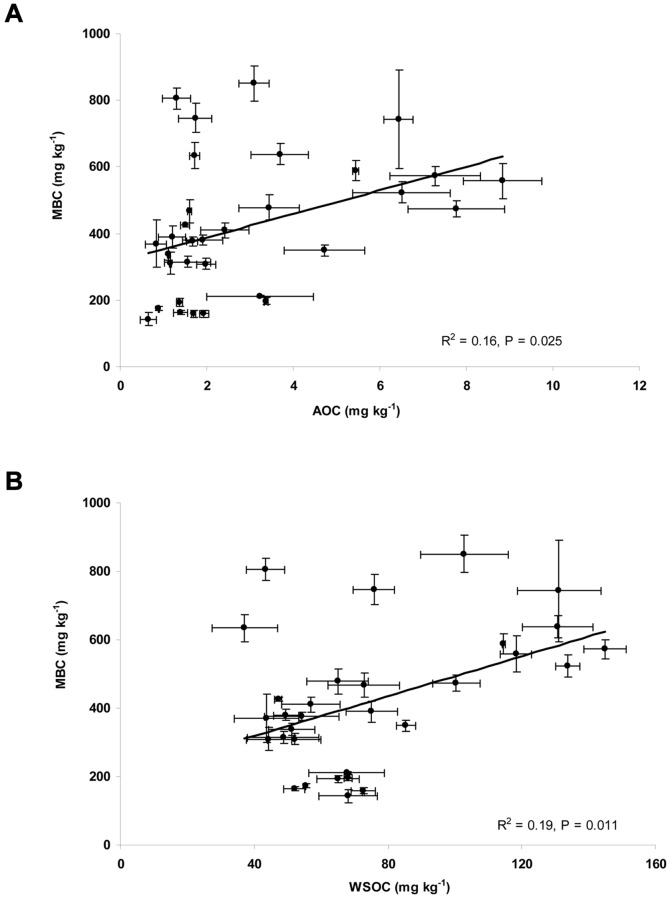
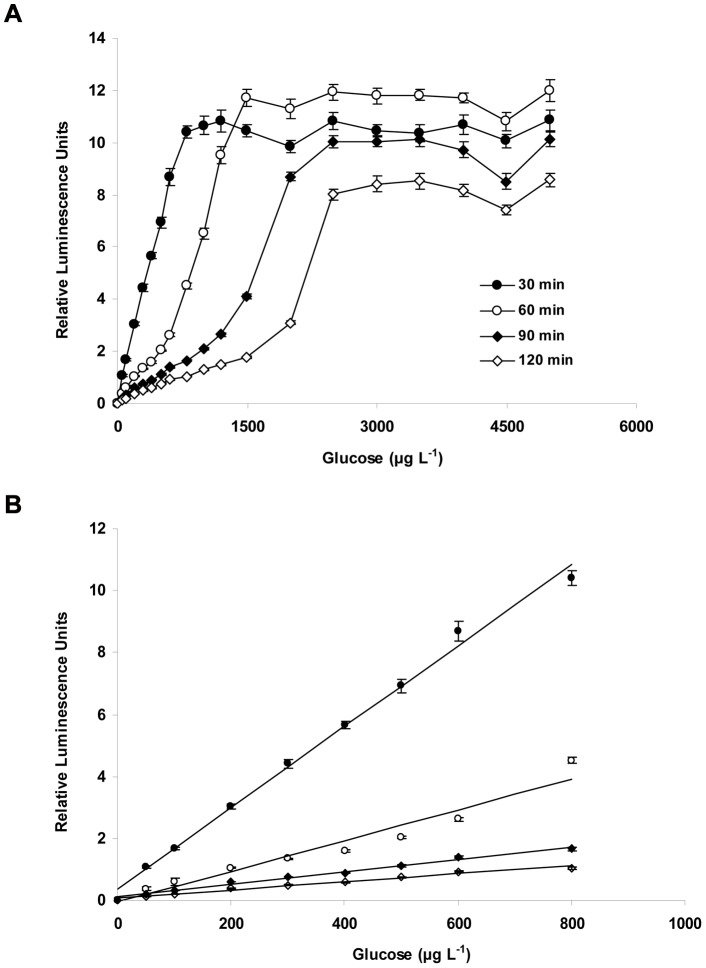
Assimilable organic carbon (AOC) is commonly used to measure the growth potential of microorganisms in water, but has not yet been investigated for measuring microbial growth potential in soils. In this study, a simple, rapid, and non-growth based assay to determine AOC in soil was developed using a naturally occurring luminous strain Vibrio harveyi BB721 to determine the fraction of low molecular weight organic carbon in soil water extract. Calibration of the assay was achieved by measuring the luminescence intensity of starved V. harveyi BB721 cells in the late exponential phase with a concentration range from 0 to 800 µg l(-1) glucose (equivalent to 0-16.0 mg glucose C kg(-1) soil) with the detection limit of 10 µg l(-1) equivalent to 0.20 mg glucose C kg(-1) soil. Results showed that bioluminescence was proportional to the concentration of glucose added to soil. The luminescence intensity of the cells was highly pH dependent and the optimal pH was about 7.0. The average AOC concentration in 32 soils tested was 2.9±2.2 mg glucose C kg(-1). Our data showed that AOC levels in soil water extracts were significantly correlated (P<0.05) with microbial biomass determined as microbial biomass carbon, indicating that the AOC concentrations determined by the method developed might be a good indicator of soil microbial biomass. Our findings provide a new approach that may be used to determine AOC in environmental samples using a non-growth bioluminescence based assay. Understanding the levels of AOC in soil water extract provides new insights into our ability to estimate the most available carbon pool to bacteria in soil that may be easily assimilated into cells for many metabolic processes and suggest possible the links between AOC, microbial regrowth potential, and microbial biomass in soils.
可同化有机碳(AOC)通常用于衡量水中微生物的生长潜力,但尚未研究其在土壤中测量微生物生长潜力的应用。本研究采用自然发光菌株哈维弧菌 BB721 建立了一种简单、快速、非生长基础的方法来测定土壤中的 AOC,以测定土壤水提取物中低分子量有机碳的分数。通过测量对数生长期晚期饥饿的 V. harveyi BB721 细胞的发光强度来校准该测定法,葡萄糖浓度范围为 0 至 800 µg l(-1)(相当于 0 至 16.0 mg 葡萄糖 C kg(-1) 土壤),检测限为 10 µg l(-1)(相当于 0.20 mg 葡萄糖 C kg(-1) 土壤)。结果表明,生物发光与添加到土壤中的葡萄糖浓度成正比。细胞的发光强度高度依赖于 pH 值,最佳 pH 值约为 7.0。在 32 个测试土壤中,AOC 的平均浓度为 2.9±2.2 mg 葡萄糖 C kg(-1)。我们的数据表明,土壤水提取物中的 AOC 水平与作为微生物生物量碳测定的微生物生物量显著相关(P<0.05),表明该方法测定的 AOC 浓度可能是土壤微生物生物量的良好指标。我们的发现提供了一种新方法,可用于使用非生长生物发光测定法测定环境样品中的 AOC。了解土壤水提取物中的 AOC 水平为我们提供了新的见解,使我们能够估计土壤中最易被细菌利用的碳库,这些碳库可能很容易被细胞同化,用于许多代谢过程,并表明 AOC、微生物再生潜力和土壤微生物生物量之间可能存在联系。