Center for Radiopharmaceutical Sciences of ETH, Institute of Pharmaceutical Science of ETH Zürich, Wolfgang-Pauli-Str, 10, Zurich, 8093, Switzerland.
EJNMMI Res. 2012 Jun 9;2(1):26. doi: 10.1186/2191-219X-2-26.
Noninvasive preclinical imaging methodologies such as small animal positron emission tomography (PET) allow the repeated measurement of the same subject which is generally assumed to reduce the variability of the experimental outcome parameter and to produce more robust results. In this study, the variability of tracer uptake in the rodent brain was assessed within and between subjects using the established radiopharmaceuticals 18F-FDG and 18F-fallypride. Moreover, experimental factors with potential impact on study outcome were elicited, and the effect of their strict homogenization was assessed.
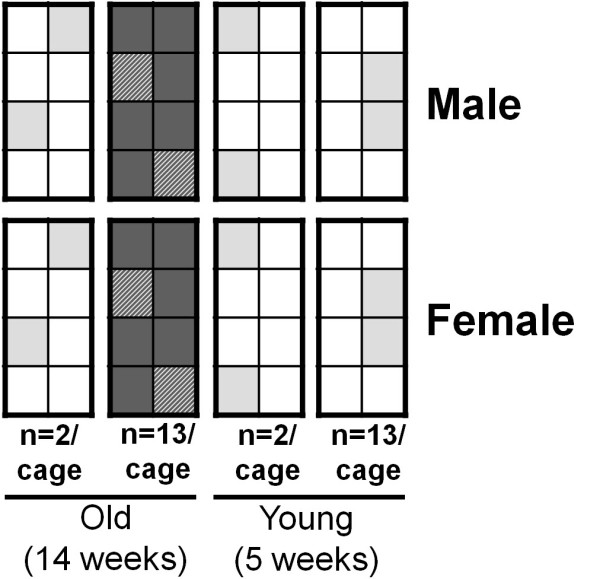
Brain standardized uptake values of rodents were compared between three PET scans of the same animal and scans of different individuals. 18F-FDG ex vivo tissue sampling was performed under variation of the following experimental parameters: gender, age, cage occupancy, anesthetic protocol, environmental temperature during uptake phase, and tracer formulation.
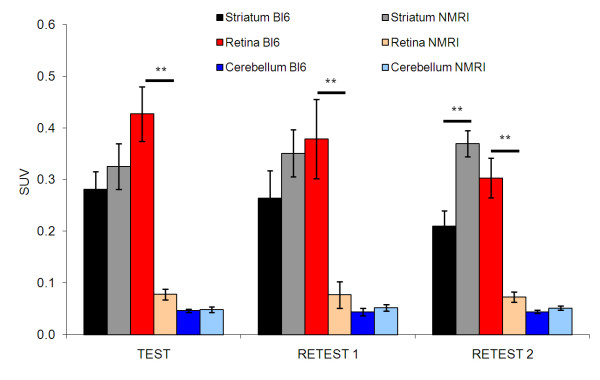
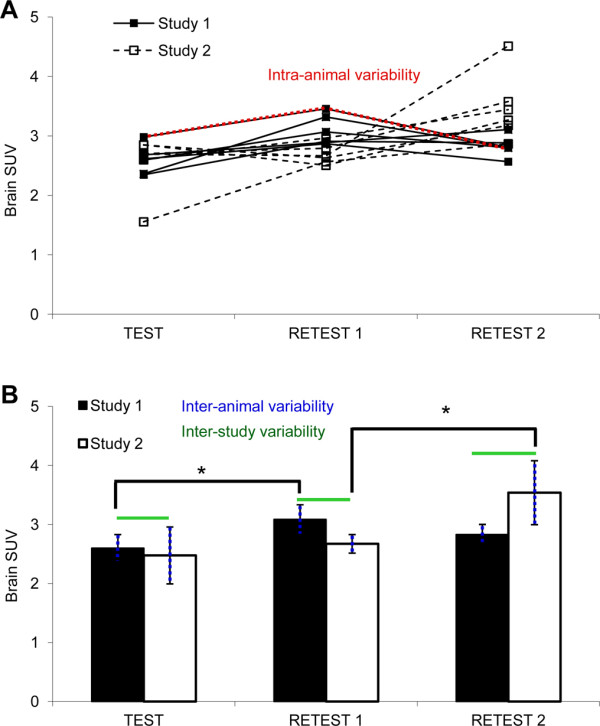
No significant difference of variability in 18F-FDG or 18F-fallypride brain or striatal uptake was identified between scans of the same and scans of different animals (COV = 14 ± 7% vs. 21 ± 10% for 18F-FDG). 18F-FDG brain uptake was robust regarding a variety of experimental parameters; only anesthetic protocols showed a significant impact. In contrast to a heterogenization approach, homogenization of groups produced more false positive effects in 18F-FDG organ distribution showing a false positive rate of 9% vs. 6%.
Repeated measurements of the same animal may not reduce data variability compared with measurements on different animals. Controlled heterogenization of test groups with regard to experimental parameters is advisable as it decreases the generation of false positive results and thus increases external validity of study outcome.
非侵入性的临床前成像方法,如小动物正电子发射断层扫描(PET),允许对同一对象进行重复测量,这通常被认为可以降低实验结果参数的变异性,并产生更稳健的结果。在这项研究中,使用已建立的放射性药物 18F-FDG 和 18F-fallypride,在个体内和个体间评估了啮齿动物大脑中示踪剂摄取的变异性。此外,还确定了可能对研究结果产生影响的实验因素,并评估了其严格均质化的效果。
比较了同一只动物的三次 PET 扫描和不同个体的扫描之间的啮齿动物脑标准化摄取值。在以下实验参数变化的情况下进行 18F-FDG 离体组织取样:性别、年龄、笼位、麻醉方案、摄取期环境温度和示踪剂配方。
同一动物的扫描之间和不同动物的扫描之间,18F-FDG 或 18F-fallypride 脑或纹状体摄取的变异性没有显著差异(COV=14±7%与 21±10%)。18F-FDG 脑摄取对各种实验参数具有稳健性;只有麻醉方案显示出显著影响。与均质化方法相反,组的均质化在 18F-FDG 器官分布中产生了更多的假阳性效应,假阳性率为 9%与 6%。
与对不同动物的测量相比,对同一只动物进行重复测量可能不会降低数据变异性。考虑到实验参数,对测试组进行有控制的异质性处理是明智的,因为它可以减少假阳性结果的产生,从而提高研究结果的外部有效性。