Department of Biology, Barnard College, Columbia University, 3009 Broadway, New York, NY 10027, USA.
Physiol Behav. 2012 Aug 20;107(1):50-8. doi: 10.1016/j.physbeh.2012.05.023. Epub 2012 Jun 6.
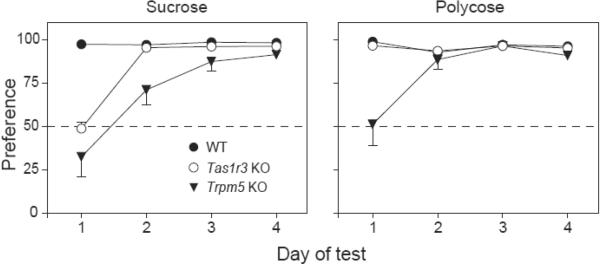
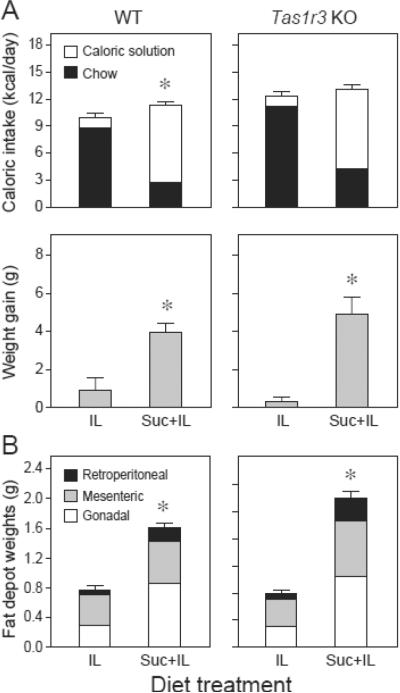
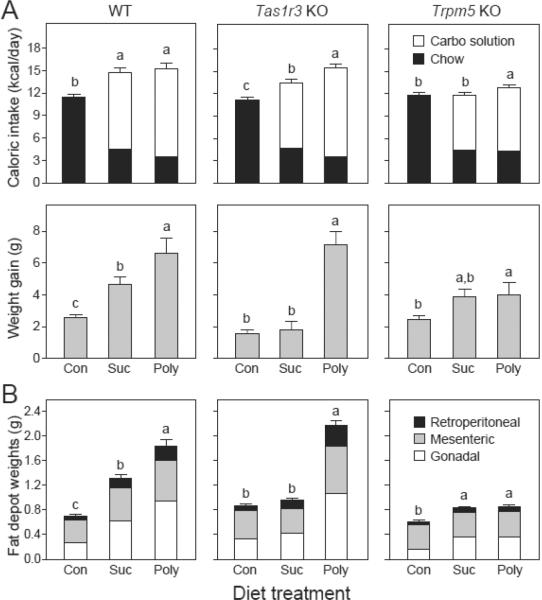
We examined the role of T1r3 and Trpm5 taste signaling proteins in carbohydrate-induced overeating and obesity. T1r3, encoded by Tas1r3, is part of the T1r2+T1r3 sugar taste receptor, while Trpm5 mediates signaling for G protein-coupled receptors in taste cells. It is known that C57BL/6 wild-type (WT) mice are attracted to the tastes of both Polycose (a glucose polymer) and sucrose, whereas Tas1r3 KO mice are attracted to the taste of Polycose but not sucrose. In contrast, Trpm5 KO mice are not attracted to the taste of sucrose or Polycose. In Experiment 1, we maintained the WT, Tas1r3 KO and Trpm5 KO mice on one of three diets for 38days: lab chow plus water (Control diet); chow, water and 34% Polycose solution (Polycose diet); or chow, water and 34% sucrose solution (Sucrose diet). The WT and Tas1r3 KO mice overconsumed the Polycose diet and became obese. The WT and Tas1r3 KO mice also overconsumed the Sucrose diet, but only the WT mice became obese. The Trpm5 KO mice, in contrast, showed little or no overeating on the Sucrose and Polycose diets, and gained less weight than WT mice on these diets. In Experiment 2, we asked whether the Tas1r3 KO mice exhibited impaired weight gain on the Sucrose diet because it was insipid. To test this hypothesis, we maintained the WT and Tas1r3 KO mice on one of two diets for 38 days: chow, water and a dilute (1%) but highly palatable Intralipid emulsion (Control diet); or chow, water and a 34% sucrose+1% Intralipid solution (Suc+IL diet). The WT and Tas1r3 KO mice both exhibited little or no overeating but became obese on the Suc+IL diet. Our results suggest that nutritive solutions must be highly palatable to cause carbohydrate-induced obesity in mice, and that palatability produces this effect in part by enhancing nutrient utilization.
我们研究了 T1r3 和 Trpm5 味觉信号蛋白在碳水化合物诱导的暴食和肥胖中的作用。T1r3 由 Tas1r3 编码,是 T1r2+T1r3 糖味觉受体的一部分,而 Trpm5 介导味觉细胞中 G 蛋白偶联受体的信号转导。已知 C57BL/6 野生型 (WT) 小鼠对 Polycose(葡萄糖聚合物)和蔗糖的味道都有吸引力,而 Tas1r3 KO 小鼠对 Polycose 的味道有吸引力,但对蔗糖的味道没有吸引力。相反,Trpm5 KO 小鼠对蔗糖或 Polycose 的味道没有吸引力。在实验 1 中,我们将 WT、Tas1r3 KO 和 Trpm5 KO 小鼠分别维持在三种饮食中的一种 38 天:实验室饲料加水(对照饮食);饲料、水和 34%的 Polycose 溶液(Polycose 饮食);或饲料、水和 34%的蔗糖溶液(蔗糖饮食)。WT 和 Tas1r3 KO 小鼠暴食 Polycose 饮食并肥胖。WT 和 Tas1r3 KO 小鼠也暴食蔗糖饮食,但只有 WT 小鼠肥胖。相比之下,Trpm5 KO 小鼠在蔗糖和 Polycose 饮食中几乎没有或没有暴食行为,并且在这些饮食中体重增加比 WT 小鼠少。在实验 2 中,我们想知道 Tas1r3 KO 小鼠是否因为蔗糖无味而在蔗糖饮食中表现出体重增加受损。为了验证这一假设,我们将 WT 和 Tas1r3 KO 小鼠分别维持在两种饮食中的一种 38 天:饲料、水和稀释(1%)但非常美味的 Intralipid 乳液(对照饮食);或饲料、水和 34%蔗糖+1%Intralipid 溶液(Suc+IL 饮食)。WT 和 Tas1r3 KO 小鼠都没有或几乎没有暴食行为,但在 Suc+IL 饮食中肥胖。我们的结果表明,营养溶液必须非常美味才能在小鼠中引起碳水化合物诱导的肥胖,而美味通过增强营养利用来产生这种效果。